The Man Who Called the Last Two Crashes Says Your House Price Won’t Recover After This One

The Man Who Called the Last Two Crashes Says Your House Price Won’t Recover After This OneFred Harrison on why this bust is different, where the rents are going, and what a home is actually for.
Most homeowners carry a number around in their heads. It’s what the house is worth. It’s the retirement plan, the inheritance, the cushion if everything else goes wrong. Now picture someone telling you that, after this crash, it won’t come back. That’s what Fred Harrison told me. And Fred isn’t a random voice on the internet. Why Fred is seldom wrongFred has called the last two house price crashes. He did it in print, years ahead, in books like Boom Bust and The Power in the Land. Some would say he’s the only forecaster who got those booms right. The indicators now point the same way. Mortgage numbers. Lending. The whole lot. We’re heading into a recession driven, once again, by speculation in house prices and other monopoly assets. So I asked the question nobody wants answered. When does the recovery come? Will it look like the ones you predicted before? His answer: this time it’s different. In a historic way. 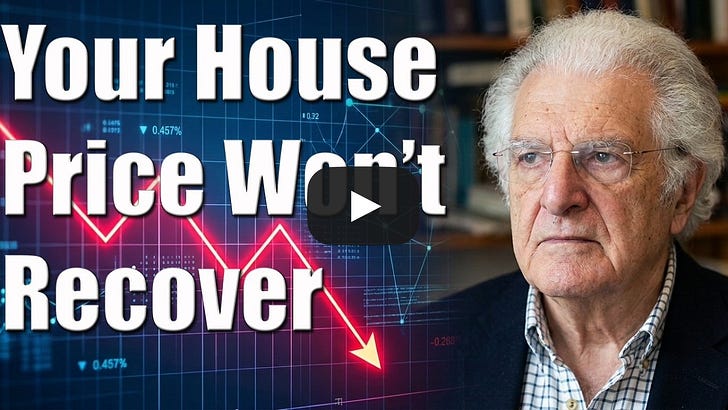
Three revolutions, one patternThe only comparable periods are the last two economic revolutions. The agricultural revolution. The industrial revolution. Each one moved the nation’s net income, the rents, away from where they used to sit and into new places. In our agricultural revolution, the rents moved to those who stole land from the community to form privatised estates. With the industrial revolution, the value shifted from farmland to urban land. Cities became where the money was. Now we’re in the third. The digital revolution. The rents are moving again, away from urban locations and towards the places that serve digital technology. That’s where the cash-rich investors are speculating, heavily and dangerously. So house prices won’t recover the way they did at the end of earlier cycles. They’ll go down. And in real terms, they’ll stay down. The Digital Free RideWhere does the rent go? Fred points at two highways. The first is in the sky. Near-Earth orbit satellites collect data from the planet and send it back to your phone. The second is on the seabed. Cables link the continents and carry data from the other side of the world to the PC on Fred’s desk at home. Both generate huge rents. No government collects them. So the tech barons do. That’s why, Fred says, the richest people on earth sit in Silicon Valley. They don’t own the ocean floor or the orbit. They don’t need to. They control the technology on top, and nobody sends them a bill for the wealth they did not create but just appropriate. His line on it: without the spectrum, the new technology is “worth bugger all”. Governments could have said so at the start. You want to use this highway? Pay the rent. The boom would have been steadier, and nobody would have ended up with a trillion-dollar fortune from a public resource. The wage squeezeAs AI and humanoid robots replace people, wages slide in real terms. Corporations sack staff by the thousand to get the cheap technology. People end up unemployed, or in lower-skilled, lower-paid work. That cuts what they can pay for shelter. And when people can pay less for homes, the land under those homes is worth less. Fred apologised for being so pessimistic. We have to be realistic if we want to force governments to make the changes that rehabilitate our communities. No safe havenWhen land was enclosed in the agricultural revolution, people were turfed off it. But they could leave. They went to new continents. Even at the start of the Industrial Revolution there was plenty of underused land in the Americas, Australia and New Zealand to be stolen from the indigenous populations. People moved, and prices rose both in the places they left and the places they went to. That option has gone. Fred says there is no safe haven to turn to this time. We’re stuck. And he thinks governments will make it worse. When we recorded, a British budget had just landed. His verdict was blunt. Governments don’t have a clue about the realities, or what to do about them. He calls that political paralysis one of the existential threats facing humanity. The big conThen there’s the tech barons’ favourite trick. You’ll have heard the warnings. AI could wipe out humanity, they say. Governments must regulate us. Fred reads it differently. It’s a transfer of responsibility. It’s your technology, he says. You answer for it. Instead, they want the state to carry the blame, so that when regulation fails, we blame the government and not the barons. The alternative is simpler. Charge the rent on the highways. Then the people who profit from the technology carry its costs. He gave an example that sounds flippant. It isn’t. Imagine parents had to pay the full rents their kids’ smartphone use was racking up. Eight hours a day of gawking at a screen would stop quickly. Responsibility follows the bill. At the moment there is no bill. One pot of rentI put the whole thing to Fred in a nutshell, and he agreed. Every society produces a pool of economic rent. It flows to the biggest monopoly of the day. Once that was farmland. Then it was the land under our cities, where workers lived and offices stood. Now the prize is monopoly over digital technology. All those trillion-dollar bets are bets on who gets to own it. The pie is only so big. So the money that used to sit in house prices, land values and business locations flows to a handful of huge technology companies. Look at them fighting. Musk trying to own near-Earth orbit. Tech firms lobbying for regulation that would lock out newer competitors. None of it is about productivity. It’s a scramble for monopoly rent. The solution is the old one. Tax the monopoly value, not the wage. Not the investment. Not the effort. It cuts the damage the monopolies do, and it pays for the public services we want. A home is not an assetA home should be a home. Security and stability for a family, with children growing up and grandparents growing old. Not a financial asset. Not a punt. Since Margaret Thatcher, he says, homeowners have treated the capital gains on their houses as theirs. Fred doesn’t mince words. They’re not. The gain in a location’s value comes from the community around it. It belongs to the community. If we saw it that way, we’d be free to make money where it adds value, in business that serves the community, with profits that aren’t taxed because the location value goes into the public purse. And if every one of us understood that we hold a share in this net income, we’d hold our representatives to account for how it’s spent. We don’t now. We’ve separated ourselves from that stream of value and handed it to whoever holds the title deeds. We now have the knowledge and the institutions to stop the cheating. If we let it run on into the digital age, it will be the robots knocking on our doors. Many of us will lose our homes. And we’ll only have ourselves to blame. If this landed, share it with someone who owns a home. Then tell me in the comments. Do you think prices come back? Fred’s Books available here: https://shepheardwalwyn.com/fred-harrison-author/ You're currently a free subscriber to Peter Smith Rewilding. For the full experience, upgrade your subscription.
|





Comments
Post a Comment