Henry is Watching: How Seeing the Cat Could Stop the Next War

Russia, Europe and America keep fighting over who collects the rent. Pay it to the people and the prize disappears.
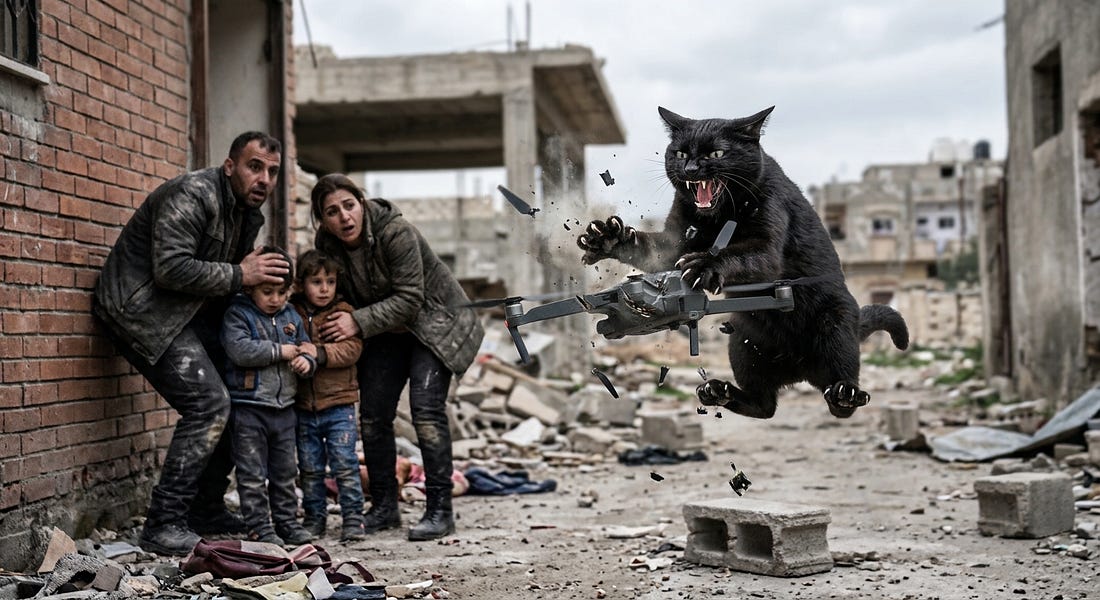
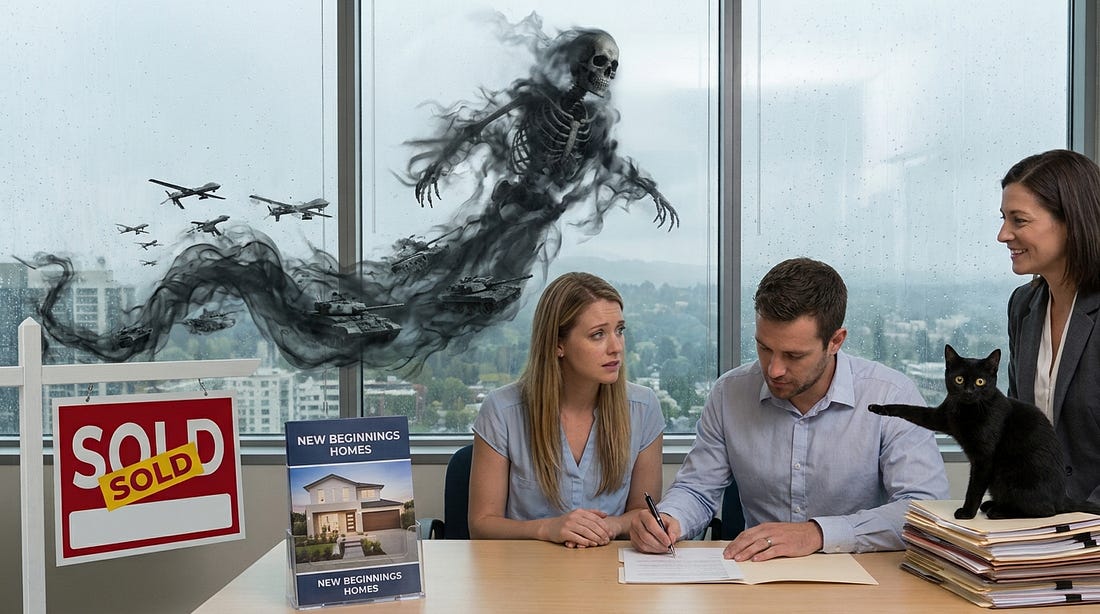
If the community reclaims the economic rent of land and natural resources, we remove the elites’ reason to go to war. We remove the reason for the security services to destabilise countries and buy politicians. We remove the reason for terrorism and covert action. The cat sees the long game of our elites: to seize the economic rents and ‘win’ the great game of geopolitics, while the people suffer.
The cat in this podcast took a physical form: my black cat, Henry. I named him after Henry George, the man who argued that the value of land and natural resources belongs to everyone. When Fred Harrison started explaining why wars get fought over rent, a small black head appeared over my shoulder. It made me smile. Henry stayed put and kept his eyes on me. I like to think there are lots of Henrys in this world, keeping their eyes on us. At least on those of us who can see them. Can you see the cat… 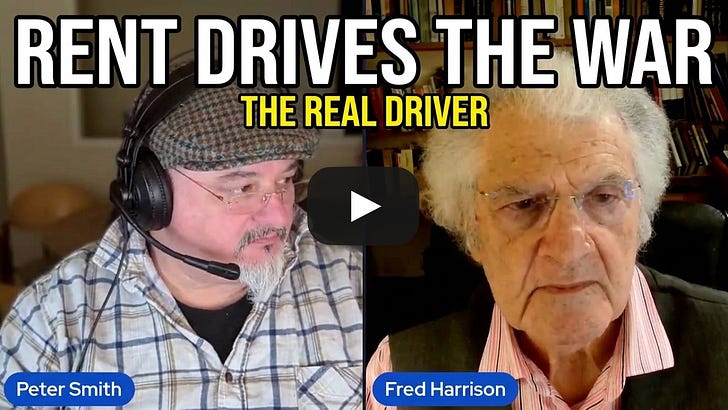
One word, a hundred commentsOur last video passed 200,000 views. Of well over 1000 comments, over a hundred expressed outrage at Fred calling Russia barbaric. Fred used it about the Kremlin, and a lot of people were upset. I have great sympathy for their views. I know what our security services have done to create this war. No one has clean hands, and this war has been fomented for nearly two decades. I said so to Fred. Fred’s response was that the Russian people are wonderful. He got to know many of them over ten years as a Duma adviser. But Russia sent the tanks in, drones hit families in their beds, in hospitals and in schools. He calls that barbaric and offers no apology. He also says Russia isn’t alone in behaving that way. To Fred, sending in the tanks was inexcusable. But I want to find peace, not blame. I want to use Fred’s unparalleled expertise to dig deep into why states go to war. The first time the rent was takenIn the 1990s Fred spent a decade travelling to Russia. He wanted Russians to build an economy where people keep what they earn and pay for what they receive from public services, with natural resource rents funding those services. He lost. The model that won was the one enforced on Russia by Western institutions. Through the loans-for-shares scheme, some of the biggest state assets were leased out at auction in return for loans from commercial banks to the government. They included stakes in Norilsk Nickel and Yukos. Vladimir Potanin took Norilsk in an auction run for the state by his own bank. Khodorkovsky’s Menatep bought a 78 per cent stake in Yukos for about $300 million. The company’s market value later climbed as high as $30 billion. That is rent being privatised in real time. The wealth sat under Russian soil and belonged to the Russian people. A few men with the right banks and the right friends stole it. Western banks and advisers wanted a slice. I put that to Fred. He agreed there was mutual extraction. He added that the West pushed Russia towards our own model, with privatised resources and a share for everyone who helped. Then Putin stepped in. He didn’t end the extraction. He took control of it. Now look at what sits at the centre of this week’s news. Russia and Ukraine met in Abu Dhabi. These were the first talks in nine months, with US ‘mediation’. One of the sticking points is the Donbas. That’s land. It has some of the richest soil in Europe, and mineral deposits as well. As Fred puts it, they want other people’s territory because they can extract the net income that belongs to it. He traces the habit back to the Mongol tribute system a thousand years ago. You can argue about the history. You can’t argue about the incentive. Nobody’s hands are cleanI don’t want this to turn into a story about one bad man in Moscow. The same system of incentives runs on the Western side of this proxy war. Last year Washington and Kyiv signed a deal that gives the US preferential access to new Ukrainian minerals deals and funds post-war reconstruction. The terms aren’t a land grab. Kyiv contributes half of its revenues from exploiting natural resources, and the money stays invested in Ukraine for the first ten years. Ukraine keeps control of its resources and its state-owned enterprises. Fair enough. But look at the shape of it. Everyone at the table is negotiating over who collects the rent. Nobody is asking whether the people of Ukraine or the Donbas should collect it. The conflict represents a chain of competing resource extraction. While Western Ukrainian oligarchs capture the economic rents of the Donbas, Russia attempts to co-opt those same revenues under the pretext of regional protection. Simultaneously, Western powers seek access to Ukraine’s resources while leveraging the conflict to destabilise Russia, ultimately targeting Russia’s vast economic rents as the primary prize of our oligarchic system. Your house price obsession is causing the warThe key to understanding economic rent is the insane value we put on our houses. We fetishise and obsess about house prices, when really we want to be rent seekers. This is the same sickness that makes our elites so desperate for war: the urge to make a claim on something that is not ours, something we did not create.
Most of us want our house price to go up. We call it security. We call it getting on the ladder. Nobody tells us it’s a claim on other people’s labour. We’re taught the system is natural, so we back it, and we vote for leaders who do the same. The idea sits right at the heart of classical political economy, the same tension that thinkers like Henry George, Adam Smith, and David Ricardo wrestled with. The concept of reclaiming economic rent as societies’ source of revenue feels uncomfortable to so many people today because it exposes the ethical fault line behind everyday, aspirational desires we all have and that are fundamental to our way of life. For most people, buying a home is not an act of malice, but an act of self-preservation. In societies where wages stagnate and social safety nets are thinning, capturing rising land values, the economic rent, is the only reliable way an ordinary family can build security, fund retirement, or pass anything on to their children. Because the system rewards this behaviour, people naturally rationalise it. They confuse the value of the bricks and mortar, which actually depreciate, with the value of the location, which appreciates solely because of the surrounding community, public infrastructure, and scarcity. Once you own that asset, you become politically invested in scarcity. You vote against new housing, oppose higher density, and fiercely defend your right to unearned gains, not out of cruelty, but because your financial survival depends on the ladder being pulled up behind you. When an economy shifts from rewarding production, such as making things and solving problems, to rewarding extraction, such as owning land and charging others to exist on it, society quietly fractures. It splits into two distinct classes: those who own land and earn wealth while they sleep, and those who work for a living and hand over half their pay packet just for shelter. Essential workers like nurses, teachers, and builders are priced out of the cities they keep running, leading to labour shortages and declining public services. Meanwhile, because land prices outpace wages, the only way to keep the market moving is to pump ever-larger amounts of credit into it, turning families into anxious debtors and making the entire financial system brittle and prone to collapse every 18 years or so, and one we are experiencing as I type. The leap from wanting house prices to rise to war and empire sounds extreme until you look at how states behave when domestic rent-seeking hits a wall. When an economy is choked by high land costs and household debt, domestic demand dries up. Businesses cannot expand because consumers have no disposable income left after paying rent or servicing mortgages, and operating costs become prohibitive. Faced with domestic stagnation and growing social unrest, ruling classes historically look outward for a release valve. Rather than confronting politically untouchable landed interests at home by reclaiming economic rent or breaking monopolies, governments seek new frontiers, cheaper resources, captive markets, and foreign rents to keep the domestic engine humming. Just as a homeowner extracts rent from a location they did not create, empires and financial superpowers seek to extract economic rents from foreign territories by controlling trade routes, energy supplies, arable land, and mineral wealth. When the internal social contract breaks down due to poverty and inequality, external enemies become useful, and the anxiety of an unstable, extractive economy is easily redirected into tribalism, militarism, and conflict over territory. The system does not require villains; it only requires millions of decent people acting rationally within a broken set of rules. Each person defending their right to capture land value sees only a modest nest egg for their family, completely blind to the aggregate effect of a civilisation that cannibalises its own young, stalls its own productivity, and eventually looks abroad for foreign adventures and new things to conquer and extract when there is nothing left to squeeze at home. The fix is old and not complicatedTake away the prize, and you take away much of the reason to fight for it. Collect the rent from land and natural resources as public revenue. Pay a share of it directly to citizens. Cut the taxes that fall on wages and on the value people add to our economy. Nothing is left for an oligarch to capture, and nothing is left for a state to seize on someone else’s territory. This isn’t a fantasy. Alaska does a small version of it. Voters set up the Permanent Fund in 1976 from oil money, and dividends have been paid since 1982, partly so that Alaskans keep a direct stake in it. Every eligible resident gets the same amount, from a retired teacher to a newborn. This year’s cheque is $1,200, including a $200 energy relief payment. It’s a crumb next to what a full rent system would raise. But it proves the point: once people hold a cheque, they defend it. A share of the rent with your name on it is hard for any oligarch to take back. Now apply that to the three powers. In Russia, a citizen with a direct share of the country’s oil and gas rent is a citizen who owns a stake in how it’s spent. A Kremlin that burns that money on war is burning the people’s money. The oligarchs lose the machine that made them. In Europe, the same rule would cut the speculation in land and housing that makes so many of us complicit. The riots would stop. The elites would stop pushing our politicians towards war and conflict, and would demand resolution and peace. In America, it would turn the argument over who owns the minerals, the oil and the ground itself into one about who gets paid. No one could profit from overthrowing Iran. Iran’s IRGC would have no claim on its oil wealth to fund proxy wars. Tensions would ease and peace deals would happen, not just be a macabre performative theatre for the world’s press. I don’t claim this ends every war. Security fears, nationalism and plain ideology all push countries into conflict. I’m saying that rent is the engine most people ignore, and the incentives are what give motivation to our elites. It’s the prize our evil oligarchs will stop at nothing to claim, no matter how many citizens are killed or maimed. Slowly, and with careIf a government tried to switch overnight to an economic rent revenue system, the banks could fail and the state could stumble. The goal is to preserve our institutions through the change. That takes a controlled transition and public explanation first. When Britain tried a land valuation in the early twentieth century, the calculations took five years. We could do it faster now. The harder job is persuading people. There would be losers: the free riders who currently collect billions. Fred’s view is that they’d still live very well. You only wear one suit at a time. They’d lose a few zeros on a bank statement, not their way of life. Would the rich leave? Let them. They can’t take the land with them. Why I get angry with Labour and the leftI’ll be blunt about the left, as I was in the episode. Labour was built to help working people. An old radical Liberal and early Labour slogan said the land belongs to the people. Somewhere along the way the party forgot it. Look at how Labour handles housing now. It adds a surcharge on homes worth £2 million or more. It raises the tax on landlords’ rental income. Those are tweaks. They leave the real prize alone: the rising value of the land under our feet. Fred’s point is simple. Most left-wing policy tries to cushion the victims of a system that extracts rent. Then it pays for the cushion by taxing earned income. That punishes work and keeps wages down. The problem gets bigger. Trying to solve a problem by amplifying it is nonsense. So when someone tells me they’re a socialist, I ask them: do you understand how economic rent works? If you don’t, you aren’t helping poor people. You’re serving the people who take the wealth working people create. I called them pseudo socialists in the episode. I meant it. Fred agreed. I like giving a socialist a good moral kicking because most are too stupid to understand their policies are counterproductive and will not work as intended. The right gets no pass. It defends rent too. But the left says it speaks for the poor, so it gets the harder question. There are Labour people who see it. The Labour Land Campaign argues that Labour should back a land value capture. Join them. Read Fred’s book. Then come back and tell me you’re a socialist. War, poverty and unaffordable homes grow from the same root. A left that won’t name it can’t fix any of them. Many in Labour have seen the cat; our Prime Minister, Andy Burnham, is one, but is too scared of the vested interests, or the people who give them their political donations, to see the policy through, and never implement. Back to HenryMany Georgists talk about the cat. Have you seen it? It is a rite of passage. It’s the moment it clicks in your brain that left-wing and right-wing politics, socialism and libertarianism, conservatism and liberalism are a smokescreen. They are an illusion created to keep us fighting. Henry the cat is my physical and spiritual guide. He is there to return my thoughts to the one problem that is fundamental to our ecological, social and geopolitical problems. We will fix nothing until more of us see that cat and act on it, to remove monopoly and externality from our societies and save humanity. Invite your friends and earn rewardsIf you enjoy Peter Smith Rewilding, share it with your friends and earn rewards when they subscribe.
|





Comments
Post a Comment