The Valueless Value of Nature: Why Only Rent Can Save the Wild

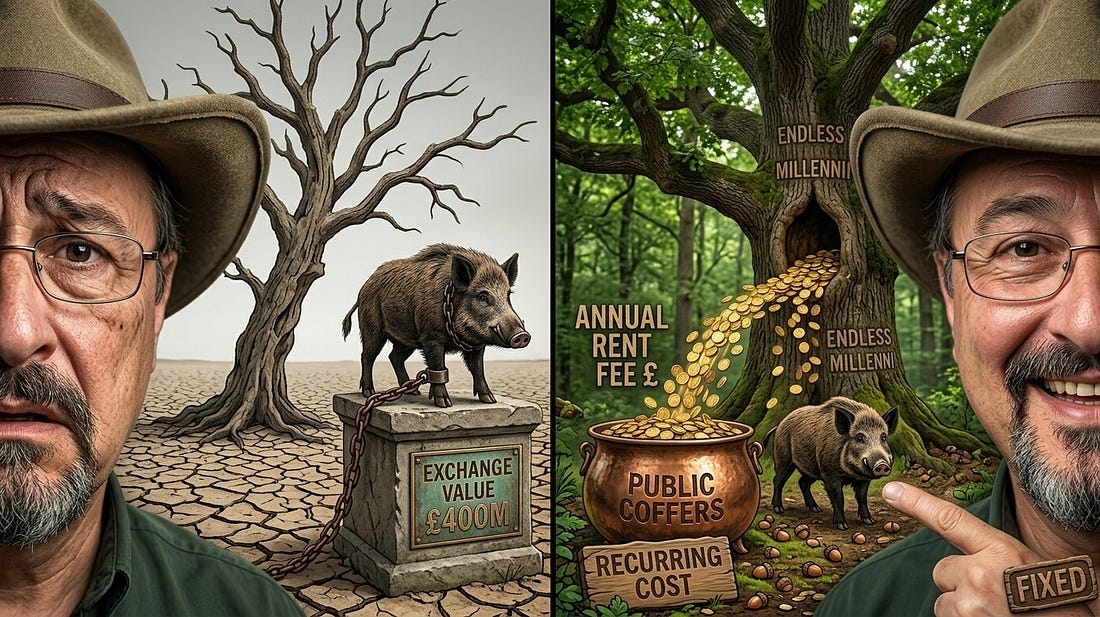
Start with an oak tree. Not as a symbol, as a genetic problem. An oak cannot pollinate itself into a healthy future. Acorns fall close to the parent tree, and if they only ever grow where they land, the population inbreeds. What rescues the species is an animal willing to carry acorns some distance and bury more than it eats: historically, the wild boar. Remove the boar and nothing catastrophic happens this year, or next year, or within any human lifetime. The catastrophe is scheduled for five thousand years’ time, when the oaks left standing are the genetically narrowed descendants of trees that could no longer disperse.
This is a useful way into the subject of value, because it shows why the normal machinery of economic valuation cannot cope with nature. Markets price things over the timescale in which they are bought and sold. Ecological relationships operate on timescales of centuries and millennia. A boar culled this winter has no measurable effect on oak genetics next spring, so no market signal registers the loss. By the time the effect is visible, the mechanism that caused it is long forgotten, and the species carrying the cost was never a party to the transaction that created it. The same logic applies to the carbon cycle, though at a different scale. Some carbon moves in short loops: a tree burns, a tree grows, the carbon returns and is reabsorbed within decades. Some carbon moves on geological loops of hundreds of millions of years, locked into rock until tectonic or volcanic activity releases it again. Industrial civilisation has spent two centuries taking carbon out of the slow loop and putting it into the fast one, at a rate the fast loop was never built to absorb. Again: no single transaction registers the damage. The damage is real, cumulative, and entirely invisible to any single point of sale. Nature, in other words, is not “the birds and the bees.” It is a set of load-bearing relationships that operate on timeframes our economic institutions were not designed to see. Any attempt to value nature that ignores this mismatch of timescales is not really valuing nature. It is valuing a snapshot of nature, at the exact moment someone wants to sell it. 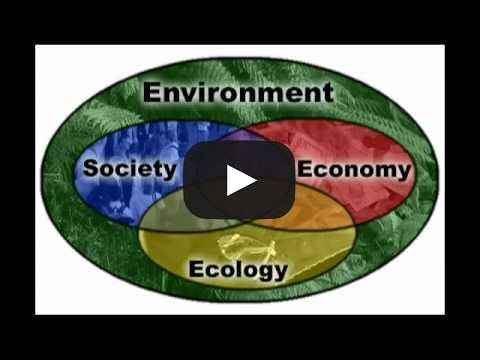
Three kinds of value, and a fork in the roadIt helps to separate the different senses in which people say they “value” nature, because the confusion between them does real damage in policy debate. There is psychological value: I find the bird beautiful, I enjoy watching it, its presence improves my day. This is real, but it is a private good and cannot by itself organise collective action to protect anything. There is sociological value: we, as a society, choose to value certain species or landscapes enough to build institutions around them. Wildlife trusts, the RSPB, national park authorities and statutory protections are all sociological value made durable. This is closer to a policy answer, but it is downstream of politics and funding cycles, and it competes for attention with every other cause a society might organise around. And there is economic value, which is where the argument in this essay lives, because it is the only of the three that determines what actually gets built, drained, mined, or felled. If the economics point one way and the sociology points the other, the economics wins, because the economics decides who profits. Within economic value there is a fork that most public debate glides past. The dominant tradition, the neoclassical consensus that has run the field since the marginalist revolution of the 1870s, is a receiver theory of value: something is worth what someone is willing to pay for it. This is sometimes dressed up as “exchange value,” and it underwrites almost all contemporary environmental economics, including the influential attempts to build a full monetary account of ecosystem services, most notably Robert Costanza and colleagues’ effort to price the entire biosphere at several dozen trillion dollars a year,1 and the UK government’s own Dasgupta Review, which tried to fold biodiversity into the language of capital, asset stock and depreciation so that the Treasury might finally take it seriously.2 These efforts are well-intentioned and analytically serious. They are also, in the end, an attempt to fit a phenomenon that operates on geological and evolutionary timescales into a valuation framework built for consumer preferences revealed in a single transaction. You cannot ask what someone would pay to save the Heath Fritillary butterfly and expect the answer to reflect five thousand years of oak genetics. You get a number. The number is not meaningless, but it is not the thing either, and treating it as the thing has consequences. The older tradition, running through the classical economists before the marginalist revolution narrowed the field’s questions, asked a different thing entirely: not what would someone pay, but what would it cost in labour and resources to replace what was destroyed. This is closer to a cost-based or reproduction theory of value. What is the labour cost of restoring a polluted river to drinking quality? What would it take, in effort and material, to breed back a species that intensive agriculture wiped out across an entire county? This framework does not ask the public to price their affection for wildlife. It asks what the destruction actually costs to undo, which is a much harder number to argue away. Well-meaning hogwashEvery few years a government commissions another attempt to give nature a single, comprehensive monetary value, an asset register for the biosphere. The Dasgupta Review is the most recent and most rigorous British example, and it deserves credit for putting biodiversity loss on the same conceptual footing as human and produced capital in the eyes of the Treasury.2 The broader international project, going back to the TEEB initiative launched after the 2007 G8+5 summit,3 has tried to do something similar at global scale. The trouble is not the ambition. The trouble is that a single number, however carefully constructed, invites exactly the wrong question: is the number big enough to outweigh the profit from destroying the thing? Every valuation exercise of this kind eventually gets used, somewhere in a planning inquiry or a cost-benefit analysis, as a ceiling. If the ecosystem service is “worth” four hundred million pounds and the development is worth six hundred million, the number has just given permission for the destruction it was meant to prevent. This is not a reason to abandon the attempt to understand ecological value. It is a reason to be honest that comprehensive natural capital accounting, however sophisticated, cannot by itself change what gets built. Something has to change on the other side of the ledger: the cost side, not the value side. The free lunch at the heart of environmental collapseHere is the actual mechanism driving ecological collapse, stated plainly. If you hold the legal right to extract value from a natural resource, in the UK context this typically means a freehold interest in land, mineral rights, water abstraction licences, or planning permission, then the profit from exploiting that resource accrues to you, and the taxation system barely touches the resource itself. Convert agricultural land to housing and the uplift in value, which can run into millions of pounds per hectare and reflects nothing you built or improved, is taxed lightly if at all. Farm land intensively, stripping soil biology and hedgerow habitat, and the resulting yield increase is taxed as ordinary income, at the same rate as the wages of the person who picks the fruit. Abstract water from a chalk stream and the ecological damage downstream, the drying of a habitat that took centuries to establish, is an externality that appears nowhere on your tax return. Extract minerals and the site’s loss of amenity and habitat value is somebody else’s problem, specifically the problem of whoever inherits the site after you have taken the profit and moved on. This is not a set of unrelated market failures. It is one structural feature of the tax system, repeated across every category of natural resource: the return to owning or controlling a scarce natural asset is taxed as though it were the return to labour or enterprise, when it is actually economic rent, and the destruction bundled into extracting that rent is not priced at all. David Ricardo identified the underlying mechanism of rent in 1817: the differential return that accrues to a factor of production simply because it is scarce and fixed in supply, unrelated to any effort by its owner.4 Adam Smith, writing four decades earlier, had already flagged that ground rents were a peculiarly suitable object of taxation precisely because a tax on rent falls on the landlord and cannot be passed on, since the supply of land is fixed regardless of the tax rate.5 Neither Smith nor Ricardo built an ecological argument from this, because ecological collapse was not yet a visible problem in their lifetimes. But the logic they established, that rent is the correct object of taxation because rent is unearned, is exactly the logic nature needs applied to it now. It was Henry George, writing in Progress and Poverty in 1879, who turned this into a practical political programme: tax the value of land itself, not the buildings or the labour or the capital applied to it, because the value of land is created by the community and by nature, not by the landowner.6 George’s single tax was aimed principally at urban land speculation and the paradox of poverty amid rising industrial wealth. But the argument generalises cleanly to any resource whose value derives from natural scarcity rather than human effort, which is to say, to almost everything currently being strip-mined from the natural world at no fiscal cost to the miner. From owning to owingIf the diagnosis is right, the fix follows a specific shape, and it is worth being precise about that shape rather than gesturing at “taxing polluters,” which is too vague to survive contact with a Treasury lawyer. The fix has to be a rent, meaning a recurring annual charge, not a one-off valuation or a one-off fine. This matters because of the timescale problem raised at the start. You cannot capture the true cost of destroying an oak wood’s genetic future in a single transaction, because the cost is distributed across centuries. What you can do is charge, every year, for the ongoing right to hold and exploit that resource, at a rate that reflects the resource’s true scarcity value to society, not merely its market price today. Pigou’s original case for correcting externalities through taxation, set out in The Economics of Welfare in 1920, rests on exactly this insight: a tax should equal the marginal external cost imposed, levied continuously for as long as the activity continues, not settled once and forgotten.7 Applied to land, this means a land value tax proper, an annual charge on the unimproved value of land, which by construction cannot be dodged by relocating the asset (land, unlike capital, cannot be moved offshore) and which falls hardest on land held speculatively or exploited destructively, since destructive exploitation is usually what is propping up the land’s current market value in the first place. Applied beyond land, the same logic extends to water abstraction, mineral extraction rights, fishing quotas, and any licence to draw down a natural stock. Each becomes an annual rental charge tied to the resource’s scarcity and its ecological carrying capacity, reassessed as conditions change, rather than a one-off permit purchased and then forgotten. This produces a moral inversion that is more significant than the fiscal mechanics might suggest. Under the present system, ownership of a natural resource is treated as an unconditional right: I own this land, this water, this mineral seam, and what I do with it is my business, subject only to specific prohibitions written into law. Under a rent-based system, ownership becomes conditional: I hold this resource, and for as long as I hold it, I owe society a payment reflecting the value I am extracting from something I did not create. The shift is from own to owe. It does not abolish private control of natural resources, which would be neither practical nor, on the evidence of state-run extraction elsewhere, obviously better for ecological outcomes. It makes private control accountable, continuously, for as long as it lasts. Why this is fiscally coherent, not just morally satisfyingThere is a version of this argument that stops at moral appeal, and that version is easy to dismiss as sentimental. The stronger version is fiscal, and it is worth stating starkly: taxes on labour, income and enterprise, which is to say income tax, National Insurance and VAT, are taxes on the very activities a functioning society wants more of. Every economics textbook concedes that taxing an activity produces less of it at the margin. We have therefore built a tax system whose largest components actively discourage work, employment and trade, while leaving the extraction and destruction of finite natural capital almost untouched. A rent-based system reverses this. Because land and natural resources cannot flee the country, cannot be manufactured on demand, and generate a rental value regardless of what the owner does with them, a tax on that rent does not reduce the supply of the resource, it simply redirects the unearned portion of its value from private pockets to public ones. Ricardo’s insight about the incidence of a land tax, that it cannot be shifted onto tenants because the fixed supply of land means the market price is already set at the maximum bearable rent, is the technical foundation for the claim that this kind of taxation carries no deadweight loss.4 It is, in the language modern public finance economists reach for, about as close to a free lunch as taxation gets, which is precisely why a shift toward land and resource rents could in principle fund a reduction in the taxes that fall on labour and enterprise, rather than simply adding a new layer of taxation on top of the old one. Conclusion: valuing nature by making its destruction expensive, foreverReturn to the oak and the boar. No exchange-value calculation, however sophisticated, will ever correctly price a relationship that pays out over five millennia, because no buyer in any market lives that long and no seller has to answer for a cost that far downstream. The Dasgupta Review, Costanza’s global ecosystem service estimates, and every natural capital register that follows them are attempts to translate an intergenerational obligation into the vocabulary of a single transaction, and that translation can never capture the true cost. The classical economists offer a different translation, one built from the start around a recurring, structural relationship between the holder of a scarce resource and the society that resource belongs to. A rent is not a price. A price is paid once, for a thing that changes hands. A rent is paid continuously, for as long as the arrangement persists, which is the only temporal structure honest enough to match how ecological damage actually accumulates. If nature is ever going to be valued in the sense that matters, protected rather than merely priced, it will not be through a better spreadsheet. It will be through a tax system that finally treats the extraction of value from land, water, minerals and the living world as what it has always been: rent, owed annually, to the generations who did not get a vote on whether it was taken. NotesRobert Costanza et al., “The Value of the World’s Ecosystem Services and Natural Capital,” Nature, vol. 387 (1997), pp. 253–260. Partha Dasgupta, The Economics of Biodiversity: The Dasgupta Review (London: HM Treasury, 2021). The Economics of Ecosystems and Biodiversity (TEEB), Mainstreaming the Economics of Nature: A Synthesis of the Approach, Conclusions and Recommendations of TEEB (Geneva: UNEP, 2010). David Ricardo, On the Principles of Political Economy and Taxation (London: John Murray, 1817), ch. 2, “On Rent.” Adam Smith, An Inquiry into the Nature and Causes of the Wealth of Nations (London: W. Strahan and T. Cadell, 1776), Book V, ch. 2. Henry George, Progress and Poverty (New York: D. Appleton and Co., 1879). Arthur C. Pigou, The Economics of Welfare (London: Macmillan, 1920), Part II, ch. 9. You're currently a free subscriber to Peter Smith Rewilding. For the full experience, upgrade your subscription.
|





Comments
Post a Comment