The Rent Wars: What Trump, Taiwan and Andy Burnham Have in Common

The Rent Wars: What Trump, Taiwan and Andy Burnham Have in CommonEvery war on the news right now is a fight over rent. Nobody in charge will say so.
I spoke to Fred Harrison this week. The conversation kept coming back to one word: rent. Not just the rent you pay a landlord. The income that comes from owning a piece of the earth, a slice of orbital space, or the seabed under an internet cable. Fred’s claim is that most of the conflicts in the news right now are fights over who collects that rent. Nobody in public life says so. 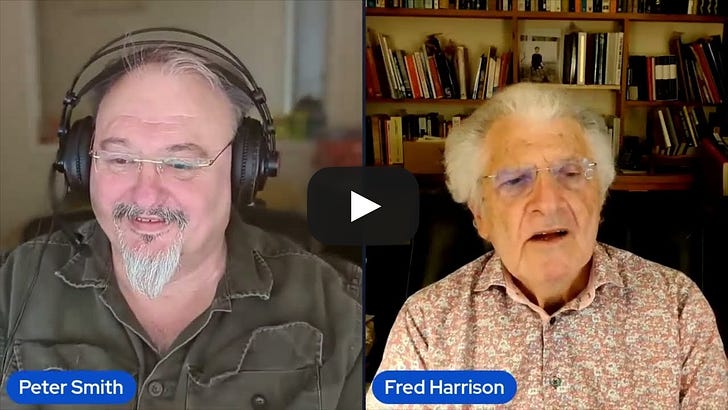
Trump the land speculatorTrump wants Greenland. He is picking fights with Canada. He promised a swift peace in Ukraine and delivered a stalemate. He has pulled America into Venezuela. Fred’s explanation is simple: Trump is a land speculator. He measures himself by what he owns and what his name is on. His foreign policy is his property portfolio, scaled up. He wants the resource rents under Greenland’s ice and Canada’s ground. He talks about sovereignty, his sovereignty over others so he can keep the rent. This doesn’t explain all of Trump. But it explains a lot more than the usual talk about ego and unpredictability. It gives his moves a pattern. Land speculators don’t act at random. They go where the rent is. Taiwan is not about TaiwanThe China and Taiwan story inverts the usual narrative. Beijing’s official line is historical unity: Taiwan belongs to the mainland. Fred’s version is different. The early Republican government that later fled to Formosa wanted to fund the Chinese state through land rent, not through taxing labour and enterprise. The Communist Party crushed that government and the idea with it. The same model then took root in Taiwan, where it worked. Taiwan became one of the most successful economies on earth, built partly on the principle the mainland had rejected. Marx dismissed land rent theory outright, and that dismissal became doctrine inside the Chinese Communist Party. Fred’s claim is that Taiwan’s success is now an ideological embarrassment Beijing can’t tolerate, and that this is closer to the real motive for invasion than any historical claim to the territory. Ukraine, and the resource behind the headlineRussia fits the pattern directly. Putin restored a rent-sharing deal with the oligarchs after Yeltsin: they keep extracting from Russia’s resources, he takes his cut, they stay loyal. The war in Ukraine is about some of the richest farmland in Europe, and the rent that comes with controlling it. And the West eyes Russia’s rent with the same envious eyes. The bubble popsThis is where the conversation moved from geopolitics to economics. Fred and I both work with the idea of an eighteen-year land and credit cycle. On that clock, we are due an almighty crash, and the volume of money going into AI and tech will make the bubble bigger and crash harder. Fred’s point is not that AI is fake. It’s that the money flooding into AI companies is chasing rent: control of digital infrastructure, orbital spectrum, the physical cables on the ocean floor that the internet runs on. Nobody frames it that way. The public debate about “reining in big tech” stops at content moderation and algorithms targeting teenagers. Nobody is proposing to charge these companies for the infrastructure rents they are quietly collecting. If we charged tech companies for use of orbital space and seabed cable routes, valuations would fall fast and hard, and those tech companies would be forced to innovate more and provide better services. The bigger problem is what happens when the bubble does burst. In 2008, governments could bail out banks because they could still borrow. This time sovereign debt is already stretched, and the people funding it are starting to hedge and pull back. If the crash comes now, there may be no one left with the balance sheet to bail out the banks, the tech firms, or the governments themselves. That deserves more attention than it gets. Why the left is no better than the right on thisFred pushed me on why the left, which I count myself part of, seems unable to grasp any of this. I told him about my week: hours in meetings about grant funding for land purchase and nature restoration, being told exactly how many trees to plant and which boxes to tick for extra money. As a working ecologist, I know some of those rules produce worse outcomes for wildlife than leaving the land alone. That’s the left’s real problem. Not malice. An addiction to control. Too many people on the left want the power to tell others what to do. Removing a bad incentive instead of adding a new rule feels, to them, like giving up power rather than using it. Reclaiming economic rent as public revenue does the opposite. It puts no bureaucrat in charge of your choices. It just stops a small number of people from enclosing value the whole community created. That’s a harder sell to most politicians than a new regulation with their name on it, because it means less power for them, not more. Marx’s contempt for rent theory still shapes the left today. Class war rhetoric fills a rally, but it has never once become a piece of legislation that fixes anything. The right offers tax cuts with no account of what should replace the lost revenue, and no serious look at land and resource rent either. Both sides avoid the same conversation. An awakeningThe one hopeful part of the conversation was Andy Burnham. As prime minister, he has started using the phrase “land value tax” in public, which is more than any of his predecessors did. Fred’s plan, and now mine, is to put together a serious analysis for him. Not “you’ve found the answer,” but a clear warning that his current policy mix, land value tax included, will not be enough to change the direction Britain is on. The aim isn’t an overnight fix. It’s to start a conversation he can carry the country through over years. If Britain led on this, even partially, it would be the first G7 economy to take the rent question seriously since the early twentieth century. Even with the predictable pushback from the right-wing press about taxing grandmothers’ gardens. Those arguments have already been answered, at length, by the late Mark Wadsworth on his Killer Arguments Against Land Value Tax, Not website. Whatever objection you’re about to raise, it’s almost certainly already covered there. https://kaalvtn.blogspot.com/p/index.html Where this leaves usFred’s closing advice was plain: read Adam Smith, John Stuart Mill, Henry George. Not for nostalgia, but because they laid out, plainly and long ago, this argument. Two hundred years of camouflage have left free-marketeers celebrating Smith while ignoring the part of his work that explains where wealth goes and why it doesn’t reach everyone. That gap in understanding causes the real damage we are facing in wars fought over rent nobody can name, and in a bubble inflated by digital rents nobody taxes. There’s no version of this where the fix arrives quickly. But naming the mechanism correctly is the precondition for fixing it at all, and almost nobody in public life is doing that. Grab one of Fred’s Books and start here: Fred's Books: https://shepheardwalwyn.com/fred-harrison-author/ |


Comments
Post a Comment