The Landlords of Thought

The Landlords of ThoughtForty years of enclosure. 25 years of Linux, the quiet counter-example. And a choice we cannot afford to get wrong.
Forty Years of EnclosurePrivate capital has spent four decades bending law and economic policy toward a single goal: extracting rent rather than creating value. Patents stretched decade after decade. Copyright terms extended beyond any reasonable incentive to create. Proprietary software locked behind licences designed not to reward invention but to toll it. The result is a digital economy dominated by monopoly rather than innovation, a landscape where the few who control the platforms extract tribute from the many who depend on them. We have watched this play out before. The dot-com bubble was rent-seeking dressed up as revolution. The AI bubble now inflating before us follows the same script. Both rest on the promise of enclosure: capture the platform, capture the users, then charge them for access to what should have been common ground from the start.
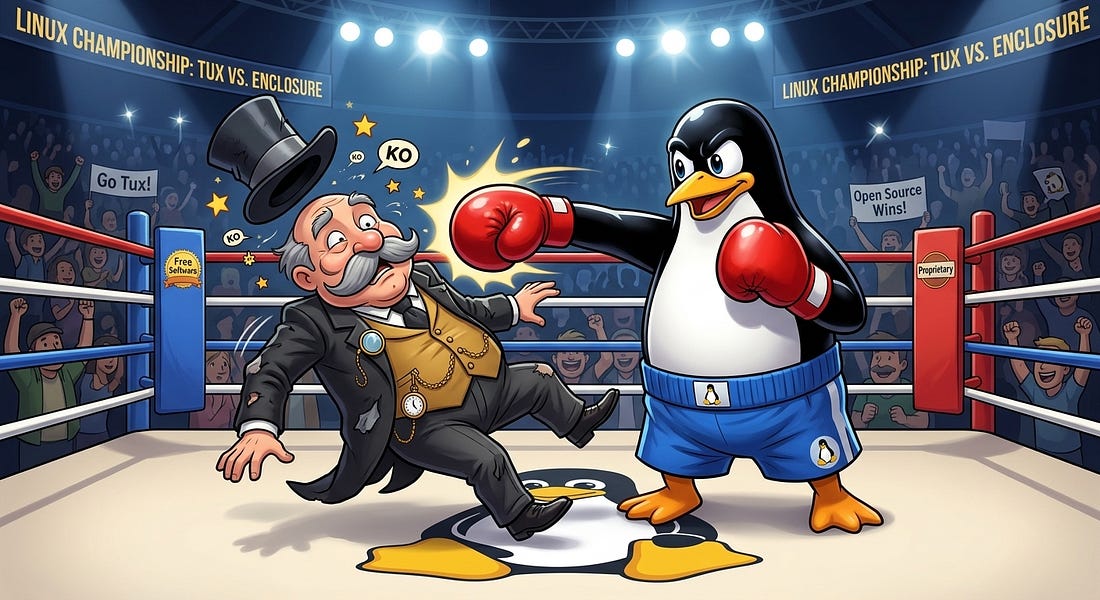
Linux: The Quiet Counter-ExampleLinux is the counter-example. It has been running quietly, growing year after year, the whole time. What began as one student’s hobby project in 1991 now powers most of the internet’s servers, most of the world’s smartphones through Android, and the majority of the world’s fastest supercomputers. Linux achieved this without a monopoly, subverting legal systems of licensing for the noble goal of freedom. It did it by being a commons: code anyone can use, inspect, modify and redistribute, with no toll booth in the middle. Compare that to the walled gardens built around it. The results speak for themselves. The commons out-competed the monopoly on pure productive efficiency, not despite being open, but because of it. I first encountered Linux in 1998. Kent Wildlife Trust needed an email server, and money was tight in the way conservation money is always tight. A volunteer named Mike showed me how to turn an old donated PC into one. Within an afternoon, everyone in the office had a free, easy-to-use email system that ran brilliantly, saved us a fortune we didn’t have, and never once fell over. That was the moment it clicked. Not the philosophy, not the licensing model, just the plain fact that something built by volunteers and given away for free was quietly outperforming commercial alternatives that would have cost us thousands. It felt like getting away with something, except nobody was losing out. Mike wasn’t selling us anything. Linus wasn’t either. The whole system worked because nobody had put a toll booth in the middle of it. I was hooked. Thanks, Linus. You are a star. The Natural Law of the CommonsThis is not an accident. It is closer to a natural law. In ecosystems, the most resilient and productive systems are those with the fewest artificial barriers to the flow of energy and information, the ones where resources circulate rather than pool. Life finds a way past blockages, because systems that hoard eventually stagnate, and systems that circulate keep adapting. Linux found that path through software. It shows us what a level technological topology looks like when nobody is allowed to extract a toll simply for standing in the way. The question is how we deliberately replicate that condition, rather than waiting for another accident of open-source culture to save us. The Georgist AnswerThe answer is the same one that applies to land, and it applies here for the same reason. Intellectual property is a monopoly granted by the state. Like a plot of land, its value comes not from the effort of the individual holding it, but from excluding everyone else. A patent’s worth lies in what it prevents others from doing. A copyright’s value lies in what it forbids others from building upon. These are not rewards for creation. They are tolls on participation. So treat intellectual property the same way we should treat land: charge a fee for the monopoly itself. Henry George understood this in the nineteenth century. He saw that land values rise not because of what landowners do, but because of what everyone else does. The community that surrounds the land, the infrastructure that serves it, the society that makes it valuable. The landowner who sits idle while his plot appreciates is capturing value he did not create. George’s solution was elegant: tax the land, not the work. Capture the unearned increment for the commons that generated it. The same logic applies to intellectual property. Its value comes not from the effort of the inventor or author alone, but from the exclusion of everyone else. The patent holder who blocks a cure to protect a profit margin is extracting rent from suffering. The software giant that locks its users into proprietary formats is extracting rent from dependency. The AI monopolist who trains on the commons then walls off the results is extracting rent from everything we have collectively built. Charge them for it. Scale the fee to the economic rent they extract. Use that revenue to remove taxes from the things we actually want more of: work, trade, investment, creation. Do that, and the incentives flip. Patents and proprietary licences stop being a free ride and start costing something proportional to the exclusivity they impose. Rent-seeking monopolists either pay for the privilege of blocking others, or they let the technology go. The field opens up to actual innovation again. What survives is not whoever locked the door first, but whoever built the most useful thing. The Commons Already WorksA fair digital playing field does not need to be legislated into some new utopian shape. It already exists. It built the servers this essay is sitting on, the computer it was written on, and the AI that corrected my dyslexic spelling and punctuation. That is the argument nobody wants to make, because it is unglamorous and slightly embarrassing. We are not weighing whether to invite this technology in. It is already in the walls. It routes the emails, it schedules the meetings, it writes the code that runs the systems that run the country, and, in my case, it quietly tidies the sentences a dyslexic brain gets tangled before anyone else has to read them. You can debate whether that is a good thing. You cannot debate whether it is a real thing. The reclamation of economic rent is the genius of Henry George, who followed in the footsteps of the great classical economists in understanding how to harness free markets and supercharge them, fostering innovation and market efficiency by removing monopoly and its stifling effects. It is the fundamental lesson we must learn to fix so many of the problems of modern life. It solves poverty, economic stagnation, the propensity for war and conflict, and harnesses the power of the free market to do good instead of harm. The Choice Before UsWe stand at a fork in the road. One path leads to a world where a handful of corporations own the means of intelligence itself. They train their originally open-source models on the sum of human knowledge, then charge us rent to access what we collectively created. They decide what the AI will say, what it will refuse to say, what it will remember and what it will forget. They set the price of admission to our own cultural inheritance. They become the landlords of thought itself. That is the dystopia waiting for us if we do nothing. The other path leads back to the commons. It leads to a world where AI is built on open foundations, where the models are transparent, where the training data is a shared resource, and where the value generated flows back to the community that made it possible. But that is only half the answer. We must also charge a fee for the monopoly of thought itself. And we must charge a monopoly fee for every physical monopoly that props up the digital economy: the data centres, the fibre optic cables, the location values of the digital highway, and even the location value of near-Earth orbits. These are not products of individual effort. They are gifts of geography, physics and the collective labour of everyone who built the networks before us. Those who enclose them should pay for the privilege. And where should that revenue go? Back to the people. Use it to lift the tax burden from working people and from real productive investment. Tax the rentier. Free the worker. Reward the builder. That is the Georgist bargain. That is the commons restored. That is the future worth fighting for. It leads to a world where we tax the monopoly, not the work. Where we charge for exclusion, not for creation. Where the toll booth is torn down and the road belongs to everyone. Linux showed us this was possible. It has been showing us for over thirty years. The commons out-competed the monopoly once. It can do it again. But it will not happen by accident. It will not happen because we hope the tech giants grow a conscience. It will not happen because we wait for another Linus to save us. It will happen because we choose it. Because we demand it. Because we understand that the rent-seeking, the enclosure, the toll booths on the digital commons are not natural laws. They are choices made by people who benefit from them. And choices can be unmade. The question is not whether we can build a better world. The question is whether we will. The tools are in our hands. The precedent is in our history. The commons is already here, running quietly, growing year after year, the whole time. Now we must defend it. Now we must expand it. Now we must reclaim the digital world from the monopolists who would fence it off and charge us for the air we breathe. The future of AI is not yet written. It can be a dystopia of corporate control, or it can be a commons that belongs to all of us. That choice is ours. That choice is now. Save the world from AI monopoly. Reclaim the commons. Reclaim the rent. Free the future.
Invite your friends and earn rewards
If you enjoy Peter Smith Rewilding, share it with your friends and earn rewards when they subscribe.
|





Comments
Post a Comment