The Economic Cycle They Won’t Name

The Economic Cycle They Won’t NameA conversation with Fred Harrison on cannibalism, debt jubilees and the coming collapse
His answer took us from a Chicago property register in the 1930s to the Bronze Age. It ended, as these conversations often do, with Fred telling me we need to storm the Bastille. Figuratively speaking 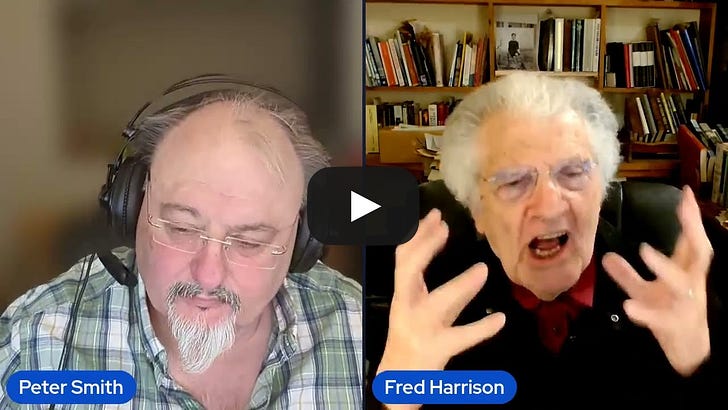
Economics that doesn’t understand its own subjectI put the question to him straight. Fred didn’t want to answer it, because answering it means saying something rude about his own profession. “This leaves me having to express my views about the quality of economics as a social science,” he said. “I fear economics is taught by people who don’t understand the fundamentals of how an economy works. Some of them do understand, but choose not to reveal it.” That’s the charge. The whole catalogue of competing cycles, in Fred’s account, is a symptom of that failure. People are trying to make sense of booms and busts that, according to general equilibrium theory, shouldn’t be happening at all. Keep government out of the market, the theory says, and prices adjust themselves towards stability. We know that isn’t what happens. So economists cast around for something else to blame, and end up with a shelf of cycles that describe symptoms rather than causes. Take Kondratiev. His wave runs somewhere between 45 and 60 years, and Fred says the reason it’s so imprecise is that Kondratiev threw everything into it: building cycles, migration, housing demand, infrastructure. “He’s describing the whole economy rather than offering a theory that accounts for the period.” There’s no clean beginning and no clean end, just a rough sense that new investment and new technology mark a fresh start. Then there’s Juglar, seven to eleven years, averaging nine. Fred’s point here is sharper. Nine years is roughly half of eighteen, and there is always a downturn at the midpoint of his cycle. So Juglar, on this reading, didn’t discover a new cycle. He isolated half of an existing one and gave it his own name. Three cycles make a collapseFred’s own cycle, the one he’s spent decades tracking, runs eighteen years: fourteen years of expansion in land rents, roughly four years of correction. Divide Kondratiev’s long wave by eighteen and you get close to three. Three Harrison cycles, or more properly three Homer Hoyt cycles, since it was Hoyt who first collected the Chicago data showing land markets moving on this eighteen-year beat. Put three of them together, Fred argues, and you get the real Kondratiev wave: not a mysterious 50-year force of its own, but the cumulative weight of three land cycles compounding on each other until the system breaks. He ran the sequence for me. The first post-war cycle from 1956 to 1974. The second from 1974 to 1992. The third from 1992 to 2010. “What do we find when we get to 2010? We’ve got a catastrophic, not a recession, but global depression. We’re at the end of three eighteen-year cycles, or in Kondratiev’s terms, 54 years.” That’s the 2008 crash, the bank bailouts, the sovereign debt pile-up, and the decade of austerity that followed in Britain. Fred’s claim isn’t just that this fits a pattern. It’s that the pattern has an actual mechanism behind it, not just a description. “It’s not just a description of all the elements in the cycle, the veneer, the symptoms. There’s an actual theory about how, in each 18-year period, the rents that people are producing get siphoned off out of the system by the rent seekers, the free riders, as they’re called.” Every other cycle theory, on this account, catalogues the wreckage. Fred’s claims to explain why the wreckage happens at all. Cannibalism, not a business cycleI put my own analogy to him. I spend a lot of time with population statistics in my other life in ecology and rewilding, and the model I keep coming back to isn’t predator and prey. Wolves and elk settle into something like equilibrium, but the real ecological cycle is when a population overuse a resource, such as eating too many trees and in a hard winter, stripping the bark, killing the tree, and it is the next year when the deer starve, and the population crashes because the trees have died. Explore predator-prey and parasite models, and their link to booms and busts in this essay:
In some cases, parasite loads do not form an equilibrium. An elk carrying an increasing parasite burden looks fine for a long time, right up until it doesn’t, and then it dies quickly. That felt closer to what happens to an economy carrying an increasing economic rent burden. We look healthy. Underneath, the load is climbing. Fred took the analogy and went further than I expected. “The emotive term I used in my book Cheating to describe the process is cannibalism. What’s being done is that the system is cannibalised, and it becomes more and more intensive, to the point where, as you say with the parasites, the collapse occurs because the parasites can’t take any more out of the prey.” One symptom of that cannibalism, he said, is the growth in debt itself. Because rents aren’t reinvested for the benefit of the whole community, governments borrow instead. Sovereign debt climbs cycle after cycle until, on a global scale, the debt that has to be serviced now exceeds what the world produces in a year. “It’s impossible to carry on,” Fred said. “Which means we need debt forgiveness. Will we get one? Depends on how tough things get in the next very few years.” Five thousand years of the same trickThis is where the conversation went somewhere I wasn’t expecting, back to antiquity. Fred’s argument is that the land cycle isn’t a modern invention. It’s the same mechanism that operated in Bronze Age Mesopotamia and Egypt, just running on a longer clock because those were agrarian societies rather than industrial ones. His account: roughly every fifty years in the ancient world, there was a clean slate, a debt cancellation. Farmers lost their land to creditors after bad harvests, became indebted, and eventually became dangerous to the stability of the state because they had nothing left to lose. The only remedy the rulers had was to cancel the debts and hand the land back. It’s recorded in the Bible, and it continued into Roman times. Fred’s arithmetic: fifty years is close enough to three of his eighteen-year cycles. “This tells us that the fundamentals of the economy is land tenure. The pricing system and the vulnerability of people to a system that took their rents out of the system, instead of reinvesting those rents back for the good of the welfare of the whole community. And that model is the one we’re still using today.” Five thousand years of booms, busts and bailouts, in other words, and modern economics still won’t name the mechanism behind them. Instead it builds three-year models, five-year models, nine-year models, all of them mathematically dressed up, none of them touching the question of land and rent. Fred was blunt about the run-up to 2008. Distinguished economists spent the early 2000s declaring the business cycle tamed. Then 2007 struck, the bailouts ran through to 2010, and there were no mea culpas. The same models are still in use today. Why nobody wants to hear itI told Fred about a dinner I’d been at the night before. I’d given a talk on rewilding to a room that included local politicians, one from the Green Party. Afterwards, sat next to me, she told me she knew the Green Party had land value tax in its policy platform. She just didn’t think it was worth explaining to voters, so the party wasn’t going to bother pushing it. Meanwhile several of the business people at the table, who’d had no prior exposure to the idea, grasped the economic rent argument faster than she did. Fred’s reading of that. “It must have a huge sign saying nobody’s going to vote for this, so just drop it instantly.” He concludes that talking to politicians is largely pointless. What’s needed instead is pressure from below, ordinary people asking the awkward questions that force the issue onto the agenda, rather than waiting for it to be handed down from Westminster. We are, in Fred’s words, playing violins on the deck of a global Titanic. Autocrats sending drones into apartment blocks, extreme weather burning through continents, migration pressure building across the Mediterranean, an AI investment boom that is already showing cracks. All of it converging while the fundamental question, why does this keep happening every fifty years, goes unasked in any forum that could actually do something about it. What makes this cycle different from the fifty or so before it, he argued, is that the old remedy may no longer be available. Ancient rulers could cancel debts and reallocate land because the state still controlled the levers. Today, when the current bubble does collapse, who is left to bail out the banks and the sovereigns bailing out the banks? Print the money, and you get inflation instead of insolvency. Either way, the mechanism that has reset this system for five thousand years is running out of road. The question nobody in the mainstream will askFred kept coming back to one point. You don’t need to be a Nobel laureate to work this out. The mathematics of economic rent, applied consistently, tells you when the next reckoning is due. What’s missing isn’t the intellectual capacity to model it. It’s the willingness to ask the question in a room that matters. That, more than any particular date on a chart, is the argument I took away from this conversation. Not a prediction dressed up as certainty, but a challenge: if the historical record shows this pattern for five thousand years, and if the mechanism is understood well enough to name, why does every mainstream account of the business cycle still leave land and rent out of the story? We’ll keep asking it. Fred’s fighting on, and so am I. Get your copy of Fred's latest book here: https://shepheardwalwyn.com/product/cheating-the-human-project-and-its-betrayal/ I made a simple interactive model of the role of economic rent in booms and busts in this post: You're currently a free subscriber to Peter Smith Rewilding. For the full experience, upgrade your subscription.
|



Comments
Post a Comment