2026 Economic Crash: 3 Months Left?

A viewer left Fred Harrison a challenge in the comments last week. Three months left in 2026, he said. You called the crash for this year. Admit you got the timing wrong. Fred didn’t flinch. He read the comment out on camera and then explained, calmly, why the question misunderstands what he’s actually predicting. I’ve watched Fred do this for years now. Someone demands precision from a model that was never built for precision. They want a date, a headline, a single dramatic morning when the market falls off a cliff. What they get instead is something less satisfying and far more useful: a pattern that has held for two hundred years, disturbed but never broken by the noise of any given decade. 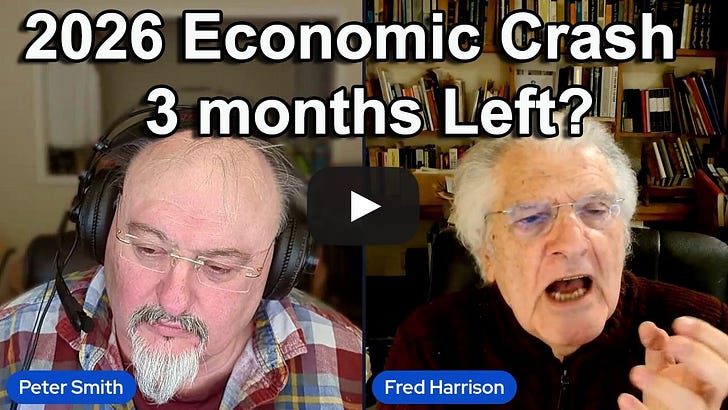
Here’s the pattern. Eighteen years. Within it, a shorter property cycle of roughly fourteen years. Fred has tracked it back through the Depression, through 1992, through 2008. In 1997 he wrote to Tony Blair and Gordon Brown and told them the housing market would peak in 2007. He didn’t know which quarter. It turned out to be the last one. Prices didn’t fall spectacularly until the final three months of the year. We’re in the same position now. Third quarter of 2026. Fred’s not backing down from the date. He’s pointing out that the crash doesn’t arrive on schedule like a train. It arrives when the pressure finally exceeds what the system can absorb, and that moment can be predicted in general but not specifically. What makes this cycle different, and what I think is the real story here, is what’s cushioning it. Fred pointed to Australia in 2008. The country dodged the crash everyone else took. Not because the theory was wrong, but because China was pouring money into Australian resources at exactly the moment the cycle should have turned. That capital absorbed the shock. It bought time. This time it’s not China buying iron ore. It’s hundreds of billions pouring into a handful of Silicon Valley companies, chasing what Fred calls, correctly, rent. Nobody in tech uses that word. They call it market position, first-mover advantage, platform dominance, the moat. Strip the language away, and it’s the same thing Adam Smith, John Stuart Mill and David Ricardo were describing two hundred years ago. A claim on value that somebody else produced. That flood of speculative capital is doing two things. It’s delaying the reckoning in housing, because money that might have gone into pushing up land values is chasing AI economic rents instead. And it’s making the eventual reckoning worse, because that same speculation is inflating a bigger rent bubble, one that will pop harder when it finally goes. Two major UK housebuilders have already pulled out of residential land purchases. That’s not a coincidence. Those businesses can see there are no more capital gains to be had on land, not for years. The market has peaked. It’s going one way from here, and that’s down. What fool buys into a depreciating asset? I keep coming back to a line Fred used in this conversation. He called it the cheating culture. Our statistics don’t measure economic rent separately from profit and wages. Not by accident. By design. If you can’t isolate rent in the numbers, you can’t point at who’s extracting it. Adam Smith wrote about this distinction in detail. So did Ricardo, so did Mill, so did Henry George. I told Fred about a conversation I had at a fundraising dinner recently with a man who called himself an economist and had never read any of them. That’s not an isolated case. That’s the state of the profession. This is why I keep sending people to Fred’s channel. Not because he has a model with more variables than anyone else’s, or a research department. He told the viewer as much himself. No crystal ball, no formula on a whiteboard. Just the discipline to read two hundred and fifty years of patterns and take them seriously when everyone paid to have an opinion refuses to. The people calling themselves experts are the ones who’ve never opened the basic texts. That’s not a provocation. That’s just true, and Fred says it plainly because somebody has to. Watch the full interview. He and I go further into why John Major understood exactly what was coming in the 1990s and let it happen anyway, and why Andy Burnham and Donald Trump are both about to inherit blame for a cycle that was set in motion long before either of them took office. If you’ve not subscribed to Fred Harrison’s YouTube channel yet, do it now. He’s been right about this for longer than most economists have had jobs. You're currently a free subscriber to Peter Smith Rewilding. For the full experience, upgrade your subscription.
|



Comments
Post a Comment