Scotland’s deer crisis: who pays the bill for the Highlands’ most expensive hobby?
Opinion • Land Reform • Ecology
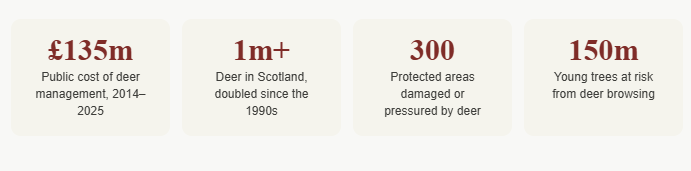
A million deer roam Scotland, kept in numbers by a culture of sporting estates and trophy hunting. The public pays £135m a decade for the privilege. It doesn’t have to be this way.
There is a peculiar kind of cognitive dissonance required to
look at the Scottish Highlands and call them wild. The bare, treeless hills are
romantic to the tourist’s eye but catastrophic to the ecologist’s. They are not
a natural landscape. They are the product of centuries of land management in
the interests of a very small number of people, sustained to this day at
extraordinary cost to everyone else.
New figures, revealed by
The Ferret, crystallise the scale of this dysfunction. Scotland’s publicly
funded forestry bodies have spent more than £134m controlling deer over the
last decade. Forestry and Land Scotland alone spent £77.6m between 2014 and
2025, a sum that has nearly doubled from £5.3m to £10.4m in a single decade. A
further £56.4m was dispensed by Scottish Forestry in grants, largely for deer
fencing, nearly triple the road length of mainland Britain, to help private
landowners cope with the animals they have every incentive to keep.
A manufactured crisis
Scotland’s deer population has exceeded one million, having
doubled since the 1990s. This is not a natural phenomenon. It is the
foreseeable consequence of a land use system organised around the deer-stalking
industry, in which large private estates have strong financial and cultural
incentives to maintain high deer numbers. Deer are the product; ecological
destruction is merely the externality.
The consequences are severe and well-documented. Some 150
million young trees are at risk from deer browsing, with tens of millions of
mature trees vulnerable to bark-stripping. Nearly 300 protected areas are being
damaged or put under pressure, including Ben Nevis, Glen Coe, and both national
parks. The critically rare Caledonian forest cannot regenerate because deer eat
every sapling before it can establish.
Peatlands face similar damage. Scotland’s peat holds vast
stores of carbon accumulated over millennia. Deer trample the surface
vegetation, exposing and destabilising soils, releasing that carbon back into
the atmosphere. NatureScot estimates that around 80 per cent of Scotland’s
peatlands are already damaged. In areas of high deer density, some reaching 64
deer per square kilometre against a recommended maximum of five to eight for
ecological sustainability, that damage compounds every year.
“Deer numbers have reached the highest-known levels,
preventing the delivery of key nature restoration programmes.”Duncan
Orr-Ewing, Scottish Environment LINK
On the roads, deer are involved in an estimated 1,850
traffic collisions in Scotland annually, contributing to around 700 deaths or
injuries across the UK each year and £17m in vehicle repairs. Meanwhile, an
estimated 100,000 deer are culled annually, possibly as many as 200,000, but
NatureScot calculates that 50,000 more must be killed every year just to meet
nature and biodiversity targets. We are running to stand still, and paying
handsomely for the treadmill.
The logic of negative externalities
In economics, a negative externality is a cost imposed on a
third party by the actions of others, where that cost is not reflected in the
price of the activity generating it. Pollution is the classic example: a
factory discharges into a river, profits from its production, and the
downstream community pays through contaminated water. The market fails because
the polluter does not bear the full cost of their choices.
Scotland’s deer problem is a textbook case of the same
failure. Sporting estates maintain deer at densities that damage soils, destroy
woodland regeneration, endanger road users, and undermine national climate
targets. The estates derive income from the stalking. The public bears the
cost, through forestry grants, direct government management, environmental
degradation, and forgone carbon sequestration.
Until very recently, the absurdity ran deeper still.
Research found that nine out of ten of Scotland’s shooting properties were
exempt from business rates, saving the sector some £10.5m a year. Some of
Scotland’s wealthiest landowners, including billionaires, were thus subsidised
in both directions: paid to put up fencing against their own deer, and relieved
of the taxes that other businesses pay. The Scottish Government’s 2026 budget
has finally ended most of these exemptions. It is a welcome step, but only a
beginning.
The principle that should govern land use is simple: those
whose activities impose costs on others should pay for those costs. This is not
punitive. It is the restoration of honest accounting. If deer management is
costing the public £10m a year and rising, and if private estates are the
proximate cause of the deer population that requires that management, then the
cost should flow accordingly.
Land value tax: realigning incentives
The most powerful tool available to correct this
misalignment is a land value tax, a levy on the unimproved value of land
itself, assessed independently of what the owner has built or developed upon
it. Unlike taxes on income or transactions, it cannot be avoided by sitting on
land and doing nothing. It falls equally on the productive farmer and the
absentee speculator, on the well-managed estate and the ecologically
destructive one.
Applied in Scotland, a well-designed land value tax would
immediately change the calculus for sporting estates. Land held at low
ecological productivity, degraded moorland stripped of trees and peatland by
excessive deer, would attract a levy reflecting its underlying site value. The
incentive to maintain high deer numbers for sporting revenue, at public
ecological expense, would diminish. The incentive to restore the land would
grow, since a richer ecosystem attracts higher ecological payments and, potentially,
a reduced tax burden under a biodiversity-adjusted scheme.
Crucially, land value tax can be structured to reward, not
merely to penalise. Landowners who achieve measurable biodiversity outcomes,
native woodland regeneration, peatland restoration, the return of lost species,
could receive payments calibrated to the positive externalities they generate.
This is the mirror image of the polluter-pays principle: those who provide
public goods should be compensated for them. Scotland’s Nature Restoration Fund
and the emerging biodiversity net gain frameworks point in this direction, but
they remain piecemeal without a coherent fiscal underpinning.
The principle is simple: the cost of ecological
destruction should not be socialised while its profits are privatised. Land
that damages the commons should pay. Land that restores them should be
rewarded.
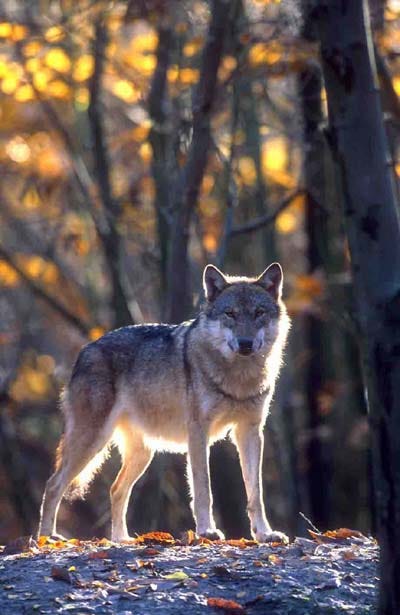
Bring back the wolf
No honest account of Scotland’s deer crisis can ignore the
missing piece at the apex of the food chain. Deer in Scotland have no natural
predators. The wolf was exterminated here around 1700; the lynx somewhat
earlier. Without top predators, deer populations can only be controlled by
human culling, an expensive, imperfect, and politically fraught substitute for
what ecology would otherwise provide for nothing.
The reintroduction of wolves to Scotland is a serious
scientific proposal, not a romantic fantasy. In Yellowstone National Park, wolf
reintroduction in 1995 triggered a cascade of ecological recovery. Deer avoided
riverbanks where they were vulnerable to predation, allowing vegetation to
regenerate, stabilising river courses, and drawing in species from beavers to
songbirds in what ecologists call a trophic cascade. Scotland’s landscapes are
different, but the principle holds.
The objection from farming communities, that wolves will
take sheep and cattle, is not frivolous and must be answered honestly. This is
where land value taxation and biodiversity compensation schemes become
essential. If wolf territories are established on land currently used for
low-productivity sheep grazing, compensation must be genuine and proportionate.
Equally, if landowners adjacent to wolf territories experience demonstrable
benefits from reduced deer pressure, recovered woodland, and the tourism value
of a genuinely wild landscape, then that value should be recognised and
factored into any fiscal settlement.
Land value tax, properly designed, can enable wolf
reintroduction by creating the fiscal space to compensate genuine losers while
capturing the gains that accrue to land values in rewilded areas. Land near
functioning wild ecosystems is, empirically, more valuable. That increased
value, unearned by the landowner and generated by the ecosystem and public
investment, is precisely the kind of economic rent that land value taxation is
designed to recapture for the common good.
The political will question
Scotland has made more progress on land reform than most
comparable countries. The community right to buy, the Land Commission, the
recent abolition of shooting rate relief: these are not trivial steps. But the
underlying structure of land ownership and its fiscal treatment has barely
shifted. Around half of Scotland’s private land is owned by fewer than 500
people, and those people exercise extraordinary influence over the ecology, the
economy, and the political possibilities of the country they own.
The deer crisis is, at bottom, a story about who pays and
who decides. For generations, private landowners have made decisions about deer
numbers and land use that impose costs on the public, on taxpayers, on road
users, on communities downstream of degraded peatlands, on the global climate.
Those costs have been socialised with minimal complaint. The £135m spent on
deer management over the past decade is not a neutral line item. It is a
subsidy to a particular model of land use, paid for by people who have no say
in how the land is managed.
Changing this requires not just better deer management
targets, or voluntary culling schemes, or even expanded NatureScot intervention
powers, though all of these matter. It requires a fiscal framework in which the
costs of ecological damage are internalised by those who cause them, and the
benefits of ecological restoration flow back to those who provide them. Land
value taxation, linked to biodiversity outcomes, is the most coherent available
mechanism for achieving this.
Scotland’s hills should be full of trees, alive with
predators, thrumming with the ecological richness that once made this one of
the most biologically diverse corners of the Atlantic world. Instead they are
managed for the entertainment of wealthy stalkers, at the expense of the
climate, the landscape, and the public purse. The deer did not choose this. The
question is whether the people of Scotland will.
Sources: The Ferret,
April 2026; Forestry and Land Scotland; NatureScot; Scottish Environment
LINK; John Muir Trust; Woodland Trust.


Comments
Post a Comment