The Beaver vs. The Banker: Why our Planet's future is being stolen from us and how we can ‘steal’ it back.
We are witnessing a “Green Grab” that threatens to finish what the Enclosure Acts began. To save the British countryside, we must first admit that our model of land ownership is fundamentally broken.
If you look at a map of the British Isles, you see a tapestry of green: hedgerows, rolling fields, patches of woodland. We are conditioned to view this landscape as a natural inheritance, a timeless vista. But this is a lie. The British landscape is not a product of nature; it is the scar tissue of a thousand-year political struggle. It is a geometry of exclusion.
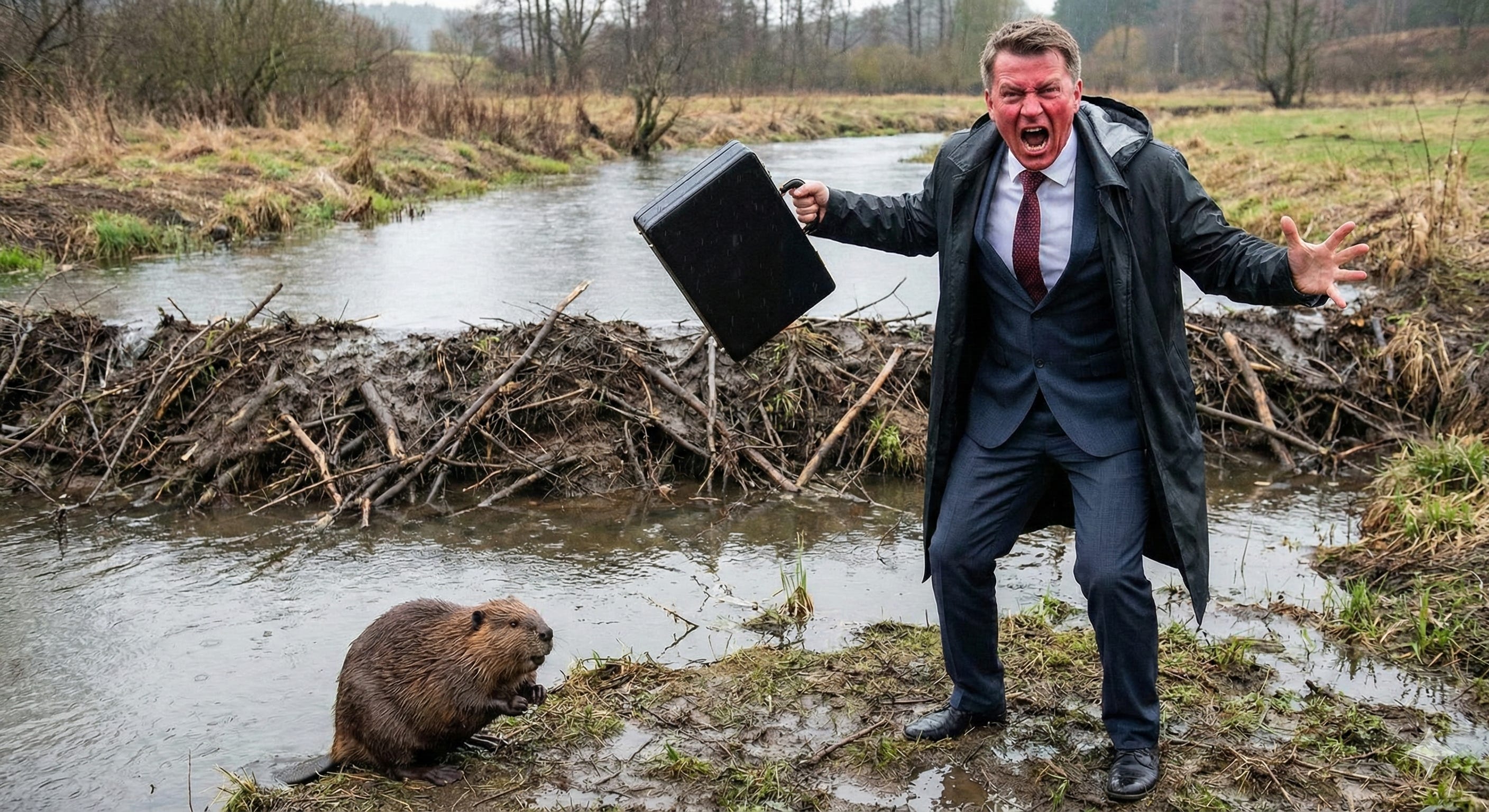
For the last twenty-seven years, I have devoted my life to a single, somewhat radical purpose: the reintroduction of beavers. On the surface, this is an ecological mission. But if I am to say the “quiet bit” out loud, my motivation is also deeply political. I promote the beaver because it is the only effective agent of “land theft” currently available to us.
When a beaver dams a stream and floods a valley, it pays no rent. It respects no title deed. It does not consult the Land Registry before converting a neat, distinct asset into a sprawling, chaotic wetland. In doing so, it steals the “utility” of that land from the private owner and returns it to the biosphere.
This friction—between the beaver’s instinct to restore and the landowner’s right to exclude—is the microcosm of a much larger crisis. We are currently trapped in an economic feedback loop where the very mechanisms designed to “save” nature are making it impossible to protect. We are witnessing the financialisation of the wild, a Neo-Enclosure movement where biodiversity is being repackaged as a speculative asset class for global capital.
The Hidden Crisis: The “Green Grab”
There is a comfortable myth in British conservation that we are all on the same team; that with enough goodwill and crowdfunding, we can restore our depleted islands. This ignores the brutal reality of neoclassical economics.
The current model for rewilding has been hijacked. What is presented as an ecological necessity has morphed into a “Green Grab.” Hedge funds, multinational corporations, and private equity firms are currently scouring the UK market, buying up vast tracts of marginal land. They are not doing this out of altruism. They are doing it to secure Carbon Credits, Biodiversity Net Gain (BNG) units, and tax relief.
The Hidden Wildlife Killer: The Paradox of Success
This is the hidden killer of the British countryside, the silent mechanism that ensures our best efforts are constantly eroded by the market. We are trapped in a tragic paradox where every penny raised by a genuine conservation charity to acquire land now buys significantly less than it did a decade ago.
We are witnessing a catastrophic 90.2% real loss of purchasing power for conservation bodies since 1990.
Think about what that means on the ground. A donation that could once have secured a thriving wetland or an ancient woodland the size of a village now barely scrapes together enough capital to buy a sterile paddock.
But the cruelty goes deeper. In our current neoclassical economic system, the very act of raising funds to “save” nature signals to the market that nature has a high monetary value. When charities enter the market to buy land, they inadvertently increase demand, driving prices up further.
It is a heartbreaking reality: a donation today makes it harder to protect wildlife tomorrow.
We are running up a down escalator that is accelerating beneath our feet. The more money we pour into the current land tenure system, the more we inflate the asset bubble that excludes us. We are feeding the beast we are trying to fight. This is not just a funding crisis; it is a structural failure. Our donations, given with hope and love for the natural world, are being swallowed whole by a land market designed to extract maximum rent, leaving us with less land, less wildlife, and a heavier heart with each passing year.
The Theft of the Commons: A History of Violence
To understand why this is happening, we must understand that this is not a new phenomenon. It is the latest chapter in a violent narrative of dispossession that began nearly a millennium ago.
The British concept of “Absolute Freehold”—the idea that a person can own a piece of the planet exclusively and perpetually—is a legal fiction constructed to dismantle the “Commons.”
1. The Pre-Feudal Baseline
Before the Norman Conquest, the dominant tenure was “customary use.” Under the Open Field System, land was defined by what it did for the community, not who held the paper. Villagers farmed strips scattered across unhedged fields to share the risk of bad soil. Once the harvest was in, private rights evaporated, and the land reverted to common grazing. Surrounding this was the “Waste”—fen and wood—which provided fuel (turbary), wood for repairs (estover), and forage for pigs (pannage).
2. The Norman Yoke & The Magna Carta: The Original Sin of Privatisation
In 1066, William the Conqueror declared that all land belonged to the Crown, parcelling it out to barons in return for military service. This established the “radical title” that still underpins our law. Yet, even then, the Charter of the Forest (1217) protected the right of the common man to exist within the Royal Forests.
We must confront the uncomfortable truth that the Magna Carta (1215)—venerated in schools and courtrooms as the cradle of English liberty—was, in reality, the greatest sin committed against the commonwealth. Often hailed as the first law of freedom, it was effectively the first law of our enslavement.
History has sold us a myth. The Magna Carta was not a “People’s Charter”; it was a peace treaty between a King and a gang of warlords (the Barons) to carve up the spoils of the country between them. It did not grant freedom to the serf; it secured the privilege of the property owner against the Crown. By establishing the legal rights of the powerful to hold land as absolute private dominion, it codified the theft of the commons. It shifted the mastership of the people from a distant, divine monarch to a local, land-hoarding elite, legally enshrining the concept that the land—and the people upon it—were assets to be owned, not a community to be shared. In this light, 1215 was not the dawn of democracy, but the moment the cage of the private freehold was locked around us.
3. The Great Liquidation: The Dissolution of the Monasteries (1536–1541)
We must also confront the cataclysm of the Tudor period, an event often sanitised in history books as a religious reformation, but which was, in reality, the largest act of privatisation in English history.
Before this state-sponsored looting, the Church held roughly a quarter of England’s land mass. While the monasteries were far from perfect landlords—often wealthy and powerful in their own right—their estates functioned as a vital, quasi-public utility. They operated on a model of “benign inefficiency.” The monastic landscape was a patchwork of medicinal gardens, fishponds, sustainable woodlands, and tenant farms held under “customary” rents that rarely rose. Crucially, they provided the only social safety net the country possessed: alms for the destitute, healthcare for the sick, and a degree of lenient tenure for the rural peasantry.
Henry VIII did not merely suppress a religion; he seized this vast “spiritual patrimony” and liquidated it.
Driven by a desperate need to fund futile foreign wars in France and Scotland, the Crown did not hold onto these lands for the public good. Instead, it initiated a fire sale. The estates were sold en masse to a rising class of commercially minded gentry, lawyers, and court favourites.
This was the pivot point where the soul of the English landscape changed. Overnight, land that had been held in a form of spiritual stewardship for centuries was thrust into the hands of private speculators who viewed it not as a heritage, but as a high-yield investment.
To recoup the cost of purchasing these estates, the new owners had to “sweat the assets.” The result was an immediate and brutal intensification of the landscape.
The Social Cost: The new “Aristocracy of the Ledger” raised rents (rack-renting), evicted tenants who could not pay, and dismantled the systems of alms-giving. This birthed a vast new underclass of the landless poor—the “vagabonds” of Tudor legislation—who were cut loose from the land that had sustained them for generations.
The Ecological Cost: The environmental impact was equally devastating. To generate quick cash, the new owners felled ancient woodlands for timber and drained wetlands for grazing. The complex, biodiverse mosaic of the monastic estate—managed for subsistence and local resilience—was streamlined into a monoculture of profit.
This was the moment the British countryside ceased to be a shared home and became a factory without a roof. The Dissolution established the precedent that land is a naked financial asset, stripping it of its social duties and biodiversity alike, and setting the stage for the industrial farming models that plague us today.
4. The Great Theft (1750–1850)
The death knell for the commons was Parliamentary Enclosure. Between 1760 and 1870, the landed gentry used their control of Parliament to pass Enclosure Acts, legally seizing over 7 million acres—one-sixth of England. They fenced off the commons, “rationalised” the fields, and evicted the peasantry. This was state-sanctioned theft on an industrial scale. It created a landless proletariat forced into the slums of Manchester to fuel the Industrial Revolution, stripping them of the ability to feed themselves.
By the time of the Victorian “New Domesday Book” in 1873, less than 5% of the population owned 99% of the land. This concentration of wealth was solidified by the Law of Property Act 1925, which simplified complex feudal duties into the clean, tradeable asset of Freehold.
The Great Betrayal: The Highland Clearances and the “Wet Desert”
If the Magna Carta and Parliamentary Enclosure were the legal codification of theft, the Highland Clearances were its most violent physical expression—a brutal, systematic dismantling of the Duthchas, the ancient Celtic principle where land was held in trust for the clan, not owned by the chief. In a devastating act of treachery, the clan chiefs—seduced by the wealth of the south—unilaterally reinvented themselves as feudal landlords, trading their kinship obligations for the cold calculus of the balance sheet. They viewed their own people not as family, but as “redundant biological units” standing in the way of the more profitable Cheviot sheep.
The result was the forced eviction of tens of thousands and the creation of the “Wet Desert”: the bare, treeless landscapes tourists now mistake for “wild” nature are, in reality, the ecological scars of ethnic cleansing. This trauma set the stage for the most concentrated land ownership pattern in the developed world, where vast “Sporting Estates”—monuments to Victorian vanity—keep millions of acres in a state of artificial barrenness for the amusement of the few. The modern fight for Scottish Land Reform is not just about economics; it is an attempt to heal a landscape that was deliberately broken to serve the “Laird,” ensuring that the deer and the grouse still possess more rights to the glen than the people who were cleared from it.
The Fallacy of Primacy
This history explains why rewilding is such a flashpoint today. We are trying to impose a fluid, dynamic ecological process onto a rigid, fossilised legal structure.
We are suffering from the Fallacy of Primacy: the mistaken belief that absolute private ownership is the only valid model for land tenure. This fallacy assumes land is a static, divisible asset, like a gold bar. But ecology is not static. Rivers migrate. Root systems spread. Seeds disperse.
The primacy of private ownership creates a fragmented landscape where a single landowner can veto ecological recovery. Genuine rewilding requires scale—contiguous corridors of nature spanning thousands of acres. Under the current model, assembling such tracts is logistically impossible.
The Beaver as Economic Vandal
This brings us back to the beaver. In a financialised landscape, the agency of a keystone species constitutes a form of theft.
To an ecologist, a beaver is a wetland engineer, creating habitats that sequester carbon and clean water. But to a landowner whose asset is valued on its “productive capacity” (whether for sheep, shooting, or carbon credits), the beaver is a vandal. By flooding a field, the beaver effectively “steals” the utility of that acreage.
When land was cheap and considered “worthless scrub,” a flooded corner was an absorbable nuisance. But now that the Green Grab has inflated land values to astronomical heights, every square metre must perform financially. A beaver flooding five acres of “Carbon Positive” woodland is no longer just a nuisance; it is destroying a high-yield financial asset.
Thus, the financialisation of nature perversely incentivises landowners to exclude the very dynamic, messy wildlife that rewilding claims to support.
The Collapse of the Acquisition Model
For decades, the strategy of conservation bodies was simple: buy the land, protect the land. That model is now mathematically broken.
Faced with impossible prices, charities have pivoted to “Covenanting”—paying landowners to manage land for nature. While this sounds pragmatic, it is often a disaster for wildlife. It suffers from a “Management Deficit,” where stewardship is outsourced to the lowest bidder. Worse, charities (which are tax-exempt) are forced to compete for land against wealthy individuals using land as an Inheritance Tax shelter. These buyers pay a 20-30% “tax premium” that charities cannot justify.
The result? The most critical sites remain in the hands of the asset-rich elite, managed for tax efficiency rather than ecological maximums.
“In many ways, nature conservation has become just another method of rent extraction by landowners who are trying to hide the fact that modern farmers’ fields are essentially deserts, devoid of wildlife, and the taxpayer must pay ‘rent’ if we want wild animals to occupy ‘their land’.” Peter Smith
“In many ways, nature conservation has become just another method of rent extraction by landowners who are trying to hide the fact that modern farmers’ fields are essentially deserts, devoid of wildlife, and the taxpayer must pay ‘rent’ if we want wild animals to occupy ‘their land’.” Peter Smith
Conclusion: From Monopoly to Stewardship
We have allowed the UK countryside to become a balance sheet for global capital. We have inverted value so thoroughly that “useless” scrubland is now worth three or four times more than prime food-producing land, simply because it serves as an indulgence for the polluting classes.
If we are to save our wildlife, we must dismantle the Fallacy of Primacy. We must puncture the speculative bubbles in the land market.
The Fundamental Correction: Breaking the Monopoly
The only structural solution that is economically efficient—and morally robust—is a Land Value Tax (LVT). We must cease taxing labour and enterprise, which we want to encourage, and start taxing land hoarding and environmental harm, which we must stamp out.
The current system allows for the private appropriation of public wealth. Consider this: when a community builds a school, funds a new railway line, or nurtures a vibrant local culture, the value of the surrounding land skyrockets. Who created that value? The community. Who pockets that value? The landlord.
This is the “unearned increment.” It is a value created by the collective effort of society, but realised as a windfall by a private individual who may have done nothing but hold a title deed.
By implementing a Land Value Tax, we penalise the passive hoarding of our most finite resource. It forces the speculator to either use the land productively or release it to someone who will, or let it return to the wild. It returns the wealth generated by the community back to the community, rather than allowing it to be siphoned off into offshore accounts. This is the only way to solve the crises of poverty, housing and biodiversity loss: by reclaiming the common treasury that lies beneath our feet.
As Winston Churchill, speaking with prophetic clarity in 1909, famously declared:
“Roads are made, streets are made, railway services are improved, electric light turns night into day, electric trams glide swiftly to and fro, water is brought from reservoirs a hundred miles off in the mountains — and all the while the landlord sits still. Every one of those improvements is effected by the labour and cost of other people. Many of the most important are effected at the cost of the municipality and of the ratepayers. To not one of those improvements does the land monopolist, as a land monopolist, contribute, and yet by every one of them the value of his land is sensibly enhanced.”
We must heed this warning. Until we tax the monopoly value of land, we are simply subsidising our own dispossession.
This reform transforms the beaver from an agent of financial ruin into a mechanism of fiscal relief. Under a Land Value Tax, if a beaver colonises a struggling farmer’s land and floods the bottom fields, the commercial capital value of that acreage naturally falls—and crucially, the farmer’s tax bill falls immediately with it. Instead of carrying the burden of “wasted” ground, the tax system automatically compensates him for the land surrendered to nature. When we couple this drop in liabilities with robust, funded externality payments—paying him a fair price for the flood protection and carbon sequestration his new wetland now provides to the public—the working farmer is left financially whole. It creates a truly equitable settlement where no honest worker needs to be dispossessed; the only true losers in this equation are the bankers, speculators, and “money men” who currently sit atop our society, extracting rent from inflated asset bubbles and sucking the future from our children to service their own greed.
We need to move away from the obsession with private freehold and towards Communal Stewardship—where land is held in trust for the community and for nature itself, so easily affordable with a Land Value Tax in place. Without addressing the economics of ownership, “rewilding” will remain a playground for the wealthy, a series of high-fenced zoos in a dying landscape.
The beaver knows that the land belongs to the water and the wood. It is time we learned the same lesson. We must ‘steal’ the land back that was originally stolen from nature and our communities, not for ourselves, but for our future.


Comments
Post a Comment