Money - The Root of All Evil
The Parasitic Economy: Striking at the Root of Global Instability
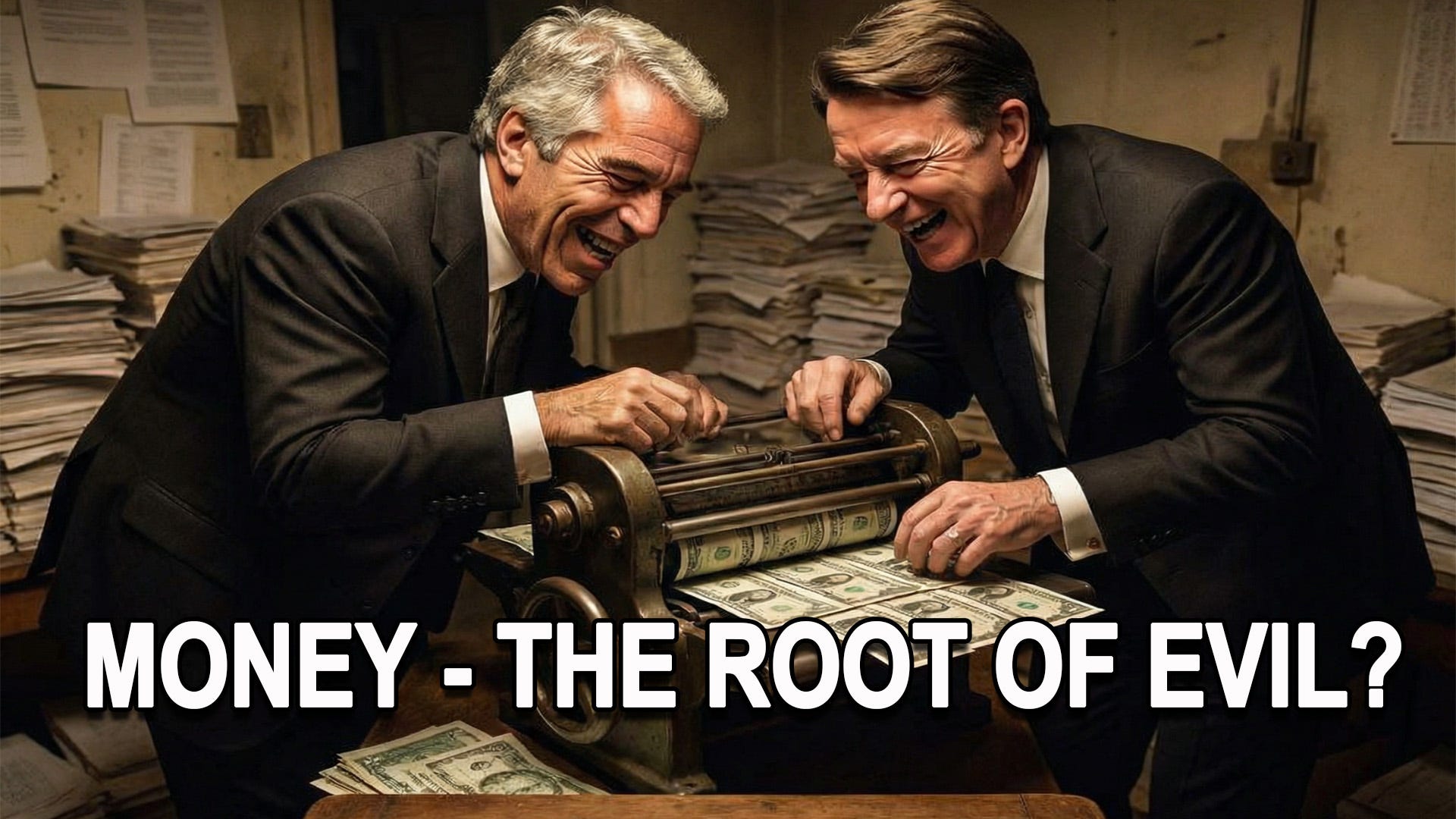
In a world plagued by recurring financial crises, geopolitical turmoil, and widening inequality, the fundamental mechanics of our economic system remain dangerously misunderstood. A recent dialogue between Peter Smith and Fred Harrison explores the “thorny issue” of money, challenging the prevailing economic orthodoxy. Their conversation dissects the myths surrounding money creation, the destructive role of land monopolies, and the moral decay of a society built on “irresponsible behaviour”. This essay examines their arguments, illustrating how a culture of “societal parasitism” has led us to the brink of a dystopian collapse, and offers a radical yet historical solution to “strike at the root” of these evils.
The Myth of the Magic Money Tree
A pervasive fallacy in modern economics is the idea that banks create money “out of thin air”. Fred Harrison argues that this notion is a “false way of representing money” designed to mislead the public. While public institutions and even the Bank of England may support this view, Harrison contends that credit is not conjured from a void; rather, it is a profound commitment of future labour.
When a borrower secures a loan—for instance, £100,000 to purchase a home—the bank does not merely print currency. It audits the borrower’s creditworthiness and secures the loan against collateral. The resulting credit represents a 20-year commitment by the borrower to work and create value equivalent to that debt. As Harrison states, “That labour power over 20 years is not thin air. It’s hard work”. The belief that money can be generated without cost or consequence leads to dangerous policies, such as the artificial expansion of the money supply, which only serves to accelerate inflation rather than averting economic crashes.
Land Monopolies and the Speculative Gamble
If money is a representation of labour and collateral, the crisis lies in the nature of the collateral itself: land. The dialogue highlights a “chicken and egg” scenario where the desperate need to access land monopolies drives the demand for credit. In our current system, housing has ceased to be primarily about shelter and has morphed into a speculative “sport” or “gamble”.
Individuals rush to “get on the housing ladder” not to add value to the economy, but to accumulate capital gains through rising property prices. This speculative frenzy forces banks to lend more against overvalued assets, pushing prices to unsustainable levels until the inevitable collapse of the 18-year business cycle. As Peter notes, this gambling on essential monopolies makes the economy dysfunctional; businesses cannot afford to operate, and people cannot afford to live, leading to a state where “the crash comes”.
Societal Parasitism and the Erosion of Morality
Perhaps the most damning critique offered is the characterisation of modern society as fundamentally “irresponsible” and “parasitic”. Harrison argues that while people view themselves as “responsible parents and concerned citizens,” their participation in the property market actively prejudices the interests of future generations. By seeking wealth through unearned capital gains rather than productive work, homeowners are engaged in “grand larceny on an epic scale”—effectively cheating their own children and the community.
This reality is painful to acknowledge. The “moral sensibilities” that should guide behaviour have been “neutralised” or perverted, allowing individuals to feel wealthy while contributing nothing to production. This “predator culture” sucks the life out of the productive economy like a parasite until “the horse dies”. Politicians and academics avoid this subject because exposing it requires telling voters that they are complicit in a system of theft.
Historical Failures: From Churchill to Thatcher
The historical context shows how missed opportunities and flawed policies have entrenched this system. Winston Churchill once recognised land as “the mother of all monopolies,” but his political will to reform the revenue system waned in the face of opposition. Had the post-WWII government reintroduced policies to capture land values—similar to the 1931 Act attempted by a Labour Chancellor—Britain might have avoided the destructive boom-bust cycles that followed.
Conversely, the policies of Margaret Thatcher are cited as a prime example of economic irresponsibility. Her “Right to Buy” scheme, which allowed social tenants to purchase homes at a discount, was sold as creating a “property-owning democracy”. In reality, it was a “scam” that transferred collective value into private hands. As prices rose to market levels, the long-term consequence has been that local authorities must now buy back these same dwellings at triple the price, burdening the taxpayer. Rather than fostering efficient businesses, Thatcher’s legacy was the creation of a “nation of rent-seeking parasites”.
The Corruption of Wealth: The Epstein Connection
The dialogue uses the recent release of the Jeffrey Epstein files to illustrate the link between unearned income and moral corruption. The files allegedly reveal an “awful relationship” between Epstein and politician Peter Mandelson, who is accused of passing government documents to Epstein to help bankers avoid taxation. Harrison argues that Epstein’s ability to “license misbehaviour” was fueled by the acquisition of wealth without labour. When income is decoupled from work—whether through land speculation or financial manipulation—it creates a moral vacuum where “anything becomes possible,” including the horrific abuses perpetrated by Epstein.
Striking the Root: A Path to Reform
The solution proposed by Harrison is a radical restructuring of the tax system. He advocates for the gradual abolition of taxes on earned income—wages and productivity—and replacing that revenue by collecting the “economic rent” of location values and natural resources.
This shift would discipline the economy: if you want wealth, you must work for it. By removing the ability to appropriate value created by the community (rent), society would eliminate the incentive for speculation and the “avarice” that drives current geopolitical and economic instability. While this transition must be phased in to protect a “dangerously fragile social system,” it represents the only way to move from a dystopia of theft to a “responsible society”. As Peter concludes, while thousands hack at the branches of evil, it is this approach that finally “strikes at its root”.



Comments
Post a Comment