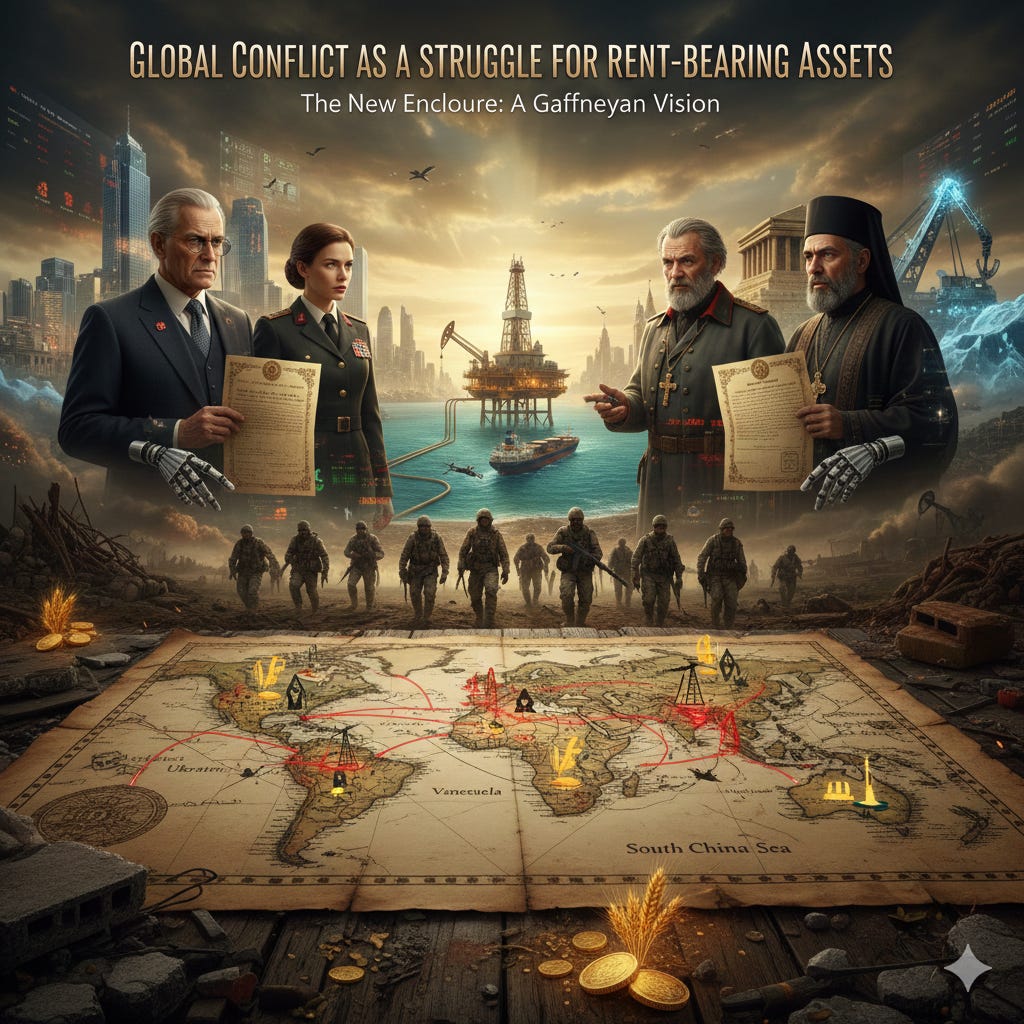
Global Conflict as a Struggle for Rent-Bearing Assets
A Neo-Gaffneyan Analysis of 21st Century Wars Erupting Across the World
Date: February 2026
Based on: The Rent-Bearing Assets of Nations (Mason Gaffney, 1988)

Summary
In February 1988, Professor Mason Gaffney warned a University of California seminar that economists were dangerously distracted. While they built arcane models of “rent-seeking” based on regulatory gaming, they were ignoring the “grosser sense” of the term: the violent seizure and policing of land. Nearly forty years later, the “grand disaster” Gaffney feared has arrived. From the steppes of Ukraine to the melting ice of Greenland, the primary driver of global conflict remains what it was for William of Normandy: the acquisition of rent-bearing assets.
This essay applies Gaffney’s 1988 analysis to the geopolitical flashpoints of today—Ukraine, Russia, Gaza, Iran, Venezuela, and Greenland. It argues that modern warfare and statecraft are not clashes of civilisation, but battles over “site value”—the economic rent derived from location, natural resources, and the monopoly power of sovereignty.
I. The Grosser Sense: Ukraine and the Eurasia Resource Belt
Gaffney posits that sovereignty over land is the “first business” of government. The Russo-Ukrainian war is frequently analysed through the lens of NATO or post Soviet expansion or ethnic irredentism. However, a Gaffneyan analysis reveals a classic “land-grab” for specific rent-generating assets.
The Donbas and the Warm Water Monopoly
The specific territories seized by Russia—Crimea, Donetsk, Luhansk, Zaporizhzhia, and Kherson—contain the vast majority of Ukraine’s mineral wealth and industrial coal reserves. These are “pre-existing” assets; their value does not derive from capital formation (which can be rebuilt) but from the geology itself.
More critically, the seizure of the southern coast is an attempt to capture location rent. By controlling the Sea of Azov and the land bridge to Crimea, Russia secures a monopoly on warm-water transit. In Gaffney’s terms, this is an attempt to “dispossess the local rent-collectors” (the Ukrainian state) and install new ones. The “defence” of Russian speakers is the ancillary cause; the economic reality is the acquisition of a rent-bearing corridor that controls the flow of grain and steel to the world market.
The Harvest of Blood: The Battle for the Black Earth
Ukraine possesses a geological endowment that is arguably more valuable in the long century ahead than oil or gas: the world’s largest contiguous belt of Chernozem, or ‘Black Gold’. This is soil of exceptional depth and fertility, a pre-existing asset of infinite duration. In a global economy increasingly beset by climate-induced desertification and food insecurity, the control of this agricultural engine is not merely a matter of national pride, but of global strategic monopoly.
The conflict, therefore, must be understood as a brutal, kinetic negotiation over who holds the title deed to these agricultural rents. It is, as Gaffney observed of the Norman Conquest, “simple, gross, and basic.” While the rhetoric of the war speaks of democracy and sovereignty, the economic reality is a hostile takeover of the world’s breadbasket.
This negotiation reveals a grotesque class dynamic. The struggle for the soil affects the “Lords”—the oligarchs and transnational equity firms—far more than the peasantry, yet it is the latter who are conscripted to die in the trenches to defend the tenure.
On the new ostfront, the nationalist fervour of the extreme right—the ideological heirs of the Banderist movement—serves as the kinetic tip of a financial spear. While these “warlords” are urged forward by the invisible statecraft of MI6 and the CIA, they function effectively as the enforcement arm for a much quieter, more sophisticated invasion: the acquisition of Ukrainian title deeds by the financial capitals of the West. The objective of the oligarchs in Lviv, allied with the capital flows of London and Wall Street, is the integration of this land into the Western portfolio—the financialisation of the soil, whereby the rents flow not to the local populace, but to the shareholders of transnational agribusiness behemoths and asset managers.
Conversely, the “solemn patriotism” invoked by the Kremlin is the mirror image of this cynical calculus. The narrative of “Mother Russia” serves as a spiritual camouflage for the oligarchs of Moscow, who seek to consolidate their own monopoly over the grain terminals of the Black Sea. They do not wish to liberate the land; they wish to re-register the deed in their own names, seizing the rent-collection mechanism from their rivals in Kyiv.
The tragedy of this war is that it is an orchestrated catastrophe designed to enrich the few at the expense of the many. Millions of lives are being ground into the very mud that is being fought over, a blood sacrifice offered up so that the “Lords B” might replace “Lords A.” It is the ultimate expression of rent-seeking: the use of catastrophic violence to transfer wealth from the commons to the private ledger, leaving the “serfs and vagrants” to bury their dead while the landlords count their harvest.
II. The “Caciques” of the Middle East: Iran and Gaza
Gaffney described “caciques” as local rulers supported by external powers to manage resources and maintain stability. This dynamic is fracturing across the Middle East.
Iran: The Rentier State, Choke Point Politics, and the Shadow of the Peacock Throne
In the Gaffneyan calculus, Iran is the ultimate “Prize of the East”—a territory defined by its subsoil wealth and its command over the world’s most critical maritime “location rent”. To understand the current hostility, one must look past the theological veneer to the century-long struggle by Western powers to install a compliant “cacique” who will facilitate the flow of oil rents to London and Washington.
The 1953 Coup: The Original Sin of Rent-Seeking
The modern history of Iranian tenure began with a blatant act of imperial dispossession. In 1951, the democratically elected Mohammad Mosaddegh moved to nationalise the Anglo-Iranian Oil Company, reclaiming the nation’s primary rent-bearing asset for the benefit of its own people. The response was Operation Boot (orchestrated by MI6) and Operation Ajax (the CIA).
By overthrowing Mosaddegh in 1953, the West effectively “laundered” the title to Iranian oil through violence, installing Mohammad Reza Pahlavi—the Shah—as the supreme cacique. The Shah’s regime became a bulwark of Western hegemony, protected by the SAVAK, a secret police force that indulged in some of the most grotesque and systematic torture of any modern state to ensure the security of Western oil “tenure”. This was Gaffney’s “policing of the land” at its most depraved: the physical breaking of a population to protect the “dribs and drabs” of transfer rent.
The Current Conflict: Bringing the Ayatollahs to Heel
The 1979 Revolution was, in economic terms, a violent expropriation of the Western-held title. Today, the tripartite intelligence apparatus of Mossad, the CIA, and MI6 seeks to bring the current clerical regime to heel, not out of a sudden devotion to Persian democracy, but to restore the rent-collection mechanism lost half a century ago.
The strategy is twofold:
The Blockade on Rent: Sanctions function as a financial siege, preventing the regime from realising the market value of its natural assets. By starving the state of oil rents, the West aims to trigger a collapse that allows for the installation of a “New Shah”—a modern cacique who will once again pay “rent” to the Western hegemony in the form of favourable concessions and geopolitical alignment.
Choke Point Diplomacy: In response, Iran engages in “offshore” rent-seeking by projecting sovereignty over the Strait of Hormuz. By threatening this global artery, Tehran creates a “transfer rent”—using the threat of global economic paralysis to extract political concessions.
The Proxy “Caciques”
Iran’s own network of proxies—Hezbollah, the Houthis, and various Iraqi militias—functions as a militarised version of the cacique system. These groups project Iranian tenure into the “precarious” margins of failing states, capturing influence and resources as a defensive buffer against Western encroachment.
The tragedy remains the same as in Gaffney’s 1988 analysis: the Iranian people are caught in a pincer movement between a domestic regime that survives on resource rents and a Western coalition that will tolerate any level of suffering—or install any level of tyranny—to ensure that those rents are eventually remitted to the “right” hands.
Gaza: The Genocide and Apartheid Ethno-supremism
In the framework of Professor Gaffney’s analysis, Gaza represents the most volatile “interface among sovereignties” in the modern world. However, to view the current catastrophe as a mere border dispute or counter-terrorism operation is to ignore the “grosser” economic reality: it is a campaign of systematic ethic cleansing designed to resolve a tenure crisis through the total erasure of the competing claimant. The Israeli state, operating as an apartheid apparatus, is leveraging military force to secure not just the land, but the immense offshore gas rents that lie beneath Palestinian waters.
The “Gaza Marine” and the Prize of Offshore Rent
At the heart of this “precarious tenure” lies the Gaza Marine gas field. This is a massive, rent-bearing asset that has remained “frozen” for decades due to the unresolved status of Palestinian sovereignty. For the Israeli state, the existence of a Palestinian entity with a legitimate claim to these resources is an intolerable barrier to total regional energy hegemony.
The current campaign—characterised by many international observers and legal scholars as a genocide—functions as a final, violent “laundering” of the title. By depopulating the territory and destroying the possibility of a viable Palestinian state, the Israeli government seeks to transform a contested “liability” into a high-value, unencumbered asset for the Israeli energy sector. As Gaffney noted, “past appropriation invites future expropriation”; the current violence is a pre-emptive strike to ensure that no future Palestinian authority can ever claim the rents from the Levant Basin.
The Uncritical West: Policing the Bulwark
This campaign of expropriation is sustained only by the uncritical support of the West, led by the US and the UK. Their refusal to intervene, and their persistent “blind eye” to the humanitarian catastrophe is a calculated move in the global game of rent-seeking. Israel is bolstered not as a “democracy,” but as a military bulwark—a sophisticated “cacique” state on a grand scale.
The Western powers view Israel as a reliable policeman in a region that is perpetually attempting to reclaim its own resource rents. By maintaining a heavily armed, technologically superior client state in the heart of the Middle East, the West ensures that the flow of regional energy rents remains disciplined and aligned with London and Wall Street. The “defence” of Israel is, in Gaffneyan terms, the policing of a massive rent-collection mechanism. The lives of the many in Gaza are treated as an unfortunate, but necessary, externality in the pursuit of securing offshore gas fields and maintaining a Western-aligned energy monopoly.
III. The Latin American Paradox: Venezuela, the Essequibo, and the New Tumpian Oil Hegemony
In the Gaffneyan framework, Venezuela serves as a harrowing case study of how the lure of “easy rents” can drive both regional powers and global empires into a state of predatory madness. Professor Gaffney warned that “territorial expansion is often self-defeating,” yet the struggle over Venezuela’s subsoil—the largest proven oil reserves on the planet—has triggered a cycle of internal rot and external aggression.
The Internal Rot of the Petrogarchy
Venezuela illustrates Gaffney’s warning regarding the corrupting influence of “discretionary funds.” When a state derives its primary revenue from oil rents rather than taxing the productive labour and capital of its citizens, the social contract is severed. The government ceases to be a servant of the people and becomes a Grand Landlord collecting rent. The collapse of the Venezuelan economy is the direct result of rent-seeking elites—or “caciques”—cannibalising the nation’s infrastructure to secure their own slice of the petro-dividend.
The Essequibo: A Kinetic Rent-Grab
The revival of Venezuela’s claim over the Essequibo region of Guyana in late 2023 is the “purest” form of Gaffneyan conflict. Following the discovery of massive offshore oil deposits by Western consortia, the Caracas regime moved to expand its borders to encompass this newly revealed rent-bearing asset.
As Gaffney observed, the greatest gains for rent-seekers come from “buying in on the ground floor” when tenures are precarious. Guyana, a small nation with a modest military, holds a legally sound but militarily vulnerable tenure. Venezuela’s aggression is a desperate gamble to seize the asset before Guyana’s tenure “firms up” through international defence treaties and the entrenchment of Western capital.
The American Imperium: Kidnapping and “Extractionary Democracy”
However, the most destabilising rent-seeking in the region is directed from the North. The American assertion of control over Venezuelan oil represents the projection of sovereignty into a foreign nation to secure “concessions and resources.”
The US-led efforts to destabilise the Maduro administration—culminating in what can be described as the geopolitical kidnapping of the Venezuelan state’s autonomy—are not motivated by a desire for “public good” or democracy. Rather, they are an attempt to replace an uncooperative landlord with a compliant “cacique” who will grant preferential access to American multinationals.
The imposition of draconian sanctions is a tactical move to “freeze” the rent-bearing capacity of the nation until the “tenure” can be transferred to ‘friendly hands’. By asserting a de facto right to determine who may sell Venezuelan oil and to whom, the United States is practising a sophisticated form of imperial rent-collection. The target is the “Black Gold” of the Orinoco; the method is the systematic dismantling of a sovereign’s ability to police its own land.
The suffering of the Venezuelan people is the “orchestrated catastrophe” of the age—a direct consequence of being caught between a domestic petrogarchy and an external empire, both of whom view the nation not as a society, but as a site to be plundered for its location and mineral rents.
IV. The Arctic Frontier: Greenland and the Silent Grab
If Ukraine is the war of the present, Greenland is the war of the future. Gaffney noted that tenure is created at the “margins of settlement and exploration.” As climate change melts the Arctic ice, Greenland is transitioning from a frozen wasteland to a rent-bearing treasure trove of rare earth minerals and strategic geography.
“Buying in on the Ground Floor”
When President Trump expressed interest in “buying” Greenland in 2019, he was mocked by the press but was acting as a rational Gaffneyan rent-seeker. He recognised that the asset (the island) was undervalued relative to its future strategic rent.
The Battle for the Rare Earths
Greenland holds some of the world’s largest deposits of neodymium, praseodymium, and uranium. Currently, China dominates the global supply chain for these minerals—a monopoly rent situation. The Western push to secure mining rights in Greenland is an attempt to break this monopoly. This is a conflict fought not with tanks, but with capital flows, exploration rights, and diplomatic pressure on the local “caciques” (the Greenlandic home rule government). It is a race to establish tenure before the value of the asset skyrockets.
V. The Grand Chessboard: The Systematic Enclosure of the Russian Frontier
In the cold logic of Professor Mason Gaffney’s “grosser rent-seeking,” we must strip away the veneer of liberal interventionism and “defence” to see the true objective of the Western alliance. The real prize for the triumvirate of Washington, London, and Brussels is not merely the protection of Ukrainian sovereignty, but the wholesale balkanisation of the Russian Federation.
Russia represents perhaps the single largest untapped repository of rent-bearing assets on the planet. From the vast mineral wealth of the Urals to the infinite timber of the Taiga and the massive natural gas reserves of the Arctic, Russia is the world’s ultimate “un-enclosed” commons. In the eyes of Western hegemony, the Russian state under Vladimir Putin acts as a stubborn landlord who refuses to grant the “right” concessions to transnational capital.
The Strategy of Disintegration
The endgame is not a settled peace, but a managed collapse. By draining Russia through a war of attrition in Ukraine, the Western intelligence apparatus aims to trigger a fragmentation of the Russian Federation along ethnic and regional lines.
With the central authority in Moscow broken and Putin removed, the “Lords” of London and Wall Street anticipate a repeat of the 1990s—a “shock therapy” era where the titles to Russia’s vast resources can be “laundered” and sold off to foreign successors-in-interest. This is the ultimate Gaffneyan land-grab: the transformation of a sovereign nation into a collection of weak, competing “cacique” states, each eager to pay tribute to the Western financial system in exchange for political survival.
The Final Conquest: The Path to China
However, even the vast prize of a balkanised Russia is only a preliminary move on the “Grand Chessboard.” In the strategic calculus of the West, Russia is the geographic and resource-rich barrier that prevents the total encirclement of the final rival: China.
The destruction of Russian sovereignty is intended to open a clear path for the final enclosure of the global market. With Russia’s resources firmly under Western tenure and its territory no longer providing a strategic “depth” to the East, the Western hegemony can pivot its full military and economic weight toward the final conquest of China.
The Orchestrated Catastrophe
We are currently witnessing an orchestrated catastrophe where the deaths of millions are viewed by the “best and brightest” systems analysts as a necessary cost of doing business. The “defence” of the West is a loaded term; it is the aggressive expansion of a global rent-collection mechanism that will not rest until every acre of the earth is under a title deed issued by a Western-aligned grantor.
The “solemn patriotism” of the combatants is the camouflage for a global land-grab. The serfs of the 21st century—be they in the Donbas, Gaza, or the Orinoco—are dying to settle a dispute between rival Lords over who will control the “Black Gold” of the soil and the offshore gas of the seas.
VI. The Mechanism: Socialised Costs, Privatised Rents
The common thread linking these conflicts is the role of the great powers—primarily the US and increasingly China—in “policing” these rents.
Gaffney argued that “National defence is a public good” is a lie. “Military spending” is the correct term. When the US Navy patrols the Persian Gulf or sends carriers to the Mediterranean, it is protecting the “tenure” of allied regimes and the corporations that hold concessions there.
The costs of this policing are socialised—paid for by the taxes of the average citizen in London or New York. The benefits, however, are privatised. They accrue to the shareholders of energy companies, the defence contractors, and the local oligarchs. As Gaffney wrote: “The Lords and Barons have much at stake; the serfs and vagrants very little.”
Conclusion: The Policy Implication
The world is currently locked in a cycle of violent rent-seeking because the rewards for seizing land and resources remain astronomically high. We treat land titles as sacred, ignoring their bloody origins, and allow the rents from these assets to flow into private hands or aggressive state coffers.
To reduce global conflict, we must return to Gaffney’s prescription: Recoup the rents.
If the economic rent of land, oil, gas, and minerals were taxed at 100%—essentially making them the common heritage of mankind or at least the nation—the incentive for invasion would vanish. If holding the Essequibo or the Donbas yielded no “super-profits” for the conqueror, but only the burden of administration, the wars would cease. Until we address the economic incentives of land-grabbing, we will remain trapped in this new, violent enclosure of the earth.


Comments
Post a Comment