So You Want to Save the World… A Guide to Fixing Almost Everything
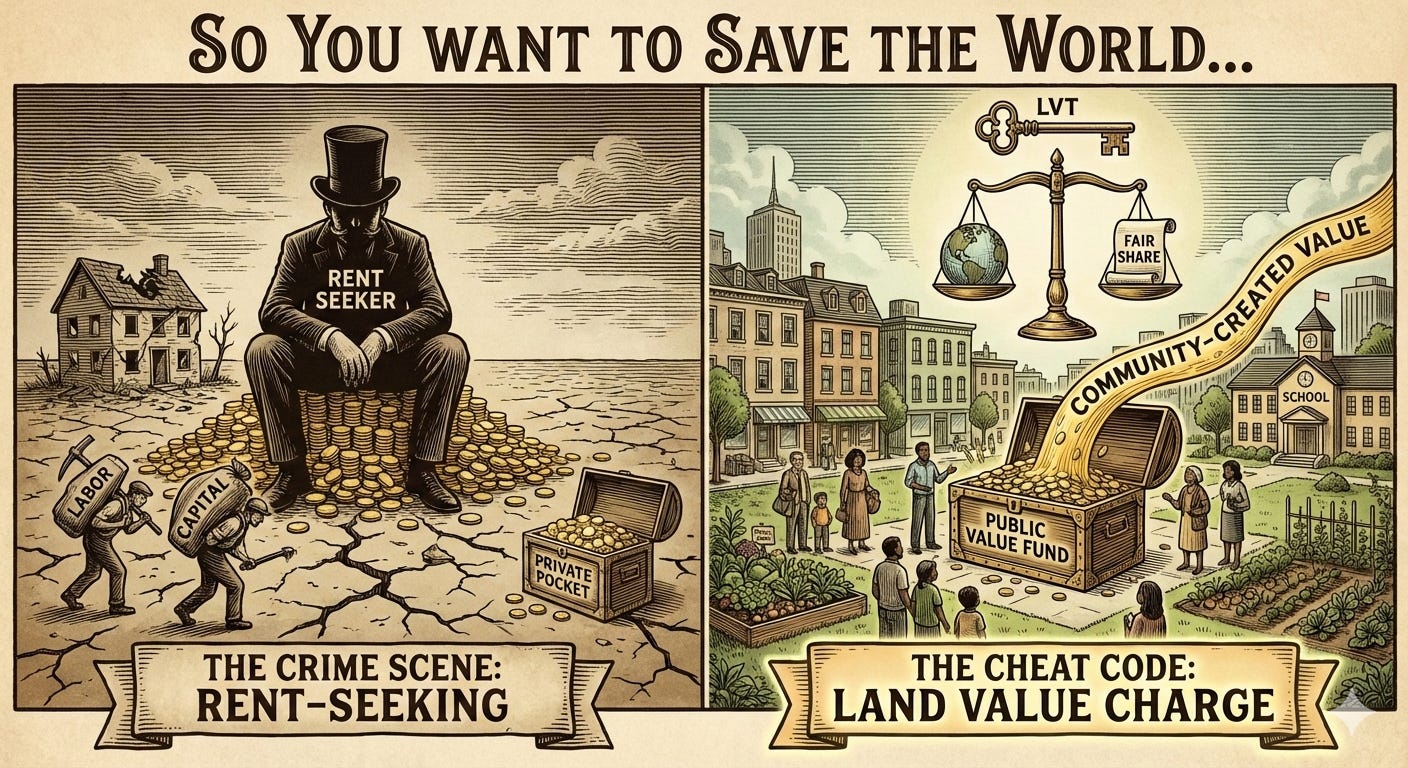
Introduction: The Secret Cheat Code to a Better Planet
Let’s be honest, trying to fix the world feels a bit like trying to put out a house fire with a water pistol. Everywhere you look, there’s a fresh disaster: grinding poverty, eye-watering inequality, an environmental crisis that makes sci-fi dystopias look optimistic, and conflicts that never seem to end. It’s enough to make you want to crawl back into bed and wait for the apocalypse.
But what if there was a cheat code? A single, elegant solution to our biggest problems that has been hiding in plain sight for over a century? It turns out that the root cause of our collective misery isn’t human nature, political ideology, or a lack of good intentions. It’s the way we handle the most basic resource of all: land.
This guide will reveal the shockingly simple fix for this fundamental flaw. Let’s explore how one small change can lead to a world with affordable homes, thriving natural habitats, an end to poverty, and a genuine shot at lasting peace. It’s time to stop treating the symptoms and finally cure the disease.
--------------------------------------------------------------------------------
1. The Crime Scene: How a Single, Ancient Scam Broke the World
Before we can apply the fix, we need to visit the scene of the crime. Think of this as a detective story, where the victim is society itself, and the culprit is a design flaw so ancient and pervasive we no longer even see it. Understanding this original scam is the first step to reversing the damage and building a world that actually works for everyone.
What is Rent-Seeking? The Art of Getting Rich by Doing Nothing
Imagine you and a friend decide to bake a cake. You buy the ingredients and do all the work, while your friend just happens to own the kitchen table. When the cake is finished, your friend demands half of it, not for helping, but simply for letting you use the table. That, in essence, is rent-seeking. It’s the art of extracting wealth, not creating it.
In economics, the income from labour is called wages, and the return on man-made tools is interest or profit. But there’s a third source of income: economic rent. This is the unearned income that flows to the owners of land and natural resources. Its value doesn’t come from anything the owner does, but from what the community does around it. When we build roads, schools, hospitals, and businesses, the value of the surrounding land skyrockets. That increased value is economic rent—wealth created by the public, but pocketed by private individuals.
As the great economist Adam Smith observed, landlords are a unique class. They “are the only one of the three orders whose revenue costs them neither labour nor care, but comes to them, as it were, of its own accord.”
The Original Sin: Privatising the Planet
For most of human history, the economic rent—the surplus generated by the community—was used to nourish its cultural and spiritual life. It was the common fund for the common welfare. The privatisation of land was, as author Fred Harrison puts it, a “coup against communities.” This was a grand heist on a civilisational scale. The community’s own surplus—the very fund that paid for its festivals, its temples, and its collective welfare—was siphoned away from the common good and into the pockets of a few. For the first time, a society created a permanent landless class, engineering poverty by design.
The consequences were catastrophic. This single act gave rise to what Harrison calls a “predator culture,” driven by an insatiable appetite for territorial expansion to capture more rent. This logic propelled the elites into endless wars, colonialism, and the wholesale destruction of other peoples to grab their land.
The Doom Loop: Why Progress Makes Poverty Worse
Here is the central paradox that has baffled economists and politicians for centuries, first identified by Henry George in his masterpiece, Progress and Poverty. As society advances and technology improves, why does poverty persist and even deepen?
The answer lies in land. As we become more productive, the extra wealth we create doesn’t flow to workers as higher wages or to businesses as higher profits. Instead, it is captured by landowners as higher rent. Every new road, every invention, every bit of progress makes the land more valuable, allowing its owners to demand a greater share of the economic pie. This is why we see the deepest poverty where wealth is greatest.
This dynamic creates a destructive economic cycle. Fred Harrison identified a recurring 18-year property cycle where land speculation creates a feedback loop of boom and bust. As an economy recovers, rising confidence and easy credit are channelled not into productive investment, but into a speculative frenzy for land. This inflates a bubble where land prices detach from reality, eventually making legitimate business and housing unaffordable. When the bubble inevitably bursts, the result is a devastating crash that closes factories, throws people out of work, and wipes out businesses. As history shows, speculative advances in land values invariably precede industrial depressions.
This is the crime scene. A system where progress itself fuels inequality and instability. But if we can identify the crime, we can also find the perfect remedy.
--------------------------------------------------------------------------------
2. The Silver Bullet: Pay for What You Take, Not What You Make
If the problem is that publicly-created land value is being privately captured, the solution is breathtakingly simple: capture it back for public benefit. This isn’t just another tax; it’s a revolutionary realignment of our economy with fairness, efficiency, and common sense. It’s called a Land Value Tax (LVT), or more accurately, a Land Value Charge, and it has the power to fix almost everything.
How It Works
The mechanism is straightforward. The community levies an annual charge on the owner of a piece of land based on its rental value. Crucially, this charge is based only on the value of the location itself, irrespective of the buildings, crops, or improvements on it.
A vacant plot in the city centre would face a high charge, encouraging its owner to develop it. A rundown building on that same plot would face the exact same charge as a gleaming skyscraper next door, rewarding improvement instead of penalising it. It fundamentally shifts the tax burden from productive activity to the passive holding of a valuable piece of the Earth.
Here’s how it compares to our current, deeply flawed system:
Our Current (Bad) Taxes
A Land Value Charge (The Good Stuff)
Tax your income and wages (a penalty on work).
Never tax wages or profits.
Tax your house and buildings (a penalty on improving things).
Never tax buildings or improvements.
Tax your purchases with VAT (makes life more expensive).
Stop taxing the things people need.
Tax business profits (a penalty on creating jobs).
Charge a fee for holding valuable locations.
Why It’s Fair and Efficient
This charge is arguably the most just and ethical way to fund a society. As Henry George wrote, it “is the taking by the community, for the use of the community, of that value which is the creation of the community.” It’s not a tax on wealth; it’s the collection of a debt owed to the public for the use of a shared asset. It simply returns to the community the value that the community itself created.
It is also stunningly efficient. The Nobel Prize-winning economist Joseph Stiglitz noted that “it is highly efficient to tax rents because such taxes don’t cause any distortions.” You can’t hide land in an offshore account. You can’t produce less of it if you tax it. It simply makes the economy work better by ensuring our most valuable resource is used productively, not hoarded for speculative gain.
The Great Tax Swap
Here’s the hidden genius of this plan. Where does the money come from to replace all the bad taxes we’re getting rid of? A principle called “All Taxes Come Out of Rent” (ATCOR) reveals that when you cut taxes on wages and business, that money doesn’t just vanish into thin air. It metamorphoses. It almost instantly reappears as higher demand for desirable locations, boosting land values. The tax base isn’t lost; it simply changes form, shifting to the very place you want to tax, making the swap seamless and self-reinforcing.
A single charge on land rent could replace the vast, complicated, and destructive tax code we suffer under today, liberating the economy and allowing genuine prosperity to flourish.
This one simple change doesn’t just fix the tax system; it reboots the entire operating system of society. Let’s look at what that new world would look like.
--------------------------------------------------------------------------------
3. The Utopia Blueprint: A Glimpse of a World Rebooted
Implementing a Land Value Charge isn’t a minor policy tweak; it’s a fundamental reboot of our society’s broken operating system. By changing the financial incentives that govern our world, we can unlock a cascade of positive outcomes that today seem like utopian fantasies. This section explores the tangible, world-changing results that this single reform promises.
Ending Poverty and Sky-High Inequality
Under the current system, material progress tends to push wages down to a bare living. With an LVT, that dynamic is reversed. As productive power increases, the benefit would flow to workers as higher real wages, because the speculative drain of rent would be gone. With the abolition of taxes on income and consumption, workers would keep what they earn, and the cost of living would plummet.
Homes for Everyone (Finally!)
An LVT makes holding land idle a costly mistake. Speculators who hoard vacant lots or keep prime city locations underused would face a hefty annual bill, forcing them to either develop the land to its best use or sell it to someone who will. Surveys of home builders have long revealed that a primary cause of housing shortages is an “acute shortage of reasonably-priced land,” even while vast tracts sit vacant. By ending the incentive for what one report called “holding it off the market for an expected future killing,” an LVT would unleash a flood of well-located land, dramatically increasing the supply of housing. The result? An end to urban sprawl and genuinely affordable homes for all.
A Healthier Planet
The principle is simple: “If the services provided by nature and society were correctly priced, we would not waste them.” An LVT makes this real. A pristine wetland, for instance, provides invaluable flood control “services” to a nearby town. Its rental value would be high due to this benefit, making it prohibitively expensive to pave it over for a low-value car park. Conversely, a polluted, derelict industrial site provides no services and would have a low rental value, but its charge would be high relative to its negative utility. This creates a powerful incentive for remediation and redevelopment. By aligning economic incentives with ecological health, LVT makes conservation profitable and pollution costly.
Brilliant Public Services, Paid for by Themselves
When the government builds a new train line, the value of the land around the stations soars. Currently, private landowners capture this windfall. With an LVT, that value increase is collected by the public. This creates a perfect self-funding mechanism for public infrastructure. The projects literally pay for themselves by capturing the value they create. This model has been used successfully in places like Hong Kong, where auctioned land leases funded public services, and Canberra, which used land value to finance its own development.
A More Peaceful World
The root cause of systemic violence, colonialism, and international conflict is the struggle to control territory and its unearned rent. The “predator culture” is built on an insatiable appetite for land. By removing the financial incentive to conquer and control land, we remove a primary driver of war.
Consider Costa Rica. It famously eliminated its army and redirected that spending towards social welfare. Supported by a tax system that discouraged large land holdings, it achieved remarkable outcomes. By 1992, its life expectancy was 76.0 years, far higher than the average of 64.8 years in the rest of Central America. Peace and justice are not utopian dreams; they are the logical outcome of a fair economic system.
These interconnected benefits—from affordable housing to global peace—all spring from a single principle: our common home should benefit all of its inhabitants.
--------------------------------------------------------------------------------
4. So, Why Haven’t We Done This Already?
At this point, a reasonable question arises: if this idea is so powerful, so logical, and so just, why isn’t it the bedrock of every economy on Earth? The answer, unfortunately, is a grim story of intellectual corruption, deliberate confusion, and the immense power of vested interests who benefit from the current broken system.
The Deliberate Confusion of Economics
As researcher Mason Gaffney documented in The Corruption of Economics, the entire field of modern economics was reshaped in the late 19th century for one primary purpose: to counter the explosive popularity of Henry George and his ideas. George’s book Progress and Poverty was a global bestseller, second only to the Bible. The landed elites and monopolists it threatened were terrified.
In response, a new school of “neoclassical” economics was funded and promoted. Its architects’ goal, as one proponent, Simon Patten, bluntly stated, was that “economic doctrine must be recast” to frustrate and confuse the “single taxers.” The key intellectual sleight of hand was to deliberately lump land (a gift of nature, fixed in supply) in with capital (man-made tools), treating them as interchangeable factors of production. This semantic trick erased the unique, unearned nature of land rent from mainstream economic discourse, rendering George’s argument unintelligible within the new framework for over a century.
The Hall of Fame: You’re in Good Company
Despite the organised opposition, this powerful idea has been championed by some of history’s greatest thinkers and leaders. Far from being a fringe theory, it has a distinguished pedigree.
Political Leaders: Sun Yat-Sen, the founder of modern China; David Lloyd George, UK Prime Minister who fought a constitutional crisis over it; and Joshua Nkomo, the Zimbabwean anti-colonial leader.
Economists & Thinkers: Henry George himself; Nobel laureate Joseph Stiglitz; and even Adam Smith, who first identified the unique nature of land rent.
Institutions & Communities: The work is carried on by organisations like the Henry George Foundation. More importantly, entire communities were founded on these principles, such as Canberra, Australia’s capital, and Arden, Delaware, providing tangible proof of implementation.
The idea has been suppressed not because it is flawed, but because it is powerful. It challenges the most deeply entrenched economic interests on the planet. But its logic is undeniable, its historical backing is strong, and in a world facing overlapping crises, its relevance has never been greater.
--------------------------------------------------------------------------------
Conclusion: Your Mission, Should You Choose to Accept It
The argument can be distilled into one clear, powerful truth: the Earth was not made by any one of us, so it belongs to all of us. The value that we create together as a community—the soaring worth of land in our towns and cities—should be shared by all to fund the society we want to live in.
The central principle is a simple exchange of rights and responsibilities: we need to “re-socialise the publicly-created value, and re-privatise the personally-created value.” Take for public use what the public creates (land rent), and leave to the individual what the individual creates (wages and profits).
Your mission, should you choose to accept it, begins with a single, powerful question you must weaponise in every conversation: Why do we punish work and reward monopoly? Spreading this question isn’t just a first step; it is an act of intellectual rebellion against a century of deliberate confusion. The answer is the key. The answer saves the world.


Comments
Post a Comment