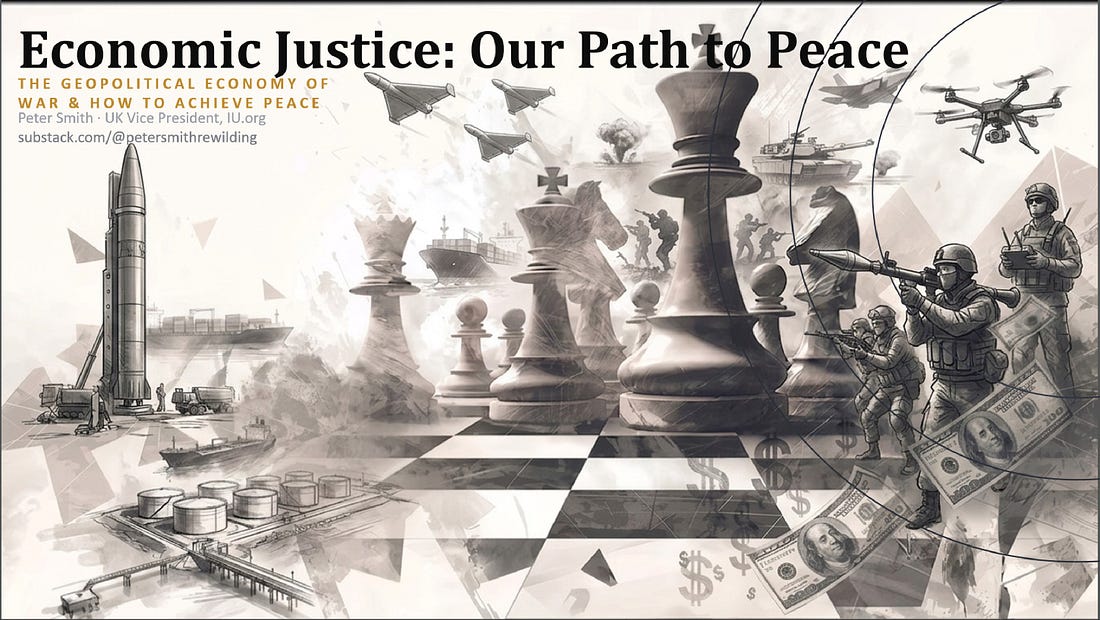
Economic Justice: Our Path to Peace

Economic Justice: Our Path to PeaceI’m giving a free online lecture on Henry George on 2 December. Here’s why I think an understanding of George is a prerequisite for anyone who wants peace.
Spend ten minutes with the news. Wars. Economy failing. Nature dying. Endless talk about AI making a handful of people astonishingly rich. They look like separate stories, but I don’t think they are.
Register hereI’ve spent decades building charities and turning around struggling ones. I’ve sat in boardrooms and got my hands very dirty pioneering rewilding. No matter what I do, I see everything humanity does that is good stifled by economic injustice, high taxes and higher costs, and everything that hurts humanity given a free ride with lower taxes and lower costs. We let a few people privatise what nature and the community create, then we act surprised when we can never solve any of the world’s problems and everything seems to be getting worse. Henry George saw this in the nineteenth century. He asked why progress produces poverty alongside plenty. His answer was simple. The rent from monopoly and natural wealth belongs to all of us, and when it’s captured privately, the rest of the economy suffers. That’s the core of the lecture. It’s titled “Economic Justice Comes Before Peace.” What I’ll coverPoverty. How do we get prosperity without poverty? George had a direct answer, and it still as true as it ever was. War. If elites profit from rent and conquest, they have every reason to push for conflict. Remove that incentive and peace gets a lot more likely. That’s why I say justice comes first. I set out the case flashpoint by flashpoint below. Technology. AI will create enormous economic rents. Who gets them? A few shareholders, or all of us? Nature. This is where I think George is most underrated. Biodiversity loss and climate change are failures of pricing. We let people dump costs on the commons for free. But there’s a bigger point. When land carries a cost to hold, nobody can sit on it idle. It goes to its best use. Land gets used efficiently, so the pressure comes off the wider countryside. Nature gets room to rewild and recreate itself. The same logic works for oil and other natural resources. When the public collects the rent on them, waste stops. We build more efficient communities. People enjoy high living standards and use less energy. There’s less pollution and less carbon. Add a tax on negative externalities, what I call the Pigouvian prerogative, and the incentives finally point the right way. Current policy is a mirage in renewable energy, which is not reducing use, just giving false hope our politicians and NGO leaders can hide behind. I’ll also make a case I think both the left and the right have missed. Free-market incentives can do good as easily as harm. We’ve just never removed the monopoly and externality that is the root of that harm. How civilisations rise and fallMy thesis is simple. Civilisations rise by socialising economic rent. They fall by privatising it. I’ll walk through the Japanese Empire, the British Empire, Athens and Sparta, and Rome. The pattern repeats. A society shares its rent, and it grows strong. Then the rent drifts into private hands, the gap widens, and wars, economic and environmental decline follow. Then I’ll turn to America. I’ll argue that Pax Americana has reached maximum rent privatisation. That’s the sign of decline. It also helps explain the rise of China and the shift towards a multipolar world. Why the wars are foughtEvery conflict in the news looks different on the surface. Different flags, different histories, different speeches. Underneath, I see the same mechanism. Someone wants the rent. By rent I mean wealth that comes from controlling something nobody made. Land. Oil. Gas. Minerals. A strait that carries a fifth of the world’s oil. Mason Gaffney warned in 1988 that economists were studying rent-seeking in regulation and ignoring its “grosser sense”. That means seizing rent-bearing assets by force, then policing them afterwards. Nations rarely fight wars. The people who run them do. And once the rent is privatised, war stops being a cost and becomes an investment. The public pays for the troops and the ships. Shareholders, contractors and oligarchs collect the return. Hermann Göring understood the mechanism. He told a psychologist at Nuremberg that leaders set the policy and the people can always be dragged along. The data points the same way. The conflict datasets I use in the lecture show wars becoming more likely when elites can push the cost onto the public, move their money offshore, and lean on foreign aid or arms to stay in power. Military interventions cluster around economic shocks and maritime chokepoints. The Current War ListIran. Outsiders have fought over Iran’s oil for generations. In 1951 Mohammad Mossadegh nationalised the Anglo-Iranian Oil Company. In 1953 MI6 and the CIA overthrew him and installed the Shah, who ruled behind a brutal secret police. That’s Gaffney’s policing of the land, almost word for word. The 1979 revolution took the title back. Sanctions and war have tried to take it away again. Look at what’s on the table now. Reuters reported a draft plan covering the US blockade of Iranian ports, the reopening of the Strait of Hormuz, a waiver on Iranian oil sales and the cancellation of new sanctions. That’s a negotiation about who collects the rent. China buys most of Iran’s oil, so a war that chokes the flow also squeezes a rival. I don’t think this was ever only about centrifuges. Gaza and Lebanon. Here territory is held because holding it confers control. Gaza Marine, the offshore gas field, was blocked from development for two decades and is now being licensed in pieces to international firms. In Israel, an average couple needs about 13 years of income to buy a flat. A young couple locked out of Tel Aviv can afford a subsidised home in the West Bank, on land seized from someone else and defended by the state. In Lebanon, Israeli leaders have called for a permanent buffer zone, and troops have pushed north past the Litani to hold ground. The public language is security and sovereignty. Underneath sit land, gas and water. Ukraine and Russia. Most of Ukraine’s mineral wealth and industrial coal lies in the territory Russia has seized. So does much of the world’s richest belt of chernozem, the black earth. Kyiv’s minerals deal with Washington in April 2025 gave the US preferential access to subsoil rent by treaty. Russia took its share by force. Both sides talk about principle. Both are fighting over who holds title to what lies underground. Russia itself is the biggest prize. It’s the world’s largest un-enclosed commons: Urals minerals, Taiga timber, Arctic gas. My reading is that western elites have driven this conflict, not just to win but by a war of attrition there hope is it will fragment the country, a 1990s-style shock could move its resource titles into Western-aligned hands, and the West could then turn on China. Africa. Patrice Lumumba became Congo’s first prime minister in June 1960. He wanted to nationalise the mines and spend the revenue on the whole country. Katanga seceded within weeks, backed by Union Minière, the company collecting the rent on some of the richest ore on earth. Mobutu took power with CIA and Belgian encouragement, as the 1975 Church Committee confirmed. Lumumba was murdered in January 1961. Now the counter-evidence. Botswana and Namibia kept a large share of their diamond rent through joint ventures with De Beers. Pre-2011 Libya used oil rent to fund free healthcare and education. Then the state that enforced the split was removed, and within years Libya had open-air slave auctions. The difference was never the resources. It was whether the state held on to the rent. Burkina Faso is the live test. The 2024 mining code raised the state’s free stake in mines from 10% to 15% and gave it an option to buy more. Ouagadougou has now told West African Resources it wants to lift its stake in the Kiaka gold mine from 15% to 40%. Captain Ibrahim Traoré is doing in gold what Lumumba tried in copper. He has survived several coup attempts. Nobody who knows what happened in Katanga would call that paranoid. Venezuela. After the January operation that captured Maduro, Trump said the money from seized crude would be controlled by him. The US took control of up to 50 million barrels, and Vitol and Trafigura began marketing it. The first sale was worth $500 million. The Financial Times reported that a senior Vitol trader gave $6 million to Trump’s re-election campaign and met the president before Vitol secured its first deal. Both trading houses have been implicated in bribery cases elsewhere. There’s a hegemonic motive too. BRICS+ economies produce roughly a third of the world’s oil and are exploring alternatives to the dollar. I see two motives running together. Strategy provides the patriotic cover. Personal enrichment gets people out of bed. Greenland. As the ice melts, a frozen wasteland becomes a rent-bearing asset. Greenland holds some of the world’s largest deposits of neodymium, praseodymium and uranium, and China dominates the supply chain. When Trump floated buying it in 2019, the press laughed. I read it as a rent-seeker spotting an undervalued asset ahead of its future price. Nobody has fired a shot yet. Capital flows, exploration rights and pressure on the home-rule government do the work. Rent creates the incentive before the shooting starts. The West at home. While the Soviet Union existed, Western elites had to keep wages up and services running, because a rival model was watching. When it fell, the discipline went with it. Michael Hudson argues that money is now made financially, not by building things. Mariana Mazzucato says rents got confused with profits, so we reward extraction instead of production. The result is a set of conditions that precede conflict everywhere: a fracturing world order, stagnant wages, elite wealth detached from ordinary welfare, politicians answering to donors, ethnic tension without shared prosperity, and rivals exploiting the cracks. The West now shows all six. The FixGeorge’s prescription hasn’t changed since 1879. Government revenue should come from the location value of land and natural resources, not labour or enterprise; today we must encompass all monopolies and can do that, not just land. Nobody can pass the tax on, because the supply is fixed. Speculation stops paying. Productivity increases. If the public captures the rent, there’s no fortune to be made from seizing an oil field, a strait or a mineral province. Nobody needs persuading to behave better. You take away the thing they’re fighting over. No tax erases historical grievance, ethnic kinship or a real sense of insecurity. Moscow’s claims and Kyiv’s don’t dissolve. Neither do Israel’s on Palestine’s. What the fix removes is the economic accelerant that turns a grievance into a war, and a war into an occupation. What really changes, as Fred Harrison tells us in his latest Book, Cheating. We need to create a culture that abhors cheating in all its forms; we must make cheating morally repugnant, and that any profit from monopoly or externalities must be criticised, and people call out for society to sanction it by removing the profit from anyone so vile as to try to take it, for we know what the consequences are: poverty, environmental calamity and war! The eventThis is a Valediction RoundTable, hosted by TrineDay. The series grew out of Paul Fitzgerald and Elizabeth Gould’s Valediction memoirs. It explores JFK’s vision for peace and Henry George’s Economics of Peace. This is RoundTable 57.
Kris Millegan of TrineDay hosts, and Adam Finnegan moderates. Paul Fitzgerald and Elizabeth Gould will be there. So will Alanna Hartzok, the Earth Rights expert and author of The Earth Belongs to Everyone. Invite your friends and earn rewardsIf you enjoy Peter Smith Rewilding, share it with your friends and earn rewards when they subscribe.
|






Comments
Post a Comment