Ricardo's Law: The Book That Explains Why Britain Keeps Failing

Ricardo's Law: The Book That Explains Why Britain Keeps FailingA tax scam so large it's invisible: how public spending gets privatised into private land values.
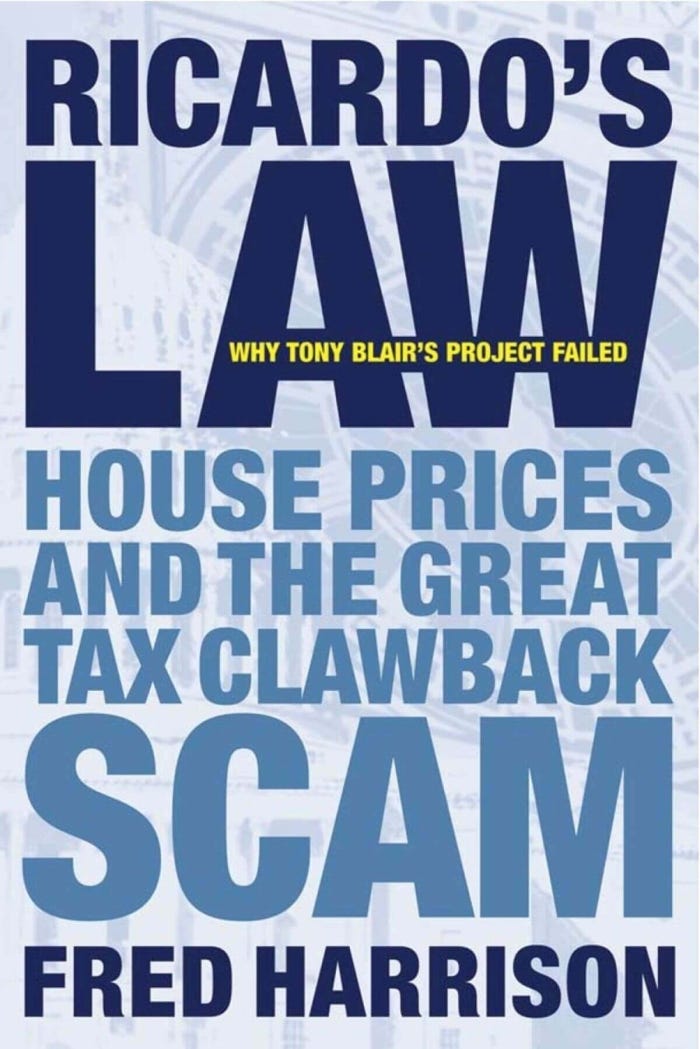
I sat down with Fred Harrison last night for our regular conversation, and I asked him a simple question. Of all his books, which one should our audience actually go and read? He didn’t hesitate. He named Ricardo’s Law: House Prices and the Great Tax Clawback Scam, first published in 2006. He called it a manual for politicians. Twenty years on, that manual is still sitting unread on the shelf, and Britain is paying for it. Make sure you subscribe to Gred’s YouTube channel https://www.youtube.com/@geophilos Andy Burnham has become Prime Minister, taking over from Keir Starmer without a general election. Burnham understands the basics of the law of rent but will not use that knowledge to transform Britain. Harrison argues that Burnham talks about fairness and regional inequality without fully understanding the mechanism that produces both. He is about to find out whether that’s true from the inside. This essay sets out to explain David Ricardo’s law of rent properly, walk through what Harrison built on top of it, and show why it still explains modern Britain better than anything coming out of the Treasury. Who Was David Ricardo, and What Did He Actually Say?Ricardo was born in London in 1772 into a Jewish stockbroking family. He made his fortune young, retired from the markets in 1814, and then did something unusual for a wealthy man: he turned his mind seriously to economics. His Principles of Political Economy and Taxation appeared in 1817. He sat in Parliament from 1819 until his death in 1823. Most people who have heard of Ricardo know him for comparative advantage, the trade theory taught in every first-year economics course. Harrison thinks this is almost a distraction. I told him I have spoken to Oxford-trained economists who, the moment you mention Ricardo, start talking about one country making cloth and another making wine. They have never engaged with the part of Ricardo’s work that actually explains the distribution of income within a country. That is the law of rent, and it is far more consequential. Here is the theory, stripped down. Economic rent is not what a tenant pays a landlord each month. It is the surplus that is left over once you have paid the wages of labour and the return on capital. It is the difference between what a piece of land can produce and what the least productive land still in use can produce. Ricardo noticed that as an economy develops, people and capital gravitate to the most productive locations: the most fertile soil, the best trading position, the most connected city. Production spreads outward from that centre until it reaches a margin, a point where the land yields just enough to cover wages and the cost of capital, with nothing left over. Beyond that margin, cultivation or enterprise doesn’t pay. Everything between the centre and the margin generates a surplus, and that surplus is rent. It rises wherever people cluster, wherever there is inventiveness, capital and infrastructure. It falls to zero at the edge. The pattern is not random. It is a law, in the sense that gravity is a law: given the starting conditions, it will always reassert itself.
Harrison writes about why this surplus matters so much to human civilisation itself, not just to economists. It is what allows some of us to stop growing food and start doing everything else: art, science, government, invention. As he puts it, “rent is the price we pay to participate as paid-up members of civilisation.” That’s a lovely way of putting something that is usually rendered in dry graphs. The question Ricardo leaves us with is not whether rent will be produced. Under any half-functioning market economy, it will be. The question is who gets to keep it. Harrison’s Move: Turning a Theory into a Map of BritainThis is where Harrison’s book earns its subtitle. He takes Ricardo’s abstract model and lays it directly over the map of England. He draws a line from the City of London, where Ricardo himself used to trade in the coffee houses, up through the country to the North East. Along that line he plots land prices per hectare, and the graph falls exactly the way Ricardo’s theory predicts: highest in London and the South East, lowest by the time you reach the North East. He runs the same test using the Domesday Book and finds the same pattern in the eleventh century. Ricardo’s Law, in other words, isn’t a quirk of modern finance. It has been operating in Britain for a thousand years. None of that would matter much if the rent produced at the centre stayed with the people who helped generate it, wherever they happened to live and whatever they contributed by way of labour, savings and custom. Harrison’s central complaint is that it doesn’t. The people in the hinterland, buying goods that pass through the centre, saving in banks headquartered there, supplying labour and demand to the whole system, have a legitimate claim on a share of that surplus. Instead, the state allows it to be privatised, overwhelmingly by whoever happens to own land in the productive locations. The Tax Clawback Scam
The opening chapters of the book set out what Harrison calls the tax clawback scam, and it’s the part I’d urge every reader to think at length on the consequences; the numbers are startling. He calculates that when you add direct taxes (income tax, National Insurance) to indirect taxes (VAT and duties), the poorest fifth of households in Britain hand over close to 38 per cent of their gross income to the state, while the richest fifth hand over just over 35 per cent. That alone should trouble anyone who has been told the British tax system is progressive. But the real trick, according to Harrison, is what happens next. Government spends that tax revenue on infrastructure, on schools, hospitals, transport links. That spending raises the value of the land nearby. A new underground line, a new hospital, a good school catchment: all of it gets capitalised into higher property prices for whoever owns land in the vicinity. Harrison walks through the arithmetic for an ordinary higher-earning homeowner on £50,000 a year with a London house worth roughly a quarter of a million pounds. In a single year, the capital gain on that house, at a conservative growth rate, comfortably exceeds the entire income tax and National Insurance bill for the year. The homeowner has, in effect, lived tax-free, funded by everyone else’s contributions to the roads, schools and hospitals that made the house valuable in the first place. Harrison mentions the property investor Don Riley, who wrote candidly about exactly this happening to him: the rise in his London property values after the Jubilee Line extension was built more than repaid every pound of tax he had ever handed over. Riley, to his credit, said so openly. Most beneficiaries of the scam never work out that this is what happened to them. This is why Harrison rejects the standard left-versus-right framing of inequality. It isn’t fundamentally a story about greedy capitalists exploiting workers, and it isn’t solved by taxing wages and profits more heavily, because that only punishes the people who are actually producing value. It’s a story about a tax-and-tenure system that allows publicly created value to be captured privately, by whoever holds the deeds to the right postcode. The Economics of Life and DeathThe chapter that stayed with me longest is called “The Economics of Life and Death.” Harrison takes Ricardo’s declining rent gradient, from London down to the North East, and lays public health statistics over the same map. Male mortality rates. Cancer registrations. The pattern holds with unsettling consistency: the further a region sits from the economic centre, the worse its health outcomes, all cause for cause equal. He cites research showing that men who move from the South of England to the rest of Britain see their risk of coronary heart disease rise, and men who move the other way see it fall, which rules out a genetic explanation and points squarely at where you live and what that location does to your income, your housing and your prospects. In our conversation, Harrison made the same point in plainer language: people born and raised in Blackpool live around ten years fewer than people born and raised in London, for no reason connected to anything they did. That is not a rounding error. That is a life-and-death consequence of a tax system that lets rent accumulate in some postcodes and starves others. The Boom-Bust MachineHarrison’s other major preoccupation, which runs through the whole book and the rest of his work, is the property cycle. He shows that between 1979 and 2005, the price of new houses in Britain rose by around 700 per cent, while the price of the land underneath them rose by around 1,700 per cent. That gap is the tell. Bricks and labour are commodities; you can produce more of them. Land in a fixed, desirable location cannot be produced at all, so all the speculative energy in a boom pours into land values rather than into actual construction.
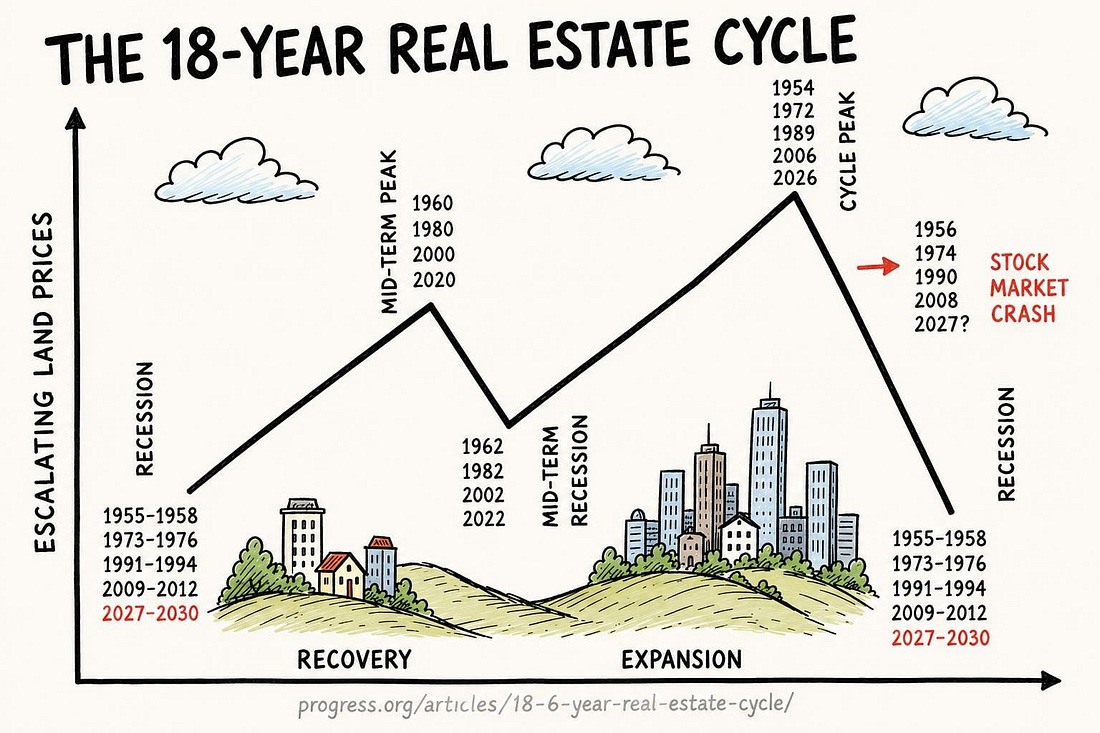
Because governments don’t tax that land value away as it’s created, it gets capitalised into ever-rising prices, encourages ever-riskier borrowing against it, and eventually collapses under its own weight. Harrison’s account of Japan’s bubble economy is a warning shot. At the height of the 1980s boom, when land prices seemed only able to rise, a Nikkei survey found that “a full three-quarters of the population considered themselves middle-class.” After the crash, that figure collapsed, replaced by a society fractured by debt, downward mobility and a decade of stagnation. He estimates the cumulative GDP lost to Australia’s four real-estate-driven downturns between 1976 and 2006 at hundreds of billions of dollars, income that simply vanished because the tax system rewarded speculation in land rather than penalising it. This is the territory where my own work on the eighteen-year property cycle sits. Reading Harrison’s chapters again reminded me why I follow mortgage-approval data so closely. Land price bubbles aren’t a mysterious feature of animal spirits. They’re the predictable output of a fiscal system that leaves the most valuable asset in the economy almost untaxed while it inflates, then leaves the public to absorb the losses when it deflates. The mathematics behind this are similar to the predator-prey population models I studied as a young man. That’s perhaps why Fred’s way of understanding economics drew me in. Why Politicians of Every Stripe Keep FailingHarrison’s four indictments, laid out at the start of the book, amount to a claim that both main parties have consistently misdiagnosed Britain’s problems because neither has been willing to touch the land question. He is scathing, in our conversation, about enterprise zones: government designates an area for regeneration, land values in that zone shoot up, and the enterprises that move in often turn out to be little more than warehouses collecting subsidy, doing nothing for local employment. He is equally scathing about calls to “tax wealth” in the abstract, which he sees as a category error that ends up punishing productive entrepreneurs alongside passive landowners, when only the latter are actually living off an unearned surplus. And he draws a straight line from this failure to the populist backlash reshaping politics on both sides of the Atlantic. People in Blackpool, in the North East, in the former industrial towns of the Midlands, correctly sense that something has been taken from them. They just don’t have, in his words from our conversation, the language to describe the mechanism. Into that vacuum step politicians who promise simple, dramatic fixes. Harrison’s example was Nigel Farage’s pledge to overhaul the system within a hundred days of taking office, a promise Harrison thinks is certain to fail for the same structural reasons every government since the war has failed. He draws the same line to Germany’s AfD, drawing its strength from the formerly East German regions that lost out under reunification, and to Donald Trump’s coalition in America’s deindustrialised heartlands. Andy BurnhamAndy Burnham has become Prime Minister, taking over from Keir Starmer partway through this Parliament, without a fresh mandate from the country. He arrives in Downing Street having spent years as Mayor of Greater Manchester complaining, correctly, that land in Britain is undertaxed, and floating a land value tax as part of the answer to regional inequality. Harrison’s charge, made before Burnham reached Number 10, was that this interest had never translated into an actual policy commitment, and that Burnham’s preferred comparison, Germany’s regional redistribution model, has itself produced the disaffected eastern regions where the far right is now strongest. Meanwhile the government Burnham inherited has already reached for the tools Harrison would recognise instantly: a new mansion tax on homes worth over £2 million, announced in the November 2025 Budget, alongside a live debate among economists and MPs about reforming council tax bands that are still, absurdly, based on 1991 valuations. Proposals for a proper land value tax are further along in serious policy circles than they have been in decades. All of this is a tacit admission that the current system is unfair and unproductive. None of it yet does what Harrison actually prescribes: replacing taxes on wages, enterprise and transactions with a tax on the rental value of land itself and all forms of economic rent, not just land, so that the surplus we generate is recycled to everyone who helped create it, rather than pocketed tax-free by whoever happens to collect the rents. Harrison’s Actual PrescriptionThis is not a punitive tax on ordinary homeowners. Harrison’s proposal, developed at length in the book’s final chapters under headings like “The Economics of Equality” and “The New Mercantilism,” is to shift taxation off wages, profits and enterprise entirely and on to economic rent. Land cannot be hidden in a tax haven, moved offshore, or produced in greater quantity to dodge the charge, which is precisely why Harrison sees it as the one tax base a government can always rely on. Because the charge falls on unimproved land value rather than on buildings or improvements, it does not penalise anyone for building, renovating or investing. And because it removes the incentive to sit on land waiting for its value to rise, Harrison argues it would smooth out the boom-bust property cycle rather than fuel it, converting what he calls “rent” from a corrosive private windfall into the fair, shared foundation of public revenue. He is honest that this collides with the deepest instinct of the modern British homeowner: the assumption that untaxed capital gains on a house are a reasonable, even earned, form of retirement saving. Reframing that gain as an unearned transfer from renters and taxpayers to owners is, as he told me, a painful conversation, one politicians of every party have so far ducked. Why It’s Worth ReadingHarrison’s case is not an abstract exercise in intellectual history. It’s an argument that the single biggest lever available to any British government, the one that would do more than any spending pledge to close the gap between London and the rest of the country, is sitting untouched because neither the political class nor the economics profession that advises it has understood, or cared to understand, the law that Ricardo set out two centuries ago. Whether Andy Burnham, now sitting where the decisions actually get made, finally reaches for that lever remains to be seen. Harrison isn’t optimistic that any individual politician will do it voluntarily. His actual argument, in our conversation, was that the pressure has to come from ordinary people who finally have the language to name the mechanism that’s been working against them all along. That’s the case for reading the book yourself, rather than waiting for Westminster to explain it to you. Get your copy here: https://shepheardwalwyn.com/product/ricardos-law/
|







Comments
Post a Comment