Fred Harrison, The Fight for the Rents of Russia

Fred Harrison, The Fight for the Rents of RussiaThe 1993 Lecture That Could Have Saved Russia, and Predicted the Crashes of 2008 and 2026
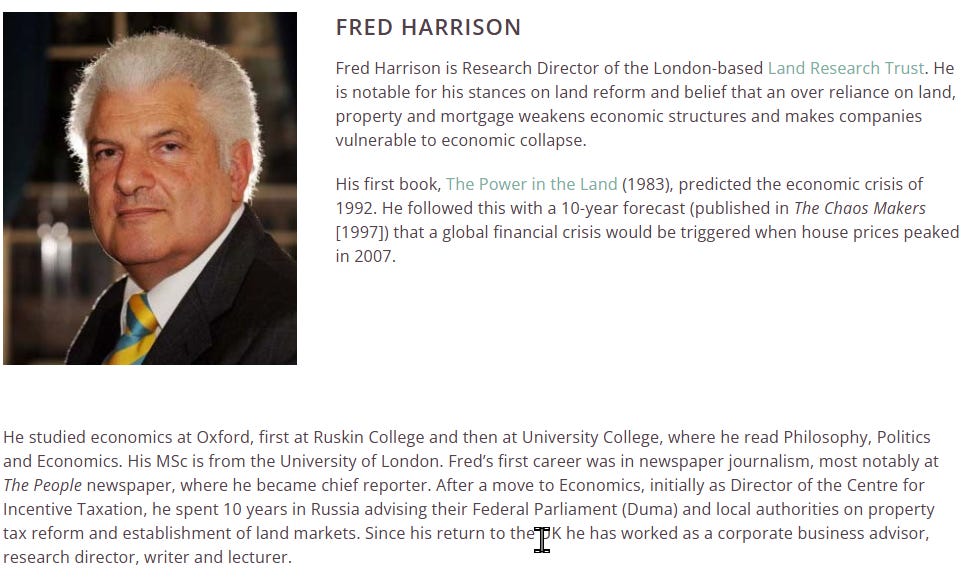
In the spring of 1993, Fred Harrison landed at Heathrow, went straight home, unpacked his suitcase, and turned up the next morning at the School of Economic Science to give a lecture. That lecture was dynamite; not only did Harrison predict the global credit crisis of 2008, 5 years before it happened, but he also predicted the global recession we are facing today in 2026. Secret Soviet economic work had confirmed his own research on the 18-year property cycle and the supercycles it spawned. The chairman introducing him joked that he’d expected a venerable grey-bearded sage and got, instead, a workaholic young investigative journalist. He called him a stakhanovite, understanding the history of Soviet propaganda, and an accurate description of Harrison even to this day. The talk Harrison gave that morning has mostly been forgotten. It shouldn’t have been. Russian economists had already confirmed the pattern behind his own research, and the lecture stands as one of the clearest first-hand accounts we have of a moment when Russia had a real choice in front of it, a choice that had nothing to do with communism versus capitalism, and everything to do with who was allowed to pocket the rent of the richest land and resources on Earth. Harrison thought he knew the answer. He was largely ignored. What happened instead is now a matter of public record, and it is not a happy one. It laid the foundations for Putinism and for the conflict that has since consumed well over a million lives, and that could yet end in a catastrophic war between Europe and Russia. 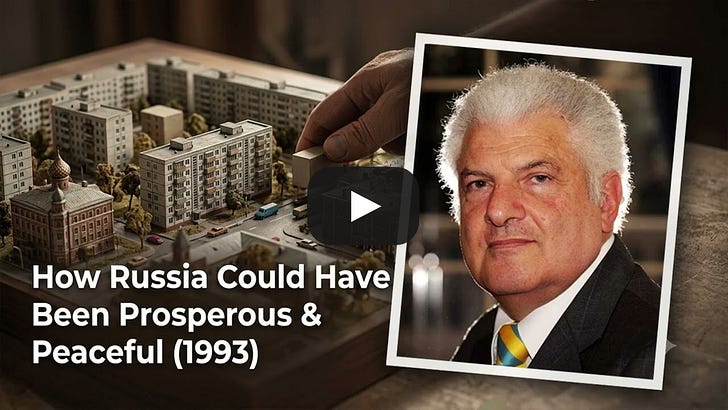
A nation cast adriftHarrison opened with facts and data. He had commissioned surveys of ordinary Russians in the months after the Soviet collapse, and the results were startling. More than half of those asked couldn’t say what kind of political system they were actually living under. Only a tenth ventured “capitalism.” A near-equal number said “feudalism.” Asked who was really running the country, the largest single group, almost a quarter, answered: the mafia. A third denounced anyone who had made money as a swindler, and a meaningful slice wanted millionaires jailed outright. This wasn’t Harrison being sniffy about the natives. He was making a specific, structural point: Western advisers were arriving with tidy models built for societies that already knew what property, price and the rule of law meant, and applying them to a country that had none of that scaffolding. You cannot administer shock therapy to a patient whose nervous system hasn’t been wired up yet. And yet he’d also seen the future for the people, in the most unlikely place. He asked to meet a kiosk owner in St Petersburg and was introduced to a woman running two of them, having given up her day job once she worked out the kiosks paid better. Her husband stayed on at the state enterprise for his safe salary and looked on, faintly bewildered, as his wife brought home more in a month than he earned in a year. She had, without anyone teaching her, worked out fair pricing, customer service, and how to handle a jealous rival at the next kiosk along. These things echo through history at the same time Putin was driving a cab, and Prigozhin was selling hot dogs. I wonder how that woman is doing today. Harrison treated her as more significant than any minister he’d met. She was, in his phrase, the first evidence that people were learning to change their minds, literally, out of necessity rather than ideology. Why the Russians play such good chessThe most unexpected passage in the whole talk is a digression on chess. Harrison noted, correctly, that Russians had dominated the world championship for decades, and wondered aloud whether this told you something about the Russian cast of mind: a genius for abstract systems that bore no fixed relationship to the ground beneath them. Under the Soviet system, he argued, land and rent had almost ceased to exist as economic categories. The nineteenth-century Russian intelligentsia, drawing an income from estates they never had to manage, developed exactly this trait: brilliant, literary, detached from land and from the peasants they wrote so movingly about. Alexander Herzen looked at the peasant commune, saw land held in common, and convinced himself it held the seed of Russia’s salvation. He was groping towards something real, Harrison argued, but he never worked out the practical mechanism that would let a modern economy keep that communal benefit while still allowing individuals to possess and improve their own plot. That unfinished argument, Harrison suggested, is one of the buried roots of the pull towards Marxism, a philosophy that promised to resolve a conflict over land and rent that Russian thinkers had correctly diagnosed but never correctly cured. Two-thirds capitalism, none of the theftHarrison’s proposal, delivered to officials in St Petersburg and to the senior advisers around Ruslan Khasbulatov, chairman of the Supreme Soviet, was disarmingly simple to state and radical in its implications: privatise the possession of land, but socialise the rent of it. Let people own their flats, their kiosks, their factories outright. Let them borrow against their own productivity rather than mortgaging a plot of dirt. But collect, as public revenue, the annual rental value of the land itself, revalued regularly, and use it to fund the state instead of taxing labour and capital. Do that, Harrison argued, and you dissolve the very conflict that Marx built his philosophy around. Workers keep the full product of their labour. Entrepreneurs keep their profit. Nobody gets rich merely by sitting on a piece of St Petersburg that happens to be near a metro station, because the rent of that location is paid to the community that created its value in the first place, not pocketed by whoever grabbed the deed first. He told his audience the plan was already reaching influential ears. A first pamphlet on socialising the rent of land had been ordered read by every deputy in the Supreme Soviet, on Khasbulatov’s own instruction, and Sir Kenneth Jupp, a retired High Court judge, was helping Harrison draft an actual property law for the Russian parliament to adopt. Note what he wasn’t proposing. He wasn’t proposing the state keep owning everything, and he wasn’t proposing an immediate fire sale of urban land either. He specifically welcomed the fact that Moscow and St Petersburg were choosing to lease land rather than sell it outright, even at rents he considered absurdly low, because leasehold at least kept the door open to capturing rising land values later. Sell the freehold cheaply now, he warned, and you hand away in perpetuity an income stream that would be worth vastly more collected patiently over decades. That is precisely what ended up happening, on a scale nobody in the room that morning could have imagined. Kondratiev’s chart - Prediction of the global credit crisis of 2008Harrison also brought a chart. A Russian economist working in the 1930s, almost certainly Nikolai Kondratiev, the Soviet economist whose name has become shorthand for long-wave theory, had tracked a recurring fifty-four year cycle in land and business activity: three turns of the same eighteen-year rhythm Harrison had spent his career mapping in Britain and America. Kondratiev’s chart, as Harrison presented it, ran through four such cycles. The first two were, in his words, peculiarly British. The third was anchored in the United States. The fourth he called a bourgeois economic cycle, and it was this fourth cycle, he told the room, that was ending right as he spoke. From those four turns of the 18-year cycleHarrioson extrapolated a fifth. Unlike its predecessors, the coming cycle would not be British or American in its centre of gravity. It would be the first genuinely global cycle, because for the first time the entire world economy was bottoming out together, and Russia, having only just stepped off the command economy, found itself standing at exactly the same starting line as the West. The single exception he named was China, which he placed midway through its own cycle, with perhaps four years still to run before it too reset to that shared starting point. A nation entering a global cycle at its very beginning, he argued, has a clear run ahead of it; a nation entering near the end barely will have no help from the West. His point was not academic. If Russia got its tax structure right at the very moment the rest of the world was resetting to zero, it wouldn’t need better products than the West, only cheaper ones, unburdened by tax on labour and capital. Within a few years, he told the room, Russia could be exporting manufactured goods that undercut Europe and America on price alone, because its factories wouldn’t be dragging along the dead weight of income tax and VAT that Western producers had to carry, and its workers would not be taxed or have excessive house prices to pay. An honestly-taxed, land-rich, scientifically educated nation of that size, arriving debt-free at the start of a fifty-four-year cycle, was not a beggar asking for Western charity. It would be a sleeping giant. The poisoned chaliceHarrison was scathing, in his understated way, about what was being pushed on Yeltsin instead. He named Jeffrey Sachs, the Harvard economist, as the source of the theoretical models Yeltsin was chanting as slogans, models built for economies that already had functioning markets and were, on Harrison’s account, failing even there. The people who actually had to run Russian state enterprises, the deputies who had to keep food moving to their own workers, knew the programme couldn’t be implemented at the speed Washington wanted without riots in the street. Yeltsin, a capable manager but a product of the planned economy himself, could not independently see that the advice reaching him through the IMF and the Washington consensus was, in Harrison’s words, going to commit economic suicide for his own country. He simply repeated what he was told. Sachs, naturally, tells a different story today. He no longer accepts the role history handed him as the architect of Russia’s collapse. His current account is that he pressed Washington for Marshall Plan-scale aid and debt relief to give shock therapy a fighting chance, and that Washington hawks and the neoconservative wing of the foreign policy establishment let the programme fail on purpose, content to see Russia weakened rather than stabilised. It is a striking admission from the man Harrison was describing in that same room as the source of the very slogans Yeltsin couldn’t independently evaluate. Whichever version of Sachs you believe, the effect on Russia was the same: the Georgist route Harrison was quietly drafting into a Supreme Soviet pamphlet never got a hearing at the top, and the shock therapy route, whether sabotaged from within Washington or simply badly designed, delivered the collapse and the oligarch capture that followed. That clash, between the Georgist alternative quietly being drafted into a Supreme Soviet pamphlet and the Sachs-IMF shock therapy programme being urged on Yeltsin’s executive, is the real subject of this talk, even though Harrison only says so obliquely. One path led to a land value capture funding a leaner, fairer, faster-growing state, with rent collected for the public instead of taxed away from wages. The other led, as the historical record now shows in grim detail, to the sale of Russia’s crown jewels, oil, gas, nickel, at a fraction of their worth, to a handful of well-connected buyers under the loans-for-shares auctions of 1995 and 1996, engineered with the encouragement of Western advisers and financed by Western capital that had every reason to prefer a Russia with no functioning land and resource capture and no serious Georgist alternative to hold up as a contrast to the shock therapy consensus. The machinery of collapse and its beneficiariesOne does not require a grand conspiracy to discern the trajectory of Russia’s descent. It is enough to set Harrison’s 1993 proposal against the reality constructed by the World Bank, the IMF, and Sachs’s Harvard cohort alongside a tight circle of Kremlin insiders. The land value capture, the very mechanism that could have anchored a stable republic, was discarded. In its place, the state was cannibalised in fire-sale auctions, often to the same financiers overseeing the bids, a process that manufactured the oligarch class with clinical efficiency. The immense rent from Russia’s natural bounty, which Harrison argued belonged to the people, was instead seized, sequestered in offshore accounts, and eventually deployed to secure political leverage and a thin veneer of international respectability. The Harvard mission eventually imploded under the weight of documented corruption, yet the IMF continued its infusions, propping up a regime whose fundamental integrity Harrison had already called into question. The magnitude of what was surrendered is staggering. A nation that had socialised its rent while privatising possession might have emerged into the new century without the parasitic weight of an oligarchic elite or the crushing necessity of taxing the wages of the poor. It could have stood as a land-value-capture sibling to the Baltic Tigers, a living refutation of the idea that Georgist principles were a futile “Russian paradigm.” Instead, the capital that should have revitalised industry and public life was liquidated into superyachts and Mayfair real estate. The country that might have charted a third way for the world ended up, a generation later, as a hollowed-out autocracy consumed by war. Testimonies from a vanishing frontierDuring the post-lecture discussion, Harrison shared the smaller, more haunting observations that often elude formal economic history but capture the truth of a moment. Returning to the kiosk entrepreneur, Harrison revealed the grit behind her success. She had entered a trade that was barely four years old, a product of Gorbachev’s tentative thaws. Her motivations were purely practical; her husband’s state salary was insufficient, and her own railway work couldn’t bridge the gap. Without ever studying the concept of differential rent, she grasped that proximity to a metro station was the primary driver of her profits. While her competitors grew resentful, she ensured her staff’s loyalty by providing a stable floor for their earnings, even as she paid protection money to the mafia as a routine cost of doing business. She lived by a code of fairness in a lawless era, and Harrison saw in her the seed of a future middle class, a woman outpacing the state bureaucrats who were still waiting for a central directive. He then recounted a visit to Kostomuksha, a mining town so isolated it still functioned under military-style restrictions. There, the director of a massive iron ore complex calculated the sale price of the entire enterprise on a handheld device. The valuation for the entire operation, reserves, machinery, and labour, was equivalent to the cost of a few modest London homes. It was a joke that carried a bitter sting; Harrison and his colleagues could have personally bought the mineral wealth of a region. It was a miniature preview of the systemic looting that would be formalised across the entire nation just eighteen months later. Other attempts to bridge the gap between Russian potential and Western capital failed through sheer inertia. When a collective farm sought help for a cheese production facility, Harrison’s team successfully identified investors and equipment in France and California. But when the details were sent back, the Russian side simply fell silent. The initial enthusiasm dissolved into a paralysis of indecision, a symptom of a culture where the responsibility of a final ‘yes’ was still a terrifying prospect. The most telling anecdote involved Joseph Stiglitz, then newly appointed to the Clinton administration. Stiglitz had privately acknowledged the brilliance of land value capture in his academic papers, yet his mainstream textbooks remained silent on the subject. Harrison was incensed by this intellectual erasure. He described Georgist thought as a ghost haunting the corridors of power, recognised by the architects of global policy in their quiet moments, but never permitted to enter the room where the actual decisions were being made. Harrison stopped short of alleging a coordinated sabotage, preferring the role of the meticulous observer. But one only has to look at who ultimately profited from Russia’s failure to reclaim its rent to realise that the outcome was not a tragic accident, but the entirely logical result of a fight for the capture of Russia’s rent. Discover Fred’s books here: https://shepheardwalwyn.com/fred-harrison-author/
Invite your friends and earn rewards
If you enjoy Peter Smith Rewilding, share it with your friends and earn rewards when they subscribe.
|




Comments
Post a Comment