Are the Normans Still Robbing Britain?

In 1993, a retired High Court judge called Sir Kenneth Jupp stood up after breakfast at the School of Economic Science and gave a talk on land and taxation in Anglo-Saxon England. It is a warm, occasionally shambolic performance. He loses his notes, mangles a date, corrects himself, gets a laugh out of Robert Maxwell and the Daily Mirror, and admits more than once that nobody really knows the answer to his own questions. But underneath the digressions is a fundamental truth, one we still have not settled on about how a country should tax the land it stands on. Jupp’s case, stripped of the asides, runs like this. The Anglo-Saxons built a system of national taxation that was more sophisticated, more locally accountable, and in one crucial respect fairer than almost anything that followed it. Then, over about two centuries after the Conquest, it was allowed to wither, not because anyone thought better of it, but because of drift, inflation, and the exclusion of the one part of the economy that was growing fastest: the towns. What replaced it was a tax on movable wealth and, later, on income. We have been living with the consequences ever since. The Video below is a digital remaster of an old cassette over 30 years old: 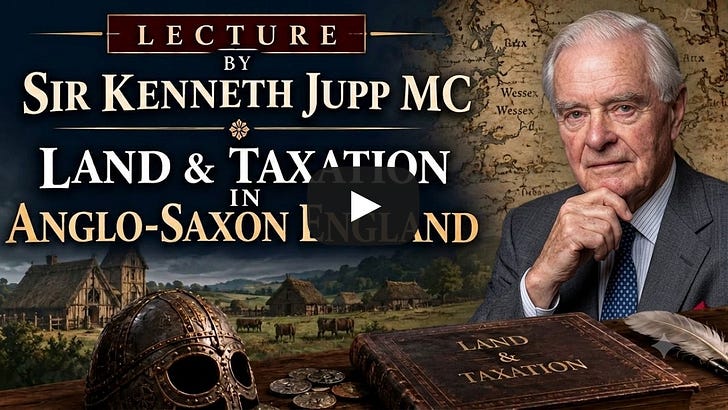
Who was speakingJupp was born Kenneth Graham Jupp on 2 June 1917, the son of a shipbroker, Albert Leonard Jupp, and his wife Marguerite Isabel, into what one obituary calls a musical family; Jupp himself became a capable amateur singer, pianist and flautist. He was educated at the Perse School and won a scholarship to University College, Oxford, where, by his own account, he spent most of his time rowing rather than studying, took a first in 1938 regardless, and won the college prize in Greek in 1939. The war interrupted his legal training almost as soon as it began. He joined the British Expeditionary Force as an officer and saw active service in France, Belgium, North Africa and Italy between 1939 and 1943, including the fighting for Tunis, before landing at Anzio in January 1944, where he was wounded and afterwards awarded the Military Cross for his conduct. He finished the war on the War Office Selection Board, then resumed his legal studies by post from his hospital bed. He was called to the Bar at Lincoln’s Inn in 1945, took silk as a QC in 1966, and became a Bencher of Lincoln’s Inn in 1973. Along the way he chaired the Independent Schools Tribunal, sat as Deputy Chairman of the Cambridge and Isle of Ely Quarter Sessions, conducted a government inquiry into the Wool Marketing Scheme for the Ministry of Agriculture, and chaired the public inquiry into a fatal fire at the Fairfield Home in Nottingham. He was appointed a Judge of the High Court, Queen’s Bench Division, in 1975, the year he was knighted, and served as presiding judge of the North Eastern Circuit from 1977 to 1981, before retiring from the bench in 1990. He married Kathleen Elizabeth, always known as Betty, in 1947, and they had two sons, Stephen and John, and two daughters, Penelope and Celia. He died at Welwyn in Hertfordshire on 15 March 2004, aged 86. None of that, on its own, would explain why a retired judge chose to spend a morning after his retirement working through the arithmetic of the Burghal Hidage. The explanation is that Jupp was not simply an antiquarian dabbler in Anglo-Saxon history. After leaving the bench in 1990 he wrote and translated several books on economic questions, chaired the trustees of the UK-based Land Research Trust, and was a long-standing contributor to Land&Liberty, the journal of the Henry George Foundation, the organisation that has spent more than a century making the case for reclaiming the value of land rather than the effort and capital applied to it. It is the reason the talk keeps circling back, under all the digressions about hides and cricket pitches, to one pointed question: why was a workable, locally accountable, means-adjusted land tax allowed to decay into a system that taxes trade and income instead? Jupp was not asking that question as a neutral historian. He was asking it as a lifelong advocate of land value taxation who had spent decades arguing that the Georgist case was not merely theoretically sound but had already been put into practice, successfully, by his own country’s medieval ancestors. The 1993 talk is best read as a piece of Georgist advocacy delivered in the disguise of a charming, digressive history lesson, by a man who had spent his retirement making exactly that argument in print. The hide: a unit of capacity, not a unit of wealthThe basic unit of the whole system was the hide. Jupp is at pains to say that nobody is certain of its etymology, and that guesses linking it to the hide of a cow are best avoided. What is agreed is its function: a hide was reckoned as the amount of land needed to support one household. It was not a fixed acreage, because land varies in quality, but a rough calibration of productive capacity. This distinction matters more than it looks. Jupp makes a point that I think the historians he was quoting from had not quite drawn out themselves: the hide taxed a household’s opportunity to produce, not the wealth it actually produced. A poor farmer paid the same geld on his hide as a good farmer working land of the same notional value. The good farmer, getting more out of the same allotment, experienced the tax as light. The bad farmer, getting less, felt it as heavy. But the underlying assessment did not change with effort or improvement. In modern language, this was a tax on the land’s value, not on the labour or capital applied to it. It rewarded improvement rather than penalising it, because your bill did not rise just because you farmed better. That is precisely the argument the later land value tax tradition, from the Physiocrats through Ricardo to Henry George, would make the centre of a whole theory of just taxation. The Anglo-Saxons seem to have stumbled on the practical version of it three centuries before Domesday. Shire, hundred, and village: taxation by consent and local knowledgeThe machinery for turning hides into revenue was a ladder of local courts, and it is where Jupp’s talk is at its most interesting, because it describes a grassroots fiscal federalism rather than a centralised despotism, which is what is increasingly happening today, although the UK’s new Prime Minister pledges to reverse… we shall see. . Central government decided how many hides a shire was worth. Somerset might be assessed at five hundred hides, Essex at two thousand, and so on. The shire court then divided that total among the hundreds within it. The hundred court, in turn, divided its share among the individual villages. At each stage, the decision was taken by people who actually knew the country and their neighbours, and Jupp’s point, made more than once, is that this meant the system had built-in flexibility. If part of a county had suffered a flood, the hundred court could reduce its share. If a man had just inherited his father’s holding and was struggling, the village meeting could ease his burden for a year. There was no need for anything like a modern rebate or subsidy system, because the tax itself could flex with genuine hardship at the level where hardship was known about, rather than being assessed from a distance by people who had never seen the flooded field or the newly bereaved farmer. The hundred itself is one of the oldest puzzles in Anglo-Saxon history, and Jupp cites Stenton’s judgement that its origin is one of the hardest problems in the whole field: nobody is sure whether it meant a hundred families or a hundred hides. Either way, by the law of King Edgar the hundred court had to meet every four weeks, and while it dealt with theft and the call-up of soldiers, its main business was tax. The gelds: a tax for every purposeJupp lists several separate levies raised on the hide, all sharing the Anglo-Saxon root geldan, to give, which survives in our word yield. The best known is the Danegeld, raised originally to buy off Viking raiders. It began under Æthelred, whose nickname is itself a pun worth pausing on: Æthelred meant “noble counsel,” but he came to be called Unræd, “no counsel” or “ill-advised,” so that the whole name became a joke on the theme of good advice with none of it taken. Once established, the Danegeld did not disappear when the Danish threat receded. Norman and Angevin kings kept collecting it under other names, most notably as the carucage, right down into the thirteenth century. A twelfth-century historian observed, with a certain grim wit, that what had once been paid to the Danes out of terror was now paid to the king out of habit. Alongside the Danegeld sat the heregeld, which funded the army and navy, and the burhgeld, which paid for the building and manning of fortified towns, the burhs, that Alfred and his successors used to hold the Danes off. Jupp also mentions a brycgeld, a bridge-toll or bridge-maintenance levy, and ties all of this to what Anglo-Saxon law called the trinoda necessitas, the three necessary services owed by anyone who held land: fortress work, bridge work, and service in the fyrd, the local levy. Alfred’s own contribution, on Jupp’s account, was to realise that calling out the whole fyrd at once wrecked the harvest, so he split it and rotated service, which let him keep a force in the field for far longer and use it offensively against the Danes rather than purely defensively. The arithmetic of the Burghal HidageThe most striking piece of evidence Jupp produces is the Burghal Hidage, a document that assigns several hides to each fortified town for the purpose of building and maintaining its walls. He works through the conversion: a pole is five and a half yards, four poles make a chain of twenty-two yards, which is the length of a cricket pitch, ten chains make a furlong of two hundred and twenty yards, and a chain by a furlong gives an acre. On the reckoning he cites, sixteen hides were required to maintain one pole’s length, one chain’s breadth, of wall, at a rate of one man per hide. Run that through and you get roughly four men per pole, a hundred and sixty per furlong, and so on. What makes this more than an antiquarian curiosity is that it checks out against the ground. Winchester’s walls measured about three thousand two hundred and eighty yards; the Burghal Hidage assessment, rounded up, gives three thousand three hundred. Wareham’s walls measured about two thousand one hundred and eighty yards against an assessment of two thousand two hundred. The same logic, Jupp says, underlay Offa’s Dyke, the hundred and forty-nine-mile earthwork along the Welsh border, six feet deep and twelve feet high, for which men were mustered by the hide under their local leaders to a schedule already surveyed by central government. This was not guesswork. It was a working system of national assessment, translated into labour and money with a precision that still matches up when you measure the walls today. A rich, literate, and well-governed countryThink just how good the Anglo-Saxon state was actually at running itself; the case for what was lost only makes sense once you see what was there. Jupp is emphatic on this. He describes the late Anglo-Saxon fiscal and administrative machine, quoting the historians he had been reading, as having the most efficient and honest civil service anywhere in the western world at the time. The currency was remarkably stable and well controlled, good enough that it became a model copied in Scandinavia. The secretarial and record-keeping apparatus behind the tax system was, in the phrase he borrows, advanced for its age. That competence is the reason the monarchy survived four changes of dynasty in the tenth century and the disaster of civil war under Stephen without the state itself collapsing: the machinery of shire, hundred, and geld kept working underneath whoever happened to be sitting on the throne. Literacy tells the same story if you read it correctly. Jupp makes the point that before Augustine’s mission the Anglo-Saxons could not read or write, and that this was long, wrongly, taken as evidence they were uncultured. He is right to correct it: an oral culture that could produce the poetry, law, and craftsmanship that survives from this period was not a primitive one. But once writing did arrive, in the seventh century, the pace of change is striking. Within a few generations England had Bede, a body of vernacular law codes going back to Æthelberht of Kent, a school of manuscript illumination good enough that its products still stop visitors in the British Museum, and, under Alfred, a deliberate state-sponsored revival of learning and translation. By the eve of the Conquest, England had a national language of government, a functioning currency, and a tax system precise enough that its arithmetic can still be checked against standing walls a thousand years later. Whatever else you want to call late Anglo-Saxon England, “backward” is not the word for it. The Norman continuityOne of Jupp’s more pointed observations concerns the Conquest itself. William I did not sweep the old system away; he used it, and adjusted it. After Hastings, his campaign of devastation looped north around London through Surrey, Berkshire and Hertfordshire, living off the land as he went. The counties he ruined on that march had their hidage assessments reduced accordingly. This is a small but telling detail: the flexibility built into the old system, the capacity to adjust for a bad year or a ruined harvest, operated even at the level of a conquering king recalibrating the tax base of an entire county he had just plundered. But the continuity was administrative, not social. William kept the machine because it was efficient at doing exactly what he now wanted it to do: identify precisely what every acre of England was worth, so that it could be redistributed. Domesday Book, compiled twenty years after Hastings, is in one sense simply the hidage system’s own logic taken to its conclusion. But it is also, when you read it the other way round, a ledger of confiscation. It records, county by county, the wholesale transfer of land from several thousand English thegns to fewer than two hundred Norman tenants-in-chief, with the king himself as the largest landholder of all. The tax base Jupp describes so admiringly did not change hands gradually through the ordinary churn of inheritance and purchase. It changed hands in about two decades, at the point of a sword, and Domesday exists to tell the new owners exactly what they had taken. Why was the system allowed to dieThis is the question Jupp poses to his audience directly: why was this admirable, locally accountable, means-adjusted system of land taxation not simply refined and carried forward into a modern land value tax, rather than abandoned? He gives three reasons. First, from the Conquest onward the geld ran in parallel with the feudal system of knight service, where dues were paid in service or, increasingly, in money as scutage, “shield money”, paid in lieu of turning up in person. The two systems overlapped and eventually the feudal one, tied to personal obligation rather than land value, came to dominate administrative attention. Second, inflation quietly hollowed out scutage. Fixed by William I at twenty shillings, enough at the time to hire a knight for a campaign, the same sum a century or two later would not buy breakfast. A tax fixed in nominal terms rather than tied to the value of land does not survive inflation with its logic intact; the hide-based geld, precisely because it was tied to land, did not suffer the same decay, but the political energy had by then shifted to the parallel, decaying system. Third, and probably decisive: the towns were never brought into the hidage system at all. The burghal hidage financed their walls, but the towns themselves, increasingly the most dynamic and fastest-growing part of the economy, paid their dues to the crown through an entirely separate mechanism, the tallage, a levy raised, nominally, with the consent of those taxed, and through the outright sale of charters of self-government. A system of national taxation that leaves out the towns just as the towns become the main engine of new wealth was a system already halfway to irrelevance. The Angevin fork in the roadThe turning point Jupp identifies comes with Richard the Lionheart’s ransom. Captured returning from crusade, Richard was held by the Duke of Austria for a sum Jupp struggles even to translate into modern terms, and it was raised not on land but through a levy of a quarter on everybody’s revenue and movable goods, with an exemption for those worth less than five pounds and a reduced rate for parish clergy. It worked, Jupp notes drily, because Richard was popular enough that people would pay almost anything to get him back. That set the precedent that his successor, John and the century that followed would build on. John’s wars in Normandy and the general rise in prices turned what had been a workable fiscal and legal system, in the words of the Oxford historian Jupp is quoting, into an instrument of extortion, provoking the baronial revolt and Magna Carta. The reissue of the Charter under the young Henry III in 1225 was bought with a grant of a fifteenth of everybody’s movable goods. Jupp underlines the point himself: land was not taxed. Three further levies on movables followed under Henry III, in 1232, 1237 and 1269, each one, as the historian he cites puts it, stretching the practice a little further and setting a precedent for what came after: customs duties, monopolies, and taxes on drink, tobacco, coffee, tea, spices, candles, soap, paper, windows, legal documents and newspapers, culminating eventually in VAT and, from 1797 and continuously only from 1842, income tax. The lessonWhat strikes me most, reading this transcript nearly a thousand years after the system it describes and thirty years after the talk itself, is how deliberately England backed away from taxing land and toward taxing everything else: goods, trade, movable wealth, and finally income and effort. The Anglo-Saxon hide, whatever its faults, taxed the fixed, unimprovable fact of land’s capacity to support a household. It did not punish the farmer who worked harder or the town that grew faster, because in principle it was never meant to reach either of those things at all; it reached the land itself. Once the crown discovered it could tax movables, and later income, it found a tool that reached directly into the growing, productive part of the economy, the part that responds to being taxed by producing less of itself. Land, unlike labour and capital, does not shrink when you tax its value rather than its use. Jupp plays the part of a judge telling a diverting story about hides and hundreds, not a man delivering a Georgist tract. But we now know that is exactly what he was doing. The material he assembles makes the case better than most modern advocacy does, because it shows the alternative was not a hypothetical proposal from a nineteenth-century economist. It was the working system of an entire country for several centuries, assessed with enough precision that you can still measure its arithmetic against the standing remains of the walls it paid for, and Jupp, as chairman of the Land Research Trust and a regular contributor to the Henry George Foundation’s own journal, knew exactly what argument he was building towards. The country had a fair, locally administered, means-adjusted land tax, and let it decay in favour of taxing trade and effort instead. Exploring the harder argument: conquest, dispossession, and the modern aristocracyNone of the above is really contested by historians. Where it gets contentious is the further step some people, myself included on my more polemical days, want to take: that the Conquest was not just a change of regime but a permanent transfer of the national surplus into private hands, that the families who benefited from it are still disproportionately in possession of Britain’s land, capital, and institutional power today, and that this is a live cause of British inequality rather than a historical curiosity. That argument deserves to be tested, rather than simply asserted. The case for it. The starting fact is not in dispute: Domesday Book records that a small number of Norman incomers, perhaps two hundred tenants-in-chief and their king, ended up holding almost all the land that several thousand English thegns had held, or rather stewarded, before 1066. What is more surprising is how much of that initial transfer appears to have stuck. Gregory Clark and Neil Cummins, tracing rare surnames of Norman origin from Domesday through university admissions, probate records, and professional registers over nine centuries, found that those surnames remained significantly overrepresented among England’s elite right through to the 2010s, a persistence rate they measured as unusually slow even by the standards of other rigid societies. Separately, the researcher Guy Shrubsole, drawing on Land Registry data, Freedom of Information requests, and his own mapping project, has estimated that the aristocracy and landed gentry still own around thirty per cent of England, with a further chunk of undeclared land, never sold on the open market and therefore invisible to the Registry, very plausibly belonging to the same families. Add the fact that landownership in Britain is unusually concentrated by international standards, that a title or a country estate still confers real advantages in access to credit, planning permission, and social networks, and that the same broad social layer remains heavily represented in the House of Lords, in the upper ranks of the City, in national newspaper ownership, and in cabinet government, and the argument writes itself: a conquest a thousand years old set a pattern of ownership that a remarkable amount of institutional inertia, primogeniture, trusts, and plain political power has kept largely in place ever since. On this view, the shift Jupp’s talk describes, away from a land-based tax that reached everyone according to what their land could yield, and toward taxes on trade, income, and effort, was not an accident of administrative drift. It was also, over the centuries that followed, very convenient for whoever already held the land, since a state that taxes wages and turnover rather than land value leaves the value of that land, and the rent it generates, largely untouched. The complications. A fair account has to sit with several things that cut against a clean, unbroken narrative of Norman families still quietly running the country. The “Norman Yoke” idea is itself an old piece of English political rhetoric, not a modern discovery: Levellers and radical pamphleteers were using the Conquest to attack aristocratic privilege in the seventeenth century, and historians have long warned that it can flatten a genuinely complicated thousand years into a single grievance. Land in England has in fact changed hands enormously since 1086: the Black Death, the Wars of the Roses, the dissolution of the monasteries under Henry VIII, the agricultural depression of the late nineteenth century, and two world wars each broke up large estates or forced sales on a huge scale, and much of what is now called “old money” was in reality assembled from Tudor court favour, colonial and slave-trade profits, or Victorian industry rather than inherited in an unbroken line from a knight who came over with William. Clark’s own surname method has been criticised by other economists as measuring something closer to the persistence of elite identity, families rising to join the club and adopting or marrying into old names, rather than proving that the literal biological descendants of 1086 landholders still hold the same power; the same paper notes that even these persistent names are regressing toward the average, just very slowly. And Shrubsole’s aristocracy figure, however striking, is an estimate built partly from the fact that so much land ownership is deliberately hidden from public record, which cuts both ways: it makes the true concentration hard to challenge, but it also means the headline number is not as solid as a land registry return would be. Britain’s inequality has plenty of other well-documented causes that have nothing to do with 1066: the Enclosure Acts of the eighteenth century, the way industrial and financial capital concentrated in the nineteenth, the tax and housing policy choices of the last fifty years, and the simple fact that land value taxation was tried and defeated politically in 1909 and again in the 1930s by arguments about administrative cost and property rights that had nothing to do with anyone’s ancestry, but still were awfully convenient to those who held land monopoly. Put those two halves together, and I think the honest position is this. The claim that a specific, nameable set of thousand-year-old Norman bloodlines is still personally extracting the nation’s surplus is plausible with some major caveats, but treating it as a literal genealogical fact is pushing it too far, but not that far. The weaker version of the argument survives the scrutiny rather well: Britain never carried out a Domesday-scale redistribution in reverse, land and inherited wealth remain far more concentrated here than in comparable countries, the class that has held disproportionate power has been remarkably good at absorbing new money and renewing itself rather than being displaced by it, and every serious attempt to tax land value directly, the one tax base the Anglo-Saxons had actually built, has been fought off by exactly the interests that stood to lose from it. You do not need a straight bloodline back to Hastings to believe that. You only need to notice that the country which once had the most locally accountable land tax in Europe has spent the last nine centuries taxing almost everything except land, and to ask who benefited most from that choice being made, and remade, every time it came up for debate. Sources: this essay draws on the recorded 1993 talk by Sir Kenneth Jupp on Anglo-Saxon land and taxation, in which he quotes and paraphrases (not always with full certainty of names or dates, as he himself admits) the work of Sir Frank Stenton and other historians of the period, along with the Burghal Hidage, the Tribal Hidage, and Domesday Book. Given the informal, unscripted nature of the talk, some names and figures given aloud are uncertain; anyone using this for further research should check the primary editions of the Burghal Hidage and Stenton’s Anglo-Saxon England directly rather than relying on a recollection given from memory at a lectern. Biographical detail on Jupp is drawn from his obituary in Land&Liberty (the quarterly of the Henry George Foundation, 2004) and a separate formal legal obituary recording his full career, honours and family. The closing section also draws on Guy Shrubsole’s Who Owns England? (2019) and its associated land-ownership mapping project, and on Gregory Clark and Neil Cummins’s surname-persistence research, “Surnames and Social Mobility in England, 1170–2012” (Human Nature, 2014) and related papers, along with published critiques of that method’s limits. Invite your friends and earn rewards
If you enjoy Peter Smith Rewilding, share it with your friends and earn rewards when they subscribe.
|




Comments
Post a Comment