Fuck Tree Planting. It’s a Scam! - The trillion-dollar feel-good fantasy of the modern ‘tree-planting industrial complex’ is complete bullshit & must stop now.
This is the story of tree planting. Not the story you’ve been sold, with the stirring music and the aerial footage of barren hillsides transforming into lush canopies. The real story. The one where we have collectively spent billions of pounds, dollars, and euros buying ourselves a warm feeling while actively damaging the ecosystems we claim to be saving.
The good news is that there
is something better. Something cheaper, more effective, more biodiverse, better
at capturing carbon, and better at delivering every single ecosystem service
you can name. It requires no logistics, no supply chains, no nurseries, no
labour forces, and no corporate branding campaigns. It is called natural
regeneration, and it has been doing this job for approximately 350 million
years without any help from us whatsoever.
We just need to get out of
the way.

The Numbers
That Should Have Ended This Debate Years Ago
Start with the headline
finding that kicked off a decade of well-meaning ecological disaster. In 2019,
a team at ETH Zurich published a paper in Science claiming there was space for
0.9 billion hectares of new forest on Earth, and that filling that space with
trees could absorb two-thirds of all human carbon emissions. It went viral
instantly. The Trillion Trees campaign was born. Corporations pledged.
Governments committed. Elon Musk donated a million dollars to Team Trees.
Everyone felt extraordinarily good about themselves.
The problem was that the
paper was wrong. Multiple scientific rebuttals followed, pointing out that the
analysis confused grasslands, savannas, and peatlands for potential forest
land, that planting trees on those ecosystems would actually release carbon
rather than capture it, and that the carbon capture figures were wildly
overstated. Thomas Crowther, the lead author, went on to spend the next four
years watching his work get weaponised by oil companies and corporate polluters
as justification for continuing their operations unchanged.
By COP28 in Dubai in 2023,
Crowther himself stood up and begged people to stop. “If no one had ever said,
‘Plant a trillion trees,’ I think we’d have been in a lot better space,” he
said. The man whose study launched the modern tree-planting industrial complex
was publicly asking that industrial complex to cease operations.
Nobody listened. The pledges
continue. The nurseries keep growing. The saplings keep dying.
What the
Science Actually Shows About Soil
Before we can talk about
what tree planting does wrong, you need to understand what it is planting into.
And to understand that, you need to recalibrate your entire sense of what soil
is.
Soil is not dirt. This
matters enormously and almost nobody grasps it.
Take a single teaspoon of
healthy, undisturbed forest soil. In that teaspoon you will find somewhere
between 100 million and one billion bacteria. Not just any bacteria, but
potentially up to 15,000 distinct species of them, forming ecological
relationships of labyrinthine complexity that science has barely begun to map.
Alongside the bacteria, there are fungi, whose thread-like hyphae extend
through the soil in networks that can cover acres from a single organism. There
are protozoa, from a thousand per teaspoon in low fertility soils to a million
per teaspoon in fertile ones. There are nematodes, hundreds of them in each
teaspoon, spanning at least three distinct trophic levels: some that eat
bacteria, some that eat fungi, some that eat other nematodes. There are mites,
springtails, tardigrades. A single square foot of forest litter and topsoil can
contain 200 species of mites alone.
All of these organisms are
in constant dynamic relationship with one another and with the plants above
them. The bacteria and fungi form the base of the web, decomposing organic
matter, fixing nitrogen, releasing phosphorus from mineral substrates, and storing
nutrients in their own bodies so they cannot be leached away by rain. The
protozoa and nematodes graze on bacteria and fungi, and in doing so release
nutrients in plant-available forms exactly where plant roots can absorb them.
The mites and springtails shred leaf litter into fragments that increase
surface area for microbial action, and they carry bacteria and fungi on their
bodies to new locations as they move through the soil, essentially performing
nutrient distribution logistics. Earthworms consume all of it, passing the
mixture through a gut that suppresses pathogens, and leave behind castings that
are among the most nutritionally complete structures in nature.
The mass of microbes per
acre of productive farmland is roughly equivalent to the biomass of two cows.
Except those cows are invisible, never stop working, require no feed, produce
no methane, and are running what is arguably the most sophisticated biochemical
processing system on the planet.
In a healthy, undisturbed
forest, the ratio of fungal biomass to bacterial biomass in the soil can be
anywhere from 10:1 to 1000:1. That fungal dominance matters because fungi are
the primary decomposers of complex organic compounds, the ones that can break
down lignin and cellulose, the tough structural materials that lock carbon into
recalcitrant, long-lived forms. Fungal networks also form the mycorrhizal
associations that connect tree roots to the broader soil ecosystem, allowing
trees to trade sugars for nutrients and water, and in some cases to transfer
resources between individual trees across a forest. The wood-wide web is real,
though considerably less telepathic than popular writing suggests, and it is
built by fungi that took decades to establish in an undisturbed soil.
Now take a spade. Drive it
into that soil. Turn it over. Plant a sapling.
You have just destroyed most
of that system.
How Tree
Planting Can Cause Net Carbon Loss
This brings the only real
published work by Nina Friggens and colleagues at the University of Stirling
and the James Hutton Institute. It is quietly one of the most important and
underreported ecological papers of the past decade.
The researchers studied four
experimental sites across Northern Scotland where native tree species,
specifically downy birch and Scots pine, had been planted onto heather moorland
twelve to thirty-nine years earlier. These were not monoculture plantations of
alien conifers. They were native species, carefully planted, with proper
experimental controls, on appropriate land. The kind of tree planting that
conservation groups point to as good practice.
The result: zero net gain in
ecosystem carbon at any of the four sites. At one site, a net carbon loss.
The tree biomass was there.
The trees had grown. Carbon had been sequestered in wood and roots, exactly as
promised. But the soil told a different story. In birch plots at the
twelve-year-old Ballogie site, soil organic carbon in the organic horizon was 58%
lower than in adjacent unplanted heather control plots. At Kerrow, where the
trees were thirty-nine years old, soil carbon was 50% lower than controls. The
carbon that had accumulated in tree trunks and branches was simply replacing
carbon that had been lost from the soil. Sometimes, not even replacing it: at
one site there was an overall deficit.
Soil respiration, the rate
at which carbon is being released back to the atmosphere, was significantly
higher in the planted plots than in the heather moorland. Not because of root
activity, interestingly: root and mycorrhizal hyphae production was similar
between planted and control plots. Something else was happening.
The researchers propose a
mechanism called priming. When you introduce trees into a grassland or
heathland ecosystem, you change the chemistry of what enters the soil. Tree
roots and tree litter carry different organic compounds than heather roots and
heather litter. These new inputs stimulate the soil microbial community. The
microbes, energised by this fresh carbon, ramp up their enzymatic activity. And
in doing so, they begin decomposing the pre-existing soil organic carbon, the
ancient, recalcitrant stuff that had been building up for centuries, the carbon
that was supposed to stay locked in the ground.
You thought you were adding
carbon to the system. You were actually unlocking a vault of it and releasing
it to the atmosphere.
There is also a mycorrhizal
dimension. Heather is colonised by ericoid mycorrhizal fungi, a type of fungus
that forms tight, enclosed associations with root cells and is particularly
effective at suppressing saprotrophic decomposers, the microbes that eat dead
organic matter. This suppression is part of why heathland builds up such thick
organic horizons over time. The heather fungi are essentially putting the
brakes on decomposition, allowing organic matter to accumulate.
Introduce birch or pine and
you introduce ectomycorrhizal fungi, a completely different guild with
different enzymatic capabilities, including peroxidases that actively break
down complex organic matter to liberate nitrogen. These fungi have faster hyphal
turnover, different enzyme profiles, and they do not suppress saprotrophic
decomposers in the same way. The net effect is to accelerate the breakdown of
organic matter that had taken centuries to accumulate.
The paper concludes:
“Ecosystem-level biogeochemistry and C fluxes must be better quantified and
understood before we can be assured that large-scale tree planting in regions
with considerable pre-existing SOC stocks will have the intended policy and climate
change mitigation outcomes.”
This is scientific language
for: we have been planting trees on carbon-rich soils and confidently expecting
them to capture carbon when the actual data shows they may be releasing it.
The
‘Tree-planting Industrial Complex’ Greenwashing Machine
The Friggens study is about
Scottish moorland. But the problem is global, and it is not limited to soil
carbon accounting errors.
In India, a major
government-led tree planting initiative was analysed by independent researchers
who found little evidence that it had resulted in more tree cover, more carbon
uptake, or any measurable community benefits. “It was a complete disaster,” said
Jim Enright, former Asia coordinator of the Mangrove Action Project, referring
to a separate record-breaking planting event.
In Sri Lanka, a government
mangrove planting programme intended to protect coastlines produced this
result: nine out of twenty-three project sites showed no surviving plants at
all. Only three sites had survival rates above fifty percent.
In Australia, billions of
dollars of public funding went into tree-planting offset schemes while
extensive land-clearing continued, effectively negating any sequestration
benefits.
And then there is Turkey’s
eleven million trees. Gone in three months.
Yale Environment 360 has
documented these failures in a piece they call “Phantom Forests,” noting that
forest scientists say such debacles are “surprisingly frequent” and are
“threatening to undermine efforts to make planting a credible means of countering
climate change.” The UN’s own Food and Agriculture Organisation has
acknowledged that many projects amount to little more than “promotional events,
with no follow-up action.”
The corporate world has
built an entire industry on this. Buy a flight, plant a tree. Offset your
factory’s emissions with a forest in Madagascar. Companies pay for carbon
credits backed by tree planting projects that, on investigation, turn out to
have extraordinarily high mortality rates, no monitoring infrastructure, and
occasionally fraudulent documentation. In June 2024, Brazil’s Federal Police
launched Operation Greenwashing, arresting individuals connected to illegal
logging schemes that had been fraudulently selling carbon credits from phantom
forests.
The Trillion Trees campaign,
meanwhile, discovered a troubling bottleneck in 2023: a massive undersupply of
seedlings. Not enough trees were being grown in nurseries to meet the planting
pledges. The industrial logic of tree planting had been scaled up faster than
the supply chain could support, with no apparent consideration of whether the
supply chain should be scaled up at all, or whether the entire approach was
conceptually flawed.
What
Natural Regeneration Actually Does
When land is removed from
intensive use and left alone, what happens is not the slow gradual creep of a
few pioneer plants across bare earth. What happens is an explosion.
At the Knepp Estate in West
Sussex, a 3,500-acre farm the “depleted, polluted, dysfunctional farmland,” the
transition began in 2001. Fences came down. Victorian drainage was broken up.
Dead trees were left standing. Free-roaming herds of English longhorn cattle,
Tamworth pigs, Exmoor ponies, and deer were introduced to replace the
ecological roles of missing megafauna. And then, essentially, nothing was done.
The results of a two-decade
review published in early 2026 are extraordinary. Breeding birds have increased
by 900% overall. Turtle doves, which have declined by 98% across the UK since
1994, increased by 600% at Knepp. Nightingales, functionally vanishing from the
British countryside, increased by 511%. Butterfly species in some areas
doubled. Dragonflies and damselflies increased by 900%. Purple emperor
butterflies, rare oak specialists, moved in to use the regenerated scrub.
Peregrine falcons and owls established themselves. White storks, absent from
Britain for centuries, are now breeding on the estate.
None of this was planted.
None of it was managed into existence by a project coordinator with a
spreadsheet. It happened because the conditions for it to happen were restored.
The soil tells the same
story from beneath. When land is left to regenerate, the fungal communities
that drive carbon accumulation and nutrient cycling re-establish themselves
gradually, spreading through hyphal networks from remnant patches of undisturbed
soil. The mycorrhizal inoculum, the reservoir of fungal spores and fragments
that new plants need to form their belowground partnerships, is rebuilt. Root
exudate chemistry diversifies as plant communities diversify, feeding a wider
range of microbial guilds. The predator-prey relationships in the soil food
web, the nematodes eating bacteria, the mites eating nematodes, the birds and
moles eating mites, rebuild their complexity. And with that complexity comes
resilience, the capacity to absorb disturbance without collapsing, which is
exactly what we need in ecosystems facing climate change.
Research on naturally
regenerating forests in New Zealand found that they had higher understory
native plant cover, higher sapling wood density, and more saplings of species
that dominate old-growth forests than planted forests of the same species. The
planted forests had higher aboveground biomass in the short term, but the
naturally regenerating forests showed healthier trajectories toward mature
forest structure and function.
A 2024 study in Nature found
that in approximately 46% of suitable areas, natural regeneration is more
cost-effective at sequestering carbon than tree planting, and that naturally
regenerating forests typically remove carbon fastest when they are between
twenty and forty years old, meaning older secondary forests can provide more
immediate climate benefits than newly planted ones.
The World Resources
Institute’s analysis of secondary forests found that carbon removal rates in
naturally regrowing tropical forests had been significantly underestimated, and
that the potential for natural regeneration in the tropics alone represents an
above-ground carbon sequestration potential of 23.4 gigatonnes of carbon over
thirty years across 215 million hectares.
That is the carbon
equivalent of more than three years of the entire planet’s gross carbon
removals from all existing tropical and subtropical forests, sitting there
waiting in land that simply needs to stop being cleared.
The
Biodiversity Gap Is Not Close
The comparison between
natural regeneration and tree planting on biodiversity is not a marginal
advantage. It is categorical.
Studies comparing the two
approaches find a 56% higher rate of biodiversity in natural regeneration
projects compared to manual tree planting under similar conditions. The World
Resources Institute notes that natural regeneration is “often cheaper and more
likely to benefit native wildlife.” The research literature on the subject is
consistent: planted forests, particularly monocultures or near-monocultures of
commercially selected species, produce a fraction of the biological diversity
of naturally regenerating ecosystems.
The reason comes back to the
soil. Planted trees, because they are chosen for growth rate, timber value, or
political palatability rather than ecological function, do not build the same
soil communities as naturally arriving pioneer species, which have evolved
alongside local soil organisms over thousands of years. The mycorrhizal
partnerships that form between naturally regenerating plants and local fungal
communities are the result of co-evolution. They are tuned to one another. They
create the conditions for the next wave of successional species to arrive and
establish.
A planted monoculture of
Sitka spruce, or eucalyptus, or even native birch planted in rows on former
heathland, cannot replicate this process. The species arriving through natural
seed dispersal, from wind, from bird droppings, from the fur of passing mammals,
arrive in a sequence shaped by millions of years of ecological development. The
pioneer species create the conditions for the species that follow them. The
shade-tolerant species arrive once the pioneers have built enough canopy. The
fungi that break down birch litter create the soil chemistry that oak seedlings
need. Oak seedlings create the conditions for hazel. Hazel creates the
conditions for the insects that the dormice need. Dormice disperse the seeds of
the trees that hazel needs for competition. This is not metaphor. This is
literally how it works.
Monoculture tree planting
short-circuits this entire process and substitutes a single-species overstorey
for a multi-layered, multi-species, multi-functional ecosystem. It is the
ecological equivalent of replacing a rainforest with a car park that has some
potted plants.
Monocultures also create
conditions that favour pest outbreaks and disease. When a single species covers
vast areas, any pathogen or pest adapted to that species has an effectively
unlimited food supply and no resistance from predator diversity in the surrounding
community. We have seen this with Dutch elm disease, with ash dieback, with the
pine beetle infestations devastating North American forests. A plantation of a
single species facing such an outbreak is not a resilient forest. It is a
waiting catastrophe.
The
Peatland Trap
The Friggens study is
specifically about organic-rich soils, and this is where tree planting policy
in the UK has created what may turn out to be one of its most significant
unintentional climate crimes.
Scotland, Wales, and
significant parts of northern England contain vast areas of peatland and peaty
soils. These are among the most carbon-dense terrestrial ecosystems on Earth.
Peat accumulates because the conditions for decomposition, drainage and oxygen,
are absent. The organic matter that falls into a bog does not rot in the normal
sense. It compresses, slowly, over millennia, building up layers of preserved
carbon at a rate of perhaps a millimetre per year.
A metre of peat represents
roughly a thousand years of accumulated carbon. Some British peatlands are
four, five, six metres deep.
The current Forestry
Commission Scotland guidance advises against planting trees on peat more than
fifty centimetres deep. The Friggens data, and a substantial body of other
research, suggests this threshold is far too permissive. Their experimental
sites had organic horizons averaging between eight and thirty-nine centimetres,
well within the permitted planting zone, and even at these depths the planting
resulted in massive net carbon losses through the priming mechanism. The
recommendations in national restoration plans that up to 34% of Scotland’s land
area may have potential for woodland expansion risk, as the paper states,
“jeopardising soil and ecosystem C stocks on the extensive heather moorlands
and heathlands with organic horizons of less than 50cm depth.”
We are planting trees on
carbon stores and calling it climate action.
The Wood
Wide Web and Why You Cannot Build It
The mycorrhizal networks
that underpin forest function are not something you can install. They are built
over time through a process of ecological succession that requires a seed bank,
an intact fauna, remnant patches of undisturbed habitat to act as sources of
colonising organisms, and decades of undisturbed development.
Research on ectomycorrhizal
fungi, the guild associated with birch, oak, pine, beech, and other major
temperate forest trees, shows that seedlings connected via root-associated
fungal hyphae to soils beneath established neighbouring adult trees grow faster
and have greater survival rates than seedlings isolated from existing fungal
mycelia. The fungal network, which can extend for metres in every direction
from an established tree, is itself a form of infrastructure that arriving
seedlings plug into. Without it, they are on their own.
This is why clear-cut
harvest and then replanting is so much less effective than selective harvesting
with retention of legacy trees. The retained trees maintain the mycorrhizal
inoculum potential in the soil. Remove them all and you remove the fungal network.
The seedlings you plant then have to start from scratch, forming new
associations with whatever fungal spores happen to be present in degraded soil,
which in a landscape fragmented by intensive agriculture and monoculture
forestry may be a very depauperate pool indeed.
Natural regeneration, by
contrast, occurs in the presence of whatever remnant ecosystem still exists.
Seeds arriving from adjacent natural habitats carry fungi on their seed coats.
Animals dispersing seeds have gut microbiomes that inoculate the soil. The
process of natural succession, plants arriving in sequence and building
communities, creates the conditions for fungi to spread and develop as each new
plant host becomes available.
The wood-wide web cannot be
installed on a Tuesday. It grows, or it does not grow. And the fastest way to
ensure it grows is to stop destroying the conditions it needs and let it grow.
What
Actually Works: The Evidence From Around the World
Eastern Europe and the
former Soviet Union provided an inadvertent natural experiment in natural
regeneration when agricultural collapse after 1991 resulted in the abandonment
of over fifty-eight million hectares of cropland across Russia and Kazakhstan.
What happened to that land? It regenerated. Forests came back, steppes
recovered, biodiversity returned, at a scale that no tree-planting programme
could have achieved or funded. Nobody planned it. It just happened.
In Costa Rica, following the
end of financial incentives for deforestation and the introduction of payments
for ecosystem services in the 1990s, forest cover increased from 21% to 52% of
the country’s land area over three decades. Much of this increase was through
natural regeneration on abandoned pasture and farmland.
In the Brazilian Amazon,
secondary forests, naturally regenerating on previously cleared land,
accumulate biomass carbon at rates that make them highly significant climate
assets. A Science Advances study modelled the carbon accumulation potential of
2.4 million square kilometres of naturally regenerating secondary forest in
Latin America over forty years, finding a potential of over 31 gigatonnes of
carbon dioxide sequestration, at minimal cost.
The consistent finding
across these studies is that the carbon sequestration rates of naturally
regenerating forests, particularly in tropical regions, are higher than
previously understood, and higher than the rates achievable through planted
monocultures at equivalent age because the diverse plant communities of natural
regeneration produce more varied root architectures, more varied litter
chemistry, and more varied mycorrhizal associations, all of which contribute to
soil carbon building rather than soil carbon priming.
Meanwhile, back in the UK,
Rewilding Britain’s analysis found that allowing and enhancing natural
regeneration, supported by native tree planting only in suitable sites where
there is no existing seed source, would be the most effective long-term approach
for landscape-scale reforestation. They model the potential to double Britain’s
woodland cover, currently among the lowest in Europe, through natural
regeneration at a fraction of the cost of planting programmes.
The
Ecosystem Services Nobody Is Counting
Carbon is only one of the
things that healthy, naturally regenerating ecosystems provide. It is perhaps
not even the most important one on a practical, day-to-day basis.
Hydrological regulation:
naturally regenerating vegetation, with its multi-layered canopy structure,
diverse root architectures penetrating the soil at different depths, and intact
soil biota creating the pore structure and aggregate stability that allows
water infiltration, is vastly more effective at regulating flood risk and
replenishing aquifers than monoculture plantations. Plantations of conifers in
particular are well-documented as increasing runoff and acidifying stream
water.
Air quality: diverse plant
communities produce a wider range of volatile organic compounds, support more
complex insect communities, and create the structural complexity that allows
pollutants to be trapped and metabolised at higher rates.
Pollinator habitat: planted
monocultures provide essentially nothing for pollinators. Naturally
regenerating scrubland, the brambles and thorns and pioneer herbs that colonise
abandoned land in the early stages of succession, is some of the richest pollinator
habitat in the temperate world. The same scrub that planning policies describe
as “undesirable rough land to be managed” is what nightingales and turtle doves
and brown hairstreak butterflies need to survive.
Mental health and wellbeing:
a forest that has been naturally structured by ecological processes, with its
varied age structure, dead wood, fallen logs, diverse understorey, and
unpredictable spatial arrangement, provides an entirely different quality of
experience from a plantation of evenly spaced trees. Research consistently
finds that contact with structurally complex natural environments has greater
mental health benefits than contact with managed, manicured ones.
Flood mitigation:
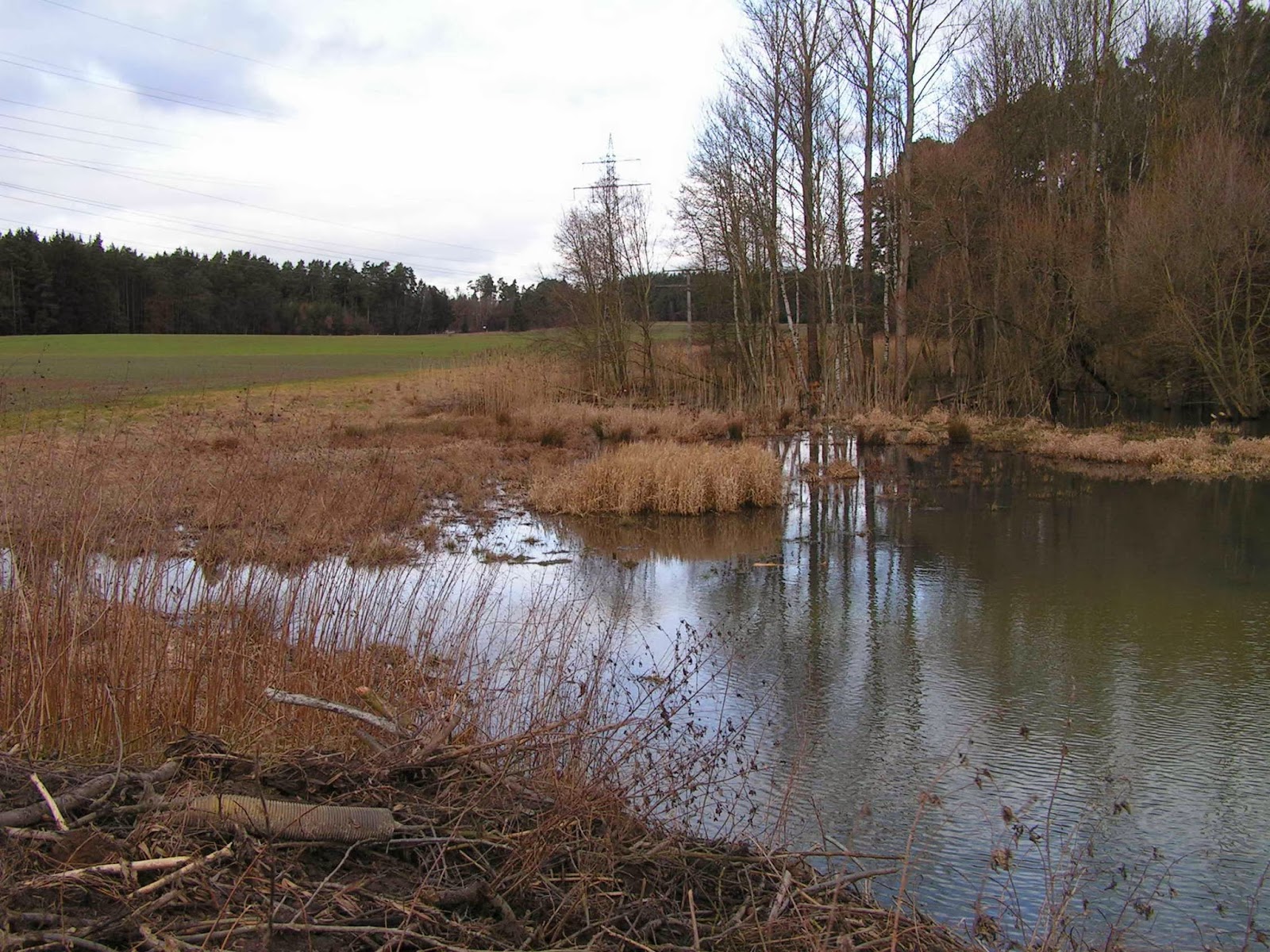
reintroduce beavers, as is happening in several UK locations, and they do in a
season what millions of pounds of engineering cannot: they create wetlands,
slow water flows, raise water tables, and reduce downstream flood peaks. This
is natural regeneration at its most dramatic, and it is free once the animals
are there.
The
Counter-Argument, Taken Seriously
It would be dishonest not to
acknowledge that in specific circumstances, active tree planting has a role.
Where natural seed sources
are absent because surrounding land has been converted, where the seed bank has
been destroyed, where invasive species prevent natural succession, or where a
particular species with specific habitat requirements needs to be established
in a location it cannot reach through natural dispersal, planting makes sense.
In heavily degraded tropical forests where the forest floor is dominated by
competitive lianas that prevent any seedling establishment, a combination of
liana removal and native species planting can accelerate recovery.
The research literature
broadly supports a position of “natural regeneration where possible, targeted
planting where necessary,” rather than a binary choice. A Nature Climate Change
study from 2024 found that using a mix of the two methods, natural regeneration
where it is cost-effective and planting where it is not, could sequester more
carbon than either method alone. The study estimates that this optimal approach
could remove 31.4 billion metric tonnes of CO2 over thirty years at less than
fifty dollars per tonne.
But the key word is “mix,”
and the key insight is that natural regeneration should be the default, with
planting used only where there is a specific, evidence-based reason why natural
regeneration will not work. This is the inverse of current policy, which treats
tree planting as the default and natural regeneration as an afterthought.
The Policy
Failure and What Should Replace It
National climate plans
submitted to the UN, analysed in November 2025 by an international expert
group, revealed that countries are planning to use 2.5 billion acres of land
for tree planting and forest restoration, an area larger than China. At the
same time, those same national plans would still allow roughly ten million
acres of forest to be destroyed every year through to 2030 and another forty
million acres degraded.
We are planning to plant
trees on grasslands while simultaneously felling ancient forests.
The priorities are exactly
backwards. An ancient forest, with its centuries of accumulated soil carbon,
its complex mycorrhizal networks, its multi-layered biodiversity, is worth
vastly more as a climate and biodiversity asset than any plantation you could
put in its place. Protecting existing forests and letting degraded land
regenerate naturally will capture more carbon, at lower cost, with greater
certainty, and with orders of magnitude greater biodiversity benefit, than
planting trees on land that is already performing ecological functions we have
not even bothered to measure.
What should change:
Stop subsidising mass tree
planting schemes without rigorous pre-planting assessment of soil carbon
stocks, existing ecological value, and natural regeneration potential. The
Friggens study shows that planting trees on peaty or organic-rich soils can cause
net carbon loss. Policy that ignores this is not climate policy. It is
performance.
Create meaningful financial
incentives for landowners to simply stop using land and allow natural
regeneration. This is dramatically cheaper than planting schemes and produces
better outcomes. Payment for ecosystem services schemes should value natural regeneration
at least as highly as active planting.
Stop counting tree planting
in monocultures toward biodiversity and carbon targets. A plantation of Sitka
spruce is not a forest. It is a timber crop. Measuring its existence as a
biodiversity or climate gain is category error at best and fraud at worst.
Fund long-term monitoring.
The failures documented in Sri Lanka, India, Turkey, and elsewhere occurred
partly because nobody was measuring outcomes beyond the planting event itself.
Carbon credits backed by tree planting should require ten-year survival and
growth monitoring before any credits are issued.
Prioritise existing
ecosystems. The most cost-effective climate and nature action available in the
UK is protecting the remaining areas of ancient woodland, upland peatland,
lowland heath, and other semi-natural habitat from further degradation. These
ecosystems are already working. They need protection from the people who want
to “improve” them.
A Final
Word About What Soil Knows
There is a particular kind
of institutional arrogance in assuming that the best response to centuries of
ecological destruction is to hire a contractor, order some saplings, and start
filling in the landscape according to a plan.
The organisms in the soil
have been solving the problem of carbon sequestration, nutrient cycling, and
ecosystem stability for hundreds of millions of years. They evolved alongside
the plants they support and the animals those plants feed. They encode, in the
structure of their communities, the accumulated knowledge of every
environmental perturbation the ecosystem has survived. When you leave them
alone, they begin immediately to rebuild. When you intervene clumsily, as the
Friggens study shows with devastating clarity, you can undermine the very
processes you were trying to support.
Natural regeneration is not
passive. It is an extraordinarily active, dynamic, highly organised process
involving millions of species making billions of decisions per second about who
to partner with, what compounds to produce, where to allocate resources, and
how to respond to environmental signals. We did not design this system. We
cannot improve on it. We can only protect the conditions it needs or destroy
them.
The trillion trees campaign
was, at its heart, a story we told ourselves about our own agency. We broke
this. We can fix it. We will plant our way back. It felt good. It gave us
something to do. It generated excellent social media content and satisfied corporate
ESG committees and let governments feel they were taking meaningful action
without touching a single fossil fuel subsidy or reforming a single
agricultural policy.
Meanwhile, in Scotland, the
soil under the birch plantations kept releasing carbon. In Turkey, the saplings
kept dying. In Sri Lanka, the mangroves never came back. And somewhere on a
hillside in West Sussex, a nightingale that nobody planted flew into scrub that
nobody managed and did exactly what nightingales have always done: found what
it needed in a landscape that had been left, finally, to decide for itself what
it wanted to become.
That is the only model that
works. Get out of the way. Stop planting. Start protecting. Fund the fence,
remove the sheep, and wait. Nature will do the rest. It always has. We just
have to stop mistaking our own busyness for action.
The Only
Mechanism That Actually Works: Land Value Tax and the Economics of Letting Go
Here is the thing nobody in
the rewilding movement wants to say out loud, because it is politically
uncomfortable and because the organisations that fund this work depend on the
goodwill of the people it most directly threatens.
Natural regeneration will
not happen at scale. Not because nature does not want to return. Not because
the ecology does not support it. Not because we lack the knowledge, the
species, the seeds, the ambition. It will not happen at scale because while profit
can be made from sub-marginal land, landowners will never voluntarily give it
back. Not this generation, not the next one, not ever. You cannot ask someone
to stop doing something that makes them money and expect them to comply out of
moral sentiment. Not at scale. Not reliably. Not in a system whose every
incentive points the other direction.
This is the root. And we
have been hacking at branches for fifty years.
I have spent thirty years
watching the conservation movement spend hundreds of millions of pounds trying
to buy back fragments of a landscape it should never have had to buy. I have
seen agri-environment schemes pay farmers rent to allow a corner of their
desert to contain a few wildflowers, while the same farmer pockets the subsidy
income that funds the intensive farming that created the wildlife desert next
door. I have watched carbon credit markets funnel money to corporations
planting trees on peat bogs, releasing stored carbon to generate a credit for
the very emissions they were supposed to offset. I have watched Biodiversity
Net Gain create a market for phantom biodiversity on paper that is, on the
ground, a monoculture of plastic tree tubes in a field margin where nothing
lives.
All of it driven by the same
structural reality: in Britain, the value of land rises regardless of what you
do with it or to it. A farmer who drains a wetland, removes a hedgerow, and
saturates his fields with neonicotinoids will, if he holds the land for twenty
years, make a substantial capital gain that has nothing to do with what he
produced and everything to do with the surrounding economy growing around him.
He did not create that value. He captures it anyway. And the wildflower meadow
that does not exist, the insect that is not there, the flooded village
downstream: these costs are externalised onto everyone else and onto future
generations, which is to say they are externalised onto no one in a way that
any market mechanism can currently capture.
This is Ricardo’s Law of
Rent. It is the root from which every branch of ecological destruction grows.
And the only instrument that strikes directly at that root is Land Value Tax.
What Land
Value Tax Actually Does to the Landscape
The principle is not
complicated, though its opponents have spent two centuries making it sound that
way. Land has value not because of what the landowner does with it, but because
of what the surrounding society builds around it. The roads, the railways, the
schools, the hospitals, the human concentration that makes one piece of the
earth worth more than another: none of that value was created by the owner of
the land. All of it should, in justice and in economic logic, flow back to the
community that created it. Land Value Tax captures that flow.
Under LVT, landowners pay an
annual charge on the rental value of their land, assessed on the site itself
rather than on anything built on it or done with it. This distinction is
everything. The tax does not fall on what you produce. It does not fall on your
labour, your investment, your enterprise. It falls on the value of the
location, which you did not create.
The ecological consequences
of this are transformative in ways that most conservation professionals have
never stopped to calculate.
Take the uplands first. The
sheep-grazed moorlands of Scotland, Wales, the Pennines, the moors of
south-west England are, in ecological terms, some of the most degraded
landscapes in Europe. They look wild. They are not. They are deserts maintained
by a combination of overstocking with sheep, driven grouse management, and deer
management that maximises deer numbers for stalking income rather than reducing
them for ecological health. Almost all of this activity is economically
irrational without public subsidy. The sheep farming is largely uneconomic
without the agricultural payments that supplement it. The grouse shooting
depends on the legal and illegal persecution of predators that would otherwise
make it unviable. The land is being actively degraded at public expense, and
the landowners profit from the capital appreciation of an asset that is rising
in value because the surrounding economy is growing, not because they have done
anything to deserve it.
Under Land Value Tax, the
annual charge on upland land with low agricultural productivity would reflect
its actual low rental value. The subsidy income that currently makes intensive
sheep grazing and grouse management the rational choice would be replaced by a
tax obligation that made low-impact, extensive land use the cheapest option.
The farmer who de-stocked his moorland, broke up the drainage grips that
currently accelerate runoff, allowed the native birch and rowan and alder scrub
to return, would pay less tax than the farmer who continued to maintain an
ecological desert at public cost. The economics would flip. And nature, which
has been waiting patiently for exactly this moment for two hundred years, would
respond within a single decade in ways that would astonish everyone watching.
In the lowlands the same
logic applies. The river corridors of England, the wet valleys and flood plains
that are currently farmed on marginal economics with taxpayer subsidy because
the subsidy makes it worth doing, would no longer be economically viable as
intensive farmland once LVT removed the income stream that justified the
enterprise. They would revert. The beavers would move in, without any
reintroduction programme, without any licence application, without any
five-year monitoring plan or stakeholder engagement process. They would move in
because the conditions for them to do so would exist, and because beavers,
given the conditions, are extremely good at being beavers.
The wetland that three
beaver families create for free is functionally equivalent, in terms of flood
mitigation, water purification, and carbon storage, to the Natural Flood
Management project I am currently running in Sussex at a cost of one million
pounds. Let that land in the gut where it belongs. Three animals, working for
nothing, do what a million pounds of public money achieves through engineering.
The only reason we are paying for the engineering rather than housing the
animals is that the economics of land tenure make it irrational for the
landowner to allow the animals to work their land.
Change the economics. Change
the land. It is that direct.
The
Conservationist’s Dirty Secret
“There are a thousand
hacking at the branches of evil to one who is striking at the root.”
I have carried that sentence
by Thoreau in my head for three decades. I have quoted it in board meetings and
conference speeches and in conversations with ministers. I believe it with the
same certainty I believe anything. And yet I spent most of my career hacking at
branches, because hacking at branches is what conservation organisations do,
because it is fundable and communicable and because it produces the individual
victories that sustain a movement emotionally, even as the broader war is being
lost comprehensively.
The dirty secret of the
British conservation movement is this: we have more protected sites, more
environmental legislation, more agri-environment schemes, more nature reserves,
more conservation charities, more public rhetoric about nature recovery, than
at any point in history. England has lost roughly 40% of its species abundance
since 1970. Priority species, those we most urgently tried to protect with
targeted resources and action plans, have lost approximately 80% of their
relative abundance over the same period. The trend, in 2024, continues downward
and appears to be accelerating.
The species we most urgently
tried to protect have lost four-fifths of their relative abundance in fifty
years.
That is not a story about
insufficient effort. It is a story about effort applied at the wrong level. We
have been trying to purchase ecological outcomes from a system whose every
structural incentive produces ecological destruction. We have been paying rent
to landowners to allow a corner of their desert to hold wildlife, while the
economic logic that created the desert, the rising land value that rewards any
use of the land over no use, the subsidies that make intensive farming the
rational choice, remains entirely unchanged.
The nature reserve model of
conservation, the system of ecological islands in an economic ocean, is not
conservation. It is an extremely expensive way of managing decline. Every
protected site requires continuous investment, because the moment the investment
stops, the economic pressure that surrounded it reasserts itself and the island
is eroded. The conservation organisations that run these reserves know this.
Most of them do not say it, because their donors would be disturbed to learn
that their contributions are paying for a system that is losing the war.
In many ways, nature
conservation has become just another method of rent extraction by landowners
who are trying to hide the fact that their fields are essentially deserts,
devoid of wildlife, and the taxpayer must pay rent if we want wild animals to
occupy their land. I said that twenty years ago. The data published by Defra in
April 2026 has not given me any reason to take it back.
The
Political Economy of a Bad Idea That Has Never Gone Away
Henry George proposed Land
Value Tax in 1879. Winston Churchill championed it in 1909. The Green Party
adopted it as official policy decades ago. Milton Friedman and Joseph Stiglitz,
economists who agreed on almost nothing else, both concluded that it was the
most economically efficient and socially just form of taxation available. Fred
Harrison used it as the analytical foundation for predicting, accurately, the
timing of every major property crash of the last forty years. Britain still
does not have one.
The gap between the quality
of the argument and the fact of its political invisibility is one of the most
instructive phenomena in modern economic history. It tells you, if you are
willing to look, that the relationship between good ideas and political power
is not determined by the quality of the ideas. It is determined by whose
interests the ideas serve.
The people who would lose
from Land Value Tax are large landowners, property developers, banks whose
balance sheets depend on rising collateral values, and the class of investors
who have discovered, over the past decade, that marginal British land can be
converted into a financial instrument through the stacking of carbon credits,
biodiversity net gain units, nutrient neutrality credits, and timber tax
relief. These people are among the most politically connected in the country.
They do not need to organise a conspiracy against the reform. Their interests
are so deeply embedded in the structure of the state, the media, the legal
system, and the assumptions of political common sense that the reform simply
does not advance.
The green movement, whose
love of nature is genuine and whose analysis of what is happening is largely
accurate, has a structural allergy to the political economy of land. Land Value
Tax is officially Green Party policy. In practice, when you raise it in most
conservation circles you encounter a reaction that ranges from polite
bafflement to active suspicion. Some see it as a market mechanism and therefore
as contaminated by capitalism, as if the critique of capitalism required the
defence of every feature of the current system, including the ones that are
most directly responsible for destroying the countryside they love. Some sense,
correctly, that it would threaten landowners, and misread this as a reason to
be wary rather than a reason to be enthusiastic. Some simply cannot make the
connection between a tax on land values and the living landscape they are
fighting for.
This is the Zen problem of
the environmental movement: people who love what they are trying to protect,
but who refuse to understand the machinery of its destruction because
understanding it feels like a contamination of the love. You can love the
lapwing and the nightingale and the dormouse and the bog-moss with every fibre
of your being, and that love is real and it matters. But love without
structural analysis is sentiment. And sentiment, however sincere, does not stop
the insect apocalypse. For fifty years, conservationists have been John
Sutherland on a broken motorcycle, waiting for someone else to understand how
it works.
Sub-Marginal
Land and the Rewilding Blockage
Here is the practical
mechanism through which Land Value Tax unlocks natural regeneration at scale,
and it is worth being precise about it because the detail is where the argument
lives.
Sub-marginal land is land
whose agricultural productivity, in a market free of subsidy, is insufficient
to cover the costs of farming it. In Britain, this category is larger than most
people realise. The steep hillside that erodes every time it rains. The wet
valley bottom that floods in winter and grows rank grass in summer. The rocky
outcrop that takes half a day to get a tractor across. The thin chalk downland
that produces modest yields at enormous input cost. Under the current subsidy
regime, much of this land is farmed, intensively or semi-intensively, because
the payments make it worth doing and because the rising capital value of the
land means it is rational to maintain its agricultural classification even at
an operational loss.
Remove the subsidies and
impose Land Value Tax at its actual rental value, which is to say at its very
low actual rental value for genuinely marginal land, and the calculation
changes completely. The farmer who de-stocks the steep hillside, who blocks the
drainage grips in the wet valley, who stops ploughing the rocky ground and lets
the scrub come in, pays minimal tax on land that is now performing its natural
ecological function. The farmer who continues to maintain the desert at input
cost, without the subsidy income that justified it, faces a combination of
operational loss and tax obligation that makes continuation irrational. The
land is released. Not transferred to a conservation body. Not bought by a
charity or a rewilding project. Simply released, by the withdrawal of the
economic pressure that held it in a degraded state.
Nature moves in. Not in a
decade. In a season. The seed bank is there, in most of Britain, within reach
of viable populations of dispersing species. The mycorrhizal inoculum, which we
spent several thousand words earlier in this piece explaining cannot be planted
or installed, is in the adjacent hedgerow, in the unimproved field corner, in
the remnant patch of old grassland three fields over. The birds bring seeds in
their guts. The wind brings spores. The water brings the propagules of aquatic
species. The first summer after a steep hillside is de-stocked and left, you
will find plants that have not grown there within living memory emerging from a
seed bank that was waiting, patient and ready, for exactly this moment.
This is what natural
regeneration actually is. Not a conservation project with a five-year plan and
a monitoring protocol and a team of ecologists taking quadrat measurements
every spring. It is the release of a biological system that has been under compression,
that has been held back by the weight of economic logic from expressing itself,
and that, the moment the weight is lifted, begins immediately to do what it
evolved over 350 million years to do.
The system does not need
managing after that. It needs to be protected from being returned to the
exploited state. That protection is provided, automatically and continuously,
by the fiscal structure. As long as LVT makes intensive farming of sub-marginal
land economically irrational, the land stays wild. Conservation does not have
to buy it, monitor it, manage it, or fight to protect it year after year. The
economics do the work.
The Cascade
That Changes Everything
The consequences run further
than the land itself. Land Value Tax in urban areas, where site values are
highest, makes it prohibitively expensive to hold land idle or in low-value
uses. Derelict sites, car parks, underused commercial plots: all of these become
development candidates as the annual tax on their potential value makes
speculation unviable. The result is denser, more walkable cities that need less
land to house the same population, generating less pressure on the countryside
surrounding them. Less urban sprawl means more land available for natural
processes on the urban fringe. More compact cities mean viable public
transport, which means fewer cars, which means less road, less car park, less
of the grey infrastructure that currently fragments habitats and kills millions
of animals a year.
The fiscal logic of LVT is
self-reinforcing in ways that compound the ecological benefit. Investment in
urban public transport raises land values along its routes. LVT recaptures
those values for the public purse, funding further transport investment. The
cycle is self-financing. At the same time, taxes on income and wages fall,
because LVT replaces them as the primary source of public revenue. The cost of
labour falls. The cost of enterprise falls. The cost of building and improving
property falls. Work becomes cheaper. Land becomes expensive. Overnight, the
incentive structure that has governed the British relationship with land for
three centuries reverses.
The families who are
currently priced out of housing by the speculative inflation of land values,
who spend sixty percent of their income on rent in cities they cannot afford to
live in, who cannot move to the rural areas where land is cheaper because there
is no work there and the trains do not run, become beneficiaries rather than
victims of the reform. They are not landowners. They have no stake in rising
land values. They are paying the cost of a system that benefits primarily those
who already own. LVT is, in this sense, the most progressive fiscal reform
available in Britain: it transfers wealth from those who own land to those who
work and build and create things, and it does so through the same mechanism
that generates the ecological outcomes this piece has been arguing for.
This is what a genuinely
green economy looks like. Not a carbon credit market designed by the City of
London to allow airlines to keep flying while paying a consultant to plant
trees on a Scottish peat bog. Not a biodiversity net gain scheme that requires
a specialist ecologist to navigate and a local authority ecologist to monitor,
neither of which exist in sufficient numbers to make the system function. A
simple, direct, well-understood fiscal mechanism that aligns the private
interests of millions of individual landowners with the ecological interests of
the country and the economic interests of everyone who is not a landowner. The
elegance of it is its greatest virtue. You do not need to manage nature. You
need to create the conditions under which managing nature is the rational
choice. LVT creates those conditions.
What I Have
Learned
I held a baby beaver once,
at Wildwood, a few days after it was born. It was the size of a guinea pig,
warm and calm, entirely indifferent to my identity and my career and my three
decades of arguments. It would grow up to reshape a section of a British river
that had been ecologically dead for decades, building wetland infrastructure
more effective than anything a million pounds of engineering could construct,
working for nothing, requiring no monitoring protocol or stakeholder engagement
process.
What that animal needed from
me was not a management plan. It needed the economic conditions in which its
existence was possible. It needed land along a river where the pressure to keep
the water channelled and the banks mowed had been lifted. It needed the
incentive structure to have changed enough that a landowner could look at a
wet, scrubby, unmown river corridor and see it as an asset rather than a
liability.
That is what Land Value Tax
delivers, and no other mechanism delivers it. Not biodiversity net gain, which
is a permission slip for destruction dressed up as mitigation. Not carbon
credits, which are increasingly a tool for greenwashing and for pricing conservation
organisations out of the land market by turning marginal land into a
speculative financial instrument. Not agri-environment payments, which are rent
we pay to landowners to do slightly less damage than they would otherwise do,
against the grain of the underlying incentive structure that makes the damage
rational in the first place.
The only mechanism that
makes natural regeneration the economically rational default across the whole
of sub-marginal British land, that does not require continuous public
expenditure to sustain, that scales without limit, that removes the economic
logic of destruction rather than trying to purchase its mitigation, is a tax on
the site value of land. Everything else is a sticking plaster on a wound that
requires surgery.
The wildlife is losing.
Badly. It has been losing for the entirety of my working life, across the
entirety of the conservation movement’s modern existence, despite more
legislation, more reserves, more schemes, more rhetoric, more international
commitments than at any point in history. England has lost 40% of its species
abundance since 1970. Priority species, the ones we tried hardest to protect,
have lost 80%.
There is a solution. It is
not complicated. It is not politically impossible, though it is politically
uncomfortable, which is a different thing entirely. Almost nobody in the
environmental movement wants to talk about it, because talking about it means confronting
the economic structures that fund their organisations and employ their donors.
We cannot save our wildlife
inside an economy that profits from destroying it. That is the root. We need to
stop hacking at the branches and strike it.


Comments
Post a Comment