The Big Bad Wolf is Coming to Save Our Children
How Reintroducing the Wolf will save our Children
Of all the animals that have ever shared these islands with us, none has occupied the human imagination quite so persistently, nor so darkly, as the wolf. It’s howl runs through our oldest stories. Its shadow falls across folklore from the Cairngorms to the Carpathians. In the common telling, the wolf is a creature of danger, of teeth and darkness, of children snatched from paths through the forest. It is the animal that, of all animals, we feel in our bones to be a mortal threat.
It is, then, a matter of some scientific consequence that this feeling is almost entirely without foundation.
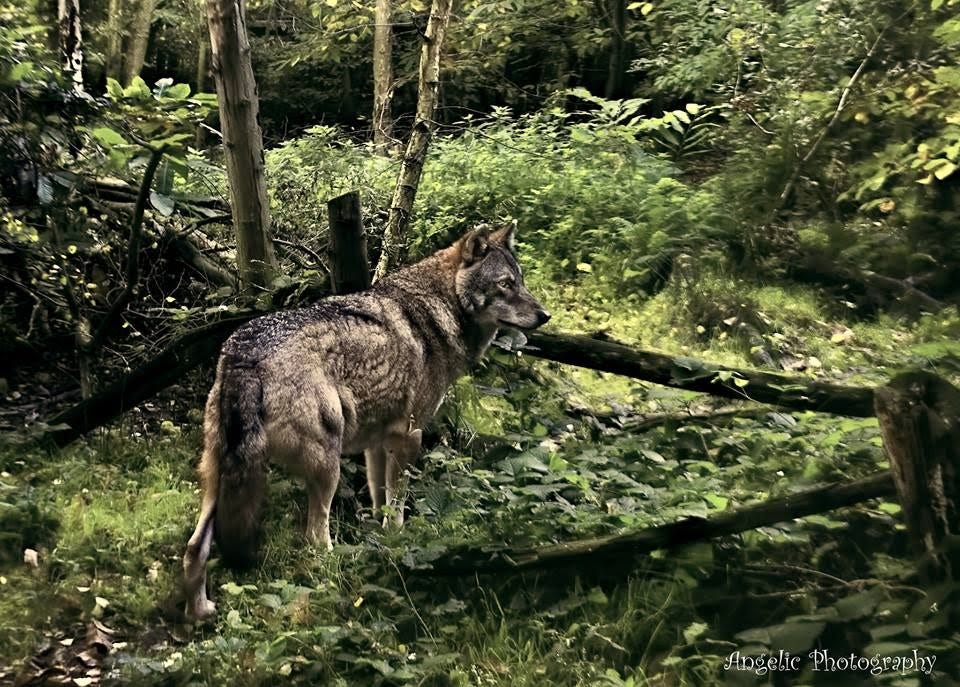
The purpose of this essay is not merely to correct a popular misapprehension, though that is a necessary beginning. It is to pursue a more unsettling argument: that the wolf, absent from Britain for nearly three centuries, is not simply harmless to human life, but is, on the available evidence, capable of actively protecting it. The mechanism by which a predator protects its prey species from killing road users requires some explanation; and that explanation, once grasped, reframes entirely the question of whether wolves belong in the Scottish Highlands.
The argument rests on three pillars of evidence. The first concerns how many people wolves actually kill. The second concerns how many people deer actually kill, specifically on British roads. The third concerns what happens to road deaths when wolves return to a landscape. These are not abstract propositions. They are quantifiable facts, and they yield a number: a number of human lives that wolves, were they to be reintroduced, might reasonably be expected to save.
Let us begin with the wolf.
I. What the record actually shows
The most comprehensive scientific assessment of wolf attacks on human beings is the 2021 study by John Linnell and colleagues at the Norwegian Institute for Nature Research, which extended and updated an earlier landmark report from 2002. Together, these two investigations cover a half-century of global incident data, and their findings, stripped of all qualification, are these.
In the fifty years to 2002, there were eight fatal wolf attacks across the whole of Europe and Russia combined. These were not evenly distributed across the continent; they were concentrated in regions where the disease of rabies remained prevalent amongst wildlife populations, and where wolves had, in some cases, lost their natural wariness of human beings through prolonged proximity to human waste and livestock. In the non-rabid, non-food-conditioned European wolf, there was, even then, essentially no record of predatory attack.
Since 2002, the record is yet more striking. Across the eighteen years from 2002 to 2020, researchers documented just twelve wolf attacks on human beings in the whole of Europe and North America combined. Of those twelve attacks, fourteen individuals were affected, and precisely two died; both fatalities occurred in North America, the first near a remote Saskatchewan mining camp where wolves had been attracted to an open refuse dump, the second in a similarly isolated area of Alaska. In Europe, over those eighteen years, with a wolf population that had grown to some fifteen thousand animals sharing territory with hundreds of millions of people, there was not a single fatal attack recorded.
The European Commission’s own analysis, published in 2023, confirms that there has been no verified fatal wolf attack on a human being in Europe in over forty years. Even though throughout that time, wolves have returned to every European country, barring Ireland.
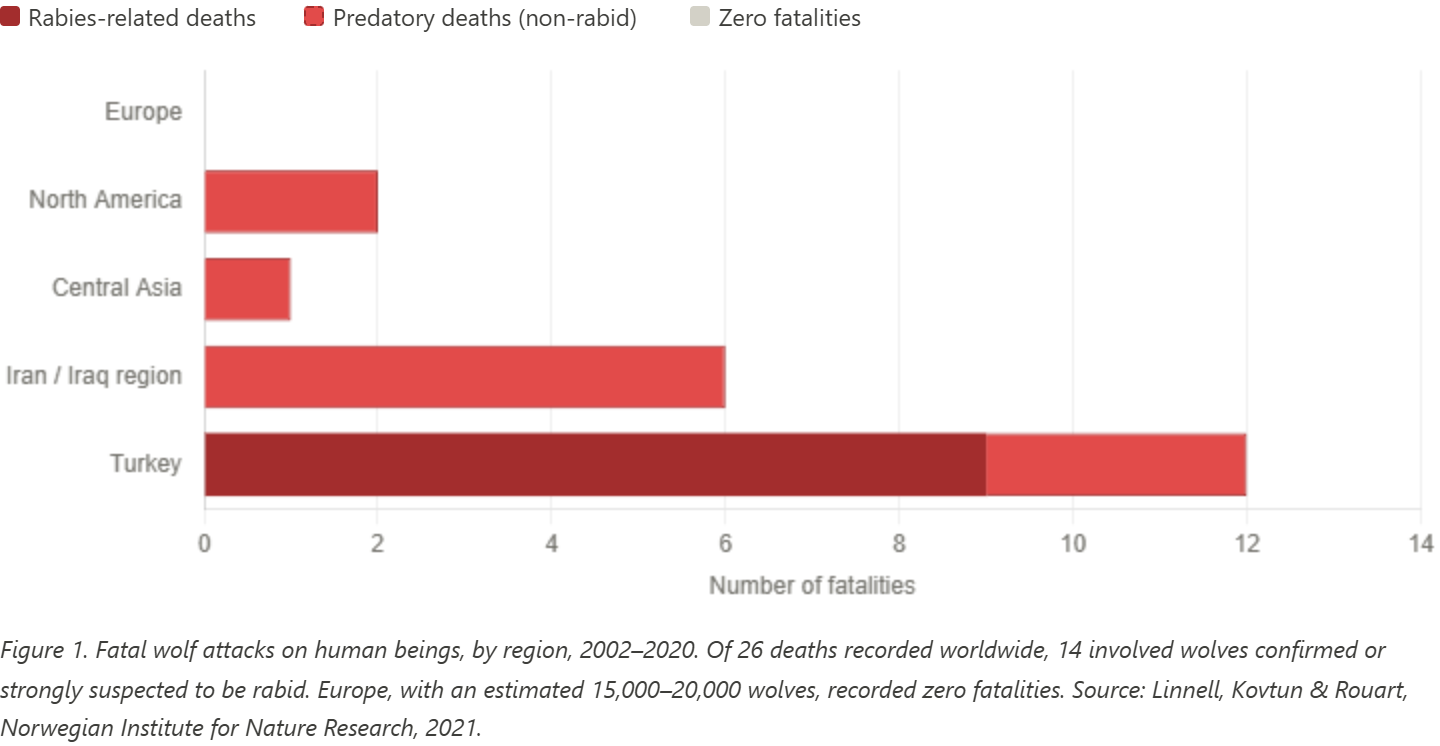
The conclusion to be drawn from these figures is not that wolves are entirely without risk; no large predator is. It is, rather, that the risk is of a specific and manageable character: it arises almost exclusively from wolves that are either infected with rabies, a disease eradicated from western Europe’s wildlife for decades, or from individuals that have become habituated to human presence through access to human food sources. The wild wolf of western Europe, living in landscapes where prey is plentiful and waste is properly managed, presents a risk to human life that is, in the words of the lead researcher, “above zero, but far too low to calculate.”
Germany, which now supports an estimated 1,200 to 1,300 wolves living within its densely populated borders, has recorded no wolf attack on a human being since the species recolonised the country at the turn of this century. France, Italy and Spain, all with substantial and growing wolf populations, report the same. The feared predator has returned to the heart of Europe, and human beings are going about their lives without incident.
Meanwhile, on Britain’s roads, a very different creature is killing people every year.
II. The deer on the road: a hidden toll
The population of wild deer in Britain is now estimated at somewhere between one and two million animals, the highest it has been for perhaps a thousand years. Six species are present, of which the native red deer and roe deer are most numerous, joined by the fallow, the sika, the muntjac and the Chinese water deer. They are, by any measure, a conservation success; but they are also, as the road network has expanded and traffic volumes have doubled since the 1970s, a source of steadily increasing danger to motorists.
A deer on a road is not merely an obstacle. It is a hazard of a particular kind. At motorway speeds, a collision with a red deer stag, which may weigh 150 kilograms, is comparable to striking a large piece of industrial machinery. The physics of such an encounter are unambiguous. At dusk and dawn, when deer are most active and human visibility is weakest, when October brings the rut and May brings dispersing yearlings, the roads of upland Britain become corridors of genuine peril.
The scale of the problem is poorly understood, partly because no central database of deer-vehicle collisions has ever been maintained in the United Kingdom. The most reliable estimates, drawn from the National Deer-Vehicle Collisions Project which has operated since 2003, suggest that between 40,000 and 74,000 deer are killed or injured on British roads each year. Each of these incidents carries a risk of human injury or death; a vehicle swerving to avoid a deer, striking it directly, or suffering a secondary collision as a result of an evasive manoeuvre may injure or kill its occupants.
The best available estimates place the annual toll of human fatalities attributable to deer-vehicle collisions in the United Kingdom at between ten and twenty. Across the fifteen years from 2010 to 2024, this accumulates to somewhere between 150 and 300 deaths; the midpoint estimate is 225 lives lost.
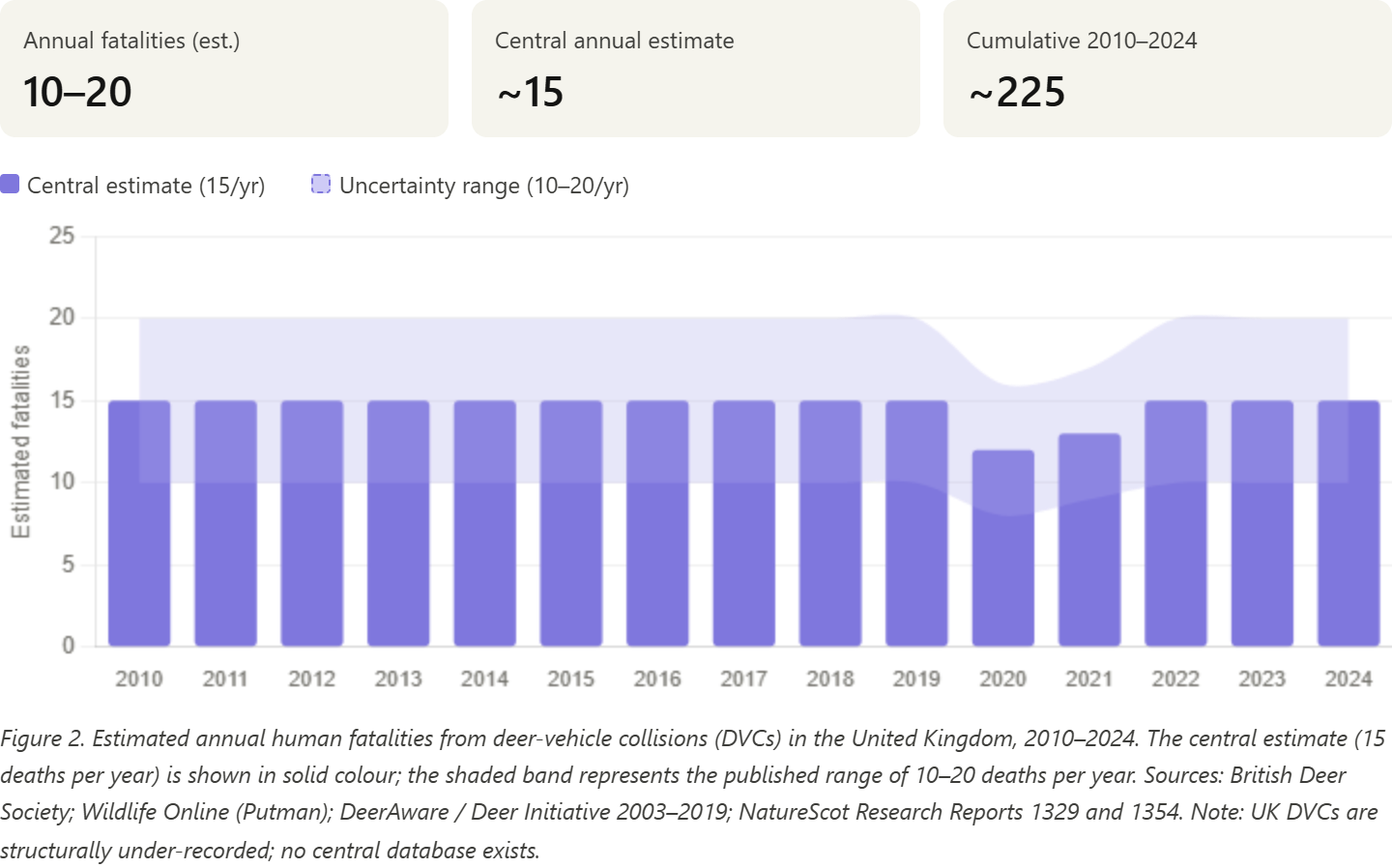
Two hundred and twenty-five lives, over fifteen years. These are not large numbers by the standards of road safety statistics; the annual toll from all causes on British roads runs to some 1,700 deaths. But they are consistent, and they are almost entirely absent from public discourse on deer management, let alone from public discourse on wolf reintroduction. They accumulate in silence, registered in coroners’ records and insurance claims, unmourned in any collective way, because there is no named cause to mourn: no named species, no named adversary, no villain in the story. There is only a car, a road, a darkness, and a deer.
In the Scottish Highlands, the problem has its own particular character.
III. Scotland’s burden
Scotland holds the majority of Britain’s red deer population, estimated at between 350,000 and 400,000 animals. The land is thinly populated by human beings but richly threaded with roads, many of them fast single-carriageway routes that cut through precisely the habitats that red deer occupy: the wooded glens, the moorland margins, the valley floors at dusk. The A82 along Loch Lomond and into Glen Coe, the A835 north of Inverness, the A87 through Glen Moriston, are amongst the most scenic roads in Europe; they are also, by consistent evidence, some of the most dangerous stretches of road in Scotland for deer-related collisions.
NatureScot, the Scottish Government’s nature agency, has maintained a database of deer-vehicle collisions since 2003, and its most recent analysis, covering the years 2008 to 2021, comprises 22,753 mapped incidents. This is known to be a substantial undercount; studies on three Highland trunk roads found that as few as one in four collisions on the more remote routes was independently reported to highway authorities. The recorded figures, therefore, represent a lower bound.
The trend within those recorded figures is instructive. From 2008 to 2016, the annual number of recorded DVCs in Scotland rose from approximately 1,100 to nearly 1,850. Since 2016, the figure has plateaued at around 1,850 per year, the plateau perhaps reflecting increased awareness and reporting standardisation as much as any change in underlying collision frequency.
Of greater concern is the human cost. Analysis of Personal Injury Accident records suggests that Scotland experiences between 70 and 120 deer-related injury accidents each year, of which between one and two annually result in fatalities. The Scottish Government’s Deer Working Group, reporting in 2020, noted that nearly 60 per cent of the injury cases involved a driver swerving to avoid a deer and striking another vehicle or a roadside object, rather than a direct impact with an animal; the deer need not be touched at all for the chain of events to prove fatal.
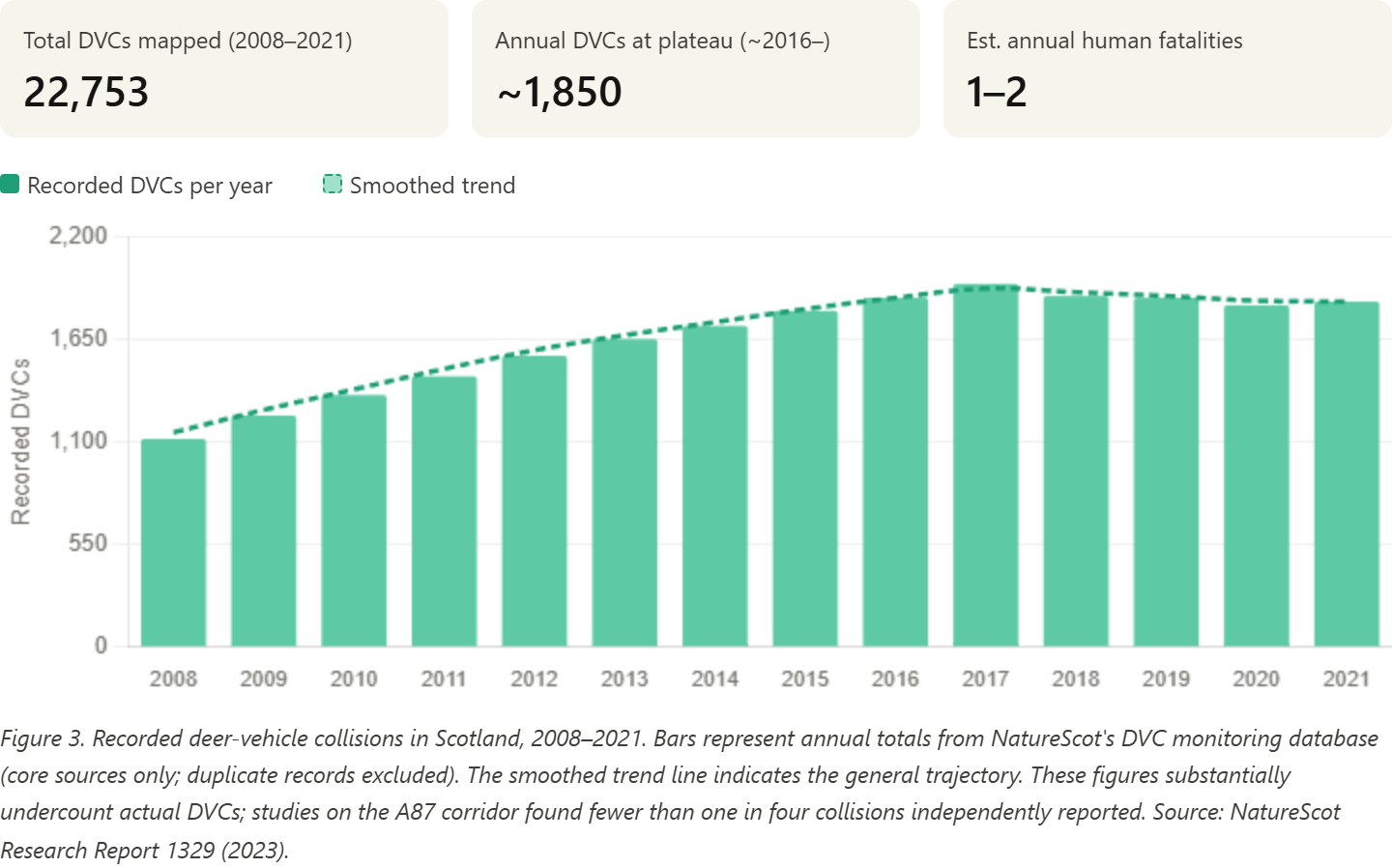
The plateau in recorded collisions since 2016 should not be read as cause for complacency. NatureScot’s own analysis notes that increases and decreases have occurred locally during this period, with the greatest increases concentrated in Scotland’s central belt, where deer populations have expanded into suburban and peri-urban environments, and the greatest decreases in some parts of the northern Highlands. The overall picture is of a hazard that has become a permanent feature of Scottish road life: not a crisis, perhaps, but a steady, recurring, and entirely preventable drain upon human life and limb.
The question then becomes: preventable by what means?
IV. The mechanism: fear as population control
To understand how wolves reduce the frequency of deer-vehicle collisions, it is necessary to understand something that ecological science has taken considerable effort to establish: that the most important thing a wolf does to a deer is not kill it, but frighten it.
The concept is known as the trophic cascade, and its most celebrated demonstration is the reintroduction of wolves to Yellowstone National Park in 1995. When wolves returned to Yellowstone after an absence of seventy years, elk populations declined, as one might expect; but the reduction in browsing pressure that followed was insufficient by itself to account for the dramatic recovery of vegetation that ecologists observed. What had changed, in addition to the number of deer, was the behaviour of deer. Animals that had formerly grazed openly in valley floors and riverbanks now avoided those areas, which were natural ambush sites where wolves could approach unseen. The deer were not present in smaller numbers so much as they were absent from particular places, particularly the places adjacent to human movement and, crucially, roads.
This phenomenon is now studied under the phrase “landscape of fear,” a term introduced by the ecologist Joel Brown in the late 1990s. It describes the spatial reorganisation of prey behaviour in response to the perceived risk of predation: not a reduction in the number of prey animals, necessarily, but a redistribution of their activity, such that they avoid places and times of high risk. For a deer, a roadside verge at dusk, with a line of approaching headlights and nowhere to flee, is precisely the kind of location that a landscape of fear causes it to avoid.
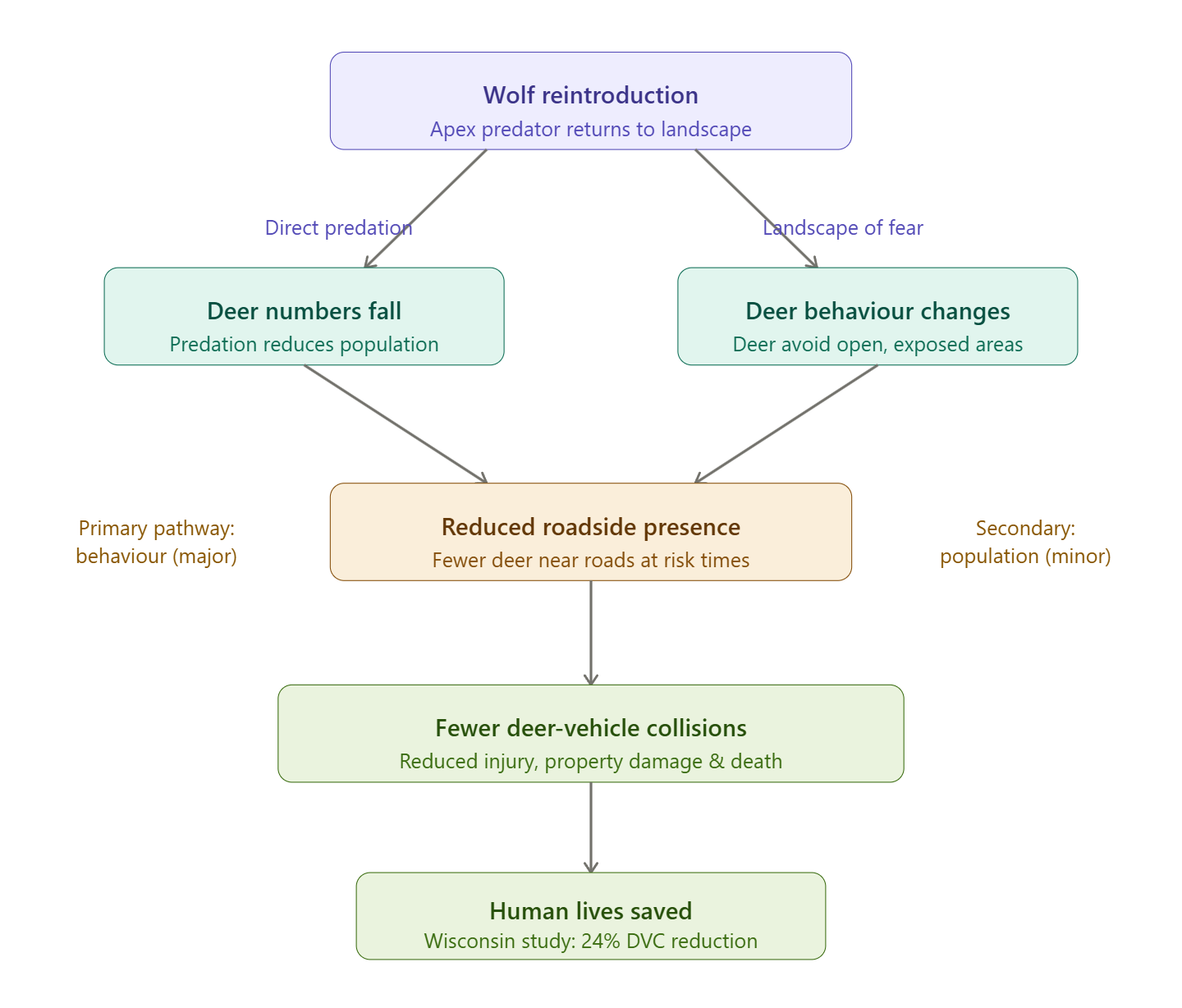
The evidence base for this mechanism is now substantial. A study published in the journal Oecologia in 2015, examining grey wolves and white-tailed deer in a northern Wisconsin forest, found that in areas of high wolf use, deer were 62 per cent less dense than in areas where wolves were absent; more remarkably, the average duration of deer visits to those areas was reduced by 82 per cent, and the proportion of time that deer spent foraging was dramatically curtailed. The wolves were not simply eating the deer in significant numbers; they were making certain places too dangerous for deer to linger in, and those places included open ground, valley floors, and road corridors.
The practical consequence for road safety was quantified directly in a landmark 2021 paper published in the Proceedings of the National Academy of Sciences by Raynor, Grainger and Parker. Analysing deer-vehicle collision data across Wisconsin counties over a period when wolf populations expanded naturally, the researchers found that the entry of wolves into a county was associated with a 24 per cent reduction in DVCs. The economic benefit of this reduction, they calculated, was 63 times greater than the total verified cost of wolf predation on livestock in the same period.
The study also addressed a question of considerable practical significance: could the same reduction in DVCs be achieved by increasing human hunting of deer, without the expense and controversy of wolf reintroduction? The answer was unambiguous. Human hunters could not replicate the effect. The reduction that wolves produce is, in the main, not a consequence of reducing the number of deer, but of changing the way deer inhabit a landscape. The “landscape of fear” is not something that a weekend shooting party can manufacture.
V. The arithmetic of lives
The question that now presents itself is simple, even if the answer is necessarily approximate: how many lives might a wolf population save, were it to be reintroduced to Scotland and, in time, to the wider uplands of Britain?
The calculation requires two inputs. The first is the baseline figure: how many people are currently dying in deer-vehicle collisions each year. The second is the reduction factor: by how much might a wolf population, in territories it occupied, reduce the frequency of those collisions?
On the first question, the evidence reviewed in the preceding sections suggests a range of ten to twenty deaths per year across the United Kingdom, with a central estimate of fifteen. For Scotland, the equivalent range is one to two deaths per year, with a central estimate of approximately 1.5. These are conservative figures; the structural under-recording of DVCs in the United Kingdom means that the true toll is likely higher, not lower.
On the second question, the Wisconsin figure of 24 per cent is the only peer-reviewed, empirically derived estimate available from a comparable landscape. It is a conservative figure to apply to Scotland, for reasons that will become apparent: the Wisconsin study measured the average effect across entire counties, many of which contained roads and habitats where wolves were not present. In the specific corridors of the Scottish Highlands where wolf territories would concentrate, the A82 through Loch Lomond, the A87 through Glen Moriston, the roads flanking the Cairngorms, the reduction in DVC frequency might reasonably be expected to exceed the county-wide average.
Applying 24 per cent to the midpoint estimates yields the projections illustrated in Figure 5.
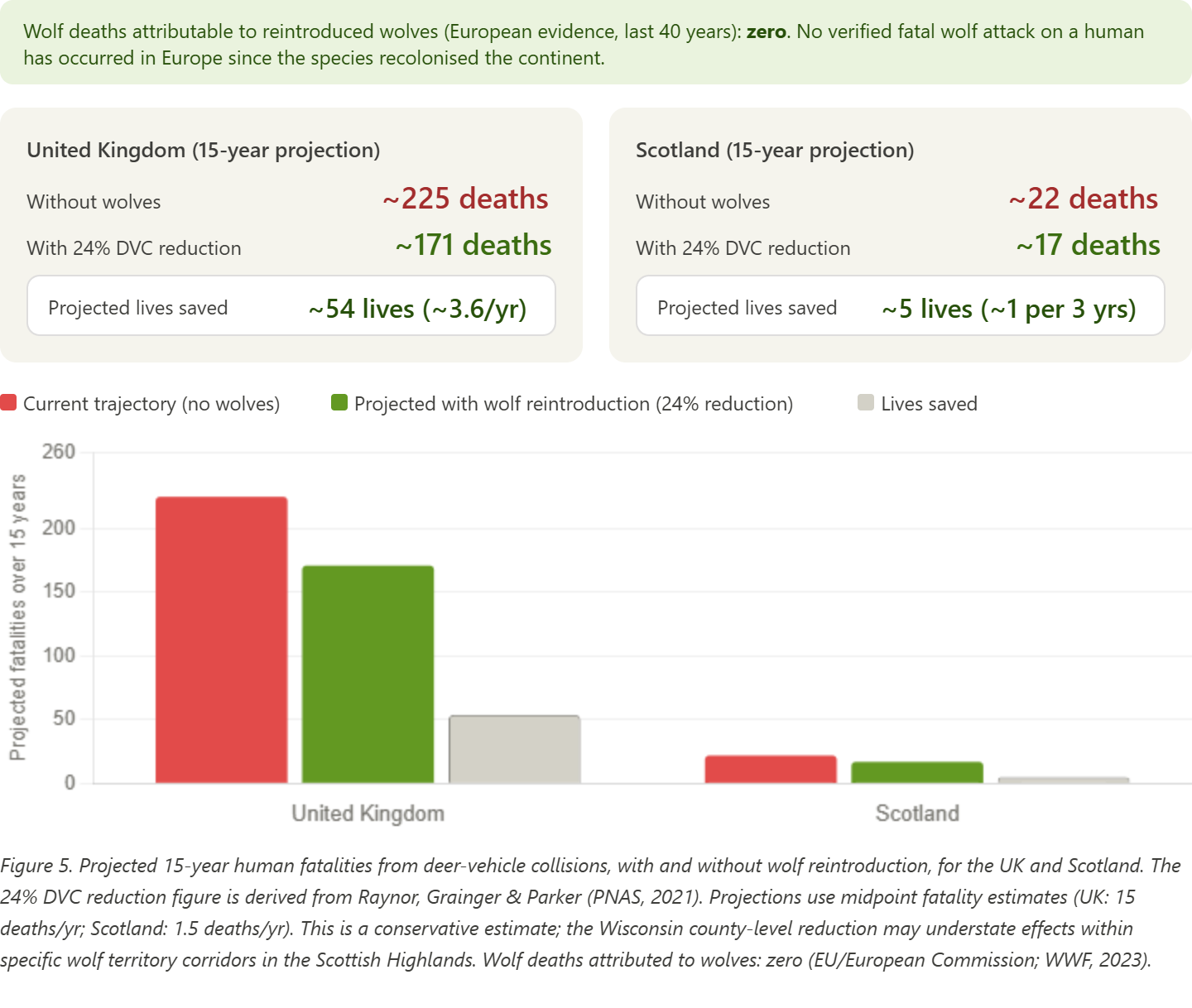
The figures are not dramatic. Fifty-four lives saved across the United Kingdom over fifteen years is not the sort of number that commands the front pages. But then neither is the loss of fifteen lives per year to deer on roads, which has proceeded without public comment for as long as records have been kept. The point is not the absolute scale of the figures. The point is the direction of the comparison: wolves, by the best available evidence, save more lives than they cost. The balance sheet is unambiguous.
There are, of course, important qualifications to be met. The Wisconsin landscape is not Scotland; the white-tailed deer is not the red deer; the social and land-use context of a reintroduction in the Scottish Highlands would differ from that of wolf recolonisation in the American Midwest. It is possible that the 24 per cent reduction is an overestimate in some respects and an underestimate in others. It is, in short, a model, and models are imperfect instruments. What they are not is worthless. In the absence of British data, the Wisconsin study is the best available evidence, derived by rigorous quasi-experimental methods from a large and well-documented natural experiment; and its findings are consistent with the general body of ecological theory on apex predator effects.
VI. The question of perception
Why, then, does the wolf remain so contentious? If the data establish that wolves in modern Europe kill no people, whilst deer on modern British roads kill fifteen people a year, why is it wolves that provoke anxiety, and deer that provoke admiration?
The answer lies, in part, in the nature of risk perception. Human beings are poorly calibrated to assess statistical risk; they respond, instead, to narrative salience. A wolf attack, were one to occur, would be a named event, with a victim and a perpetrator, reported in every newspaper. A deer-vehicle collision resulting in a fatality is recorded, if at all, as a road traffic incident; the deer is not named; no inquest addresses the question of the species involved. The wolf death is a story; the deer death is a statistic.
There is, in addition, a deep cultural inheritance at work. The wolf as predator occupies a symbolic space in the European imagination that no amount of ecological data can easily dislodge. It is the creature of children’s stories and folk memory, of dark forests and winter nights, of the livestock lost, and the shepherd’s livelihood ruined. These are not imaginary concerns; they are the distilled experience of centuries of genuine conflict between rural people and a large carnivore that killed their animals and, occasionally, in earlier centuries when rabies was common and wolf populations were under pressure from persecution, their children. The fear is not irrational; it is merely obsolete.
The livestock question deserves brief treatment in this context, because it is the objection most frequently raised by those who work the upland landscapes where wolves would live. The European Commission’s data indicate that wolves across the European Union kill approximately 65,500 head of livestock each year, of which 73 per cent are sheep and goats. This is not a negligible figure for individual farmers; at a local level, the impact on a small hill farm can be severe. The economic and welfare costs of livestock predation are real, and any serious proposal for wolf reintroduction must reckon with them honestly, through compensation schemes, the adoption of proven protective measures such as livestock guarding dogs and predator-proof enclosures, and a genuine partnership between conservation interests and farming communities.
These are, however, problems that the countries of mainland Europe have learned to manage. They are management problems, not fundamental objections.
Conclusion: rebalancing the calculus
The wolf offers us numerous advantages, and learning to live alongside them will ultimately help save lives. We need to look more closely at the root of our anxiety. Often, this fear is fanned by landowners who prioritise extracting every penny of profit from their estates at the expense of the natural world.
This leads to a broader issue: how do we prevent the destruction of nature for financial gain? We see this clearly in the Scottish stalking estates that overbreed deer, or sheep farmers who overgraze the land for profits that only exist because of government subsidies or tax breaks.
The most economically mature and sensible solution is to introduce a Land Value Tax. Under this system, land with high biodiversity would attract a lower tax rate, while land that is heavily exploited would be charged more. There is a long history of support for this fundamental economic model. Respected organisations such as the Scottish Land Revenue Group have championed it, and the more forward-thinking members of both the Scottish Greens and the Nationalists have a history of advocating for this policy.
Such a policy would remove the economic argument from these groups, who form the most vocal and organised opposition, feeding on the fear people unjustly have.
Then there is the longer inheritance. The rewilded landscapes that wolves would allow to regenerate, by holding deer populations below the threshold at which saplings can survive, is estimated to sequester one million tonnes of CO2 every year. Britain’s existing trees already provide over £400 million a year in flood protection alone, with their natural capital value put at up to £25 billion over a century. A rewilded Highland landscape, filtered through living root systems rather than stripped bare by overgrazing, would hold more water, slow more floods, clean more rivers, and lock away more of the carbon that is already warming the summers and swelling the storms our children will live through. The case for wolves is sometimes framed as a question of rewilding ideology or rural economics. It is also, straightforwardly, a question of what kind of country we are leaving behind. Every year we delay is another year of preventable accidents, accelerating emissions, and degraded landscapes passed on to people who had no voice in the decision.
That is the wolf paradox, stated in its starkest form: the creature we fear for its danger to human life is, if the evidence is followed to its conclusion, a net protector of it. The animals presently occupying British uplands in their hundreds of thousands, browsing placidly at the roadside as evening falls, kill more people every year than wolves have killed in Europe in living memory. To debate wolf reintroduction purely based on the wolf’s danger to human beings is, in this light, to argue precisely the wrong way round.
The wolf is not the threat. The absence of the wolf is.
Sources and further reading: Linnell, J.D.C., Kovtun, E. and Rouart, I. (2021). Wolf attacks on humans: an update for 2002–2020. Norwegian Institute for Nature Research; Raynor, J.L., Grainger, C.A. and Parker, D.P. (2021). Wolves make roadways safer, generating large economic returns to predator conservation. Proceedings of the National Academy of Sciences 118(22); NatureScot Research Report 1329 (2023). Deer Vehicle Collision Analysis 2019–2021; Scottish Government Deer Working Group Report (2020), section 15; British Deer Society, Deer Vehicle Collisions (2023); WWF Europe, Facts about wolves in Europe (2023).


Comments
Post a Comment