The Beavers are Doing the Work For Free
What a semi-aquatic rodent can teach us about Land Value Tax, the cost of conservation, and who really pays when we get land wrong.
Get me on Substack now: Peter Smith Rewilding
LAND, ECOLOGY AND POLITICAL ECONOMY
There is a striking irony at the heart of modern
conservation: we pour enormous sums into restoring habitats and recovering
species, and yet we consistently overlook the cheapest, most effective
workforce on the planet. It does not invoice. It does not require a project
manager or a steering group. It does not need a monitoring contract renewed
every three years. It just turns up, reads the landscape, and gets on with the
job.
It is, of course, the beaver.

This essay began as a comment on a LinkedIn post by Matt
Larsen-Daw, a conservationist whose argument I find difficult to fault. He made
the point that policy thinking around biodiversity tends to chase
single-species spectacles whilst ignoring the systemic pressures that are
fragmenting habitats in the first place. He is right about that. But the
observation that lodged in my mind was a simpler, more provocative one: that
classical conservation is extraordinarily expensive, and beaver rewilding, by
comparison, is almost absurdly cheap. And when you follow that thread far
enough, you arrive somewhere unexpected. You arrive at Land Value Tax.
The true cost of restoration
To understand why beaver rewilding is so economically
unusual, it helps to think carefully about what conservation normally costs.
When we attempt to restore a degraded wetland, a relic meadow or a fragment of
ancient woodland through conventional means, we are essentially trying to
recreate, by human effort and expenditure, the conditions that nature would
have created and maintained for nothing. That requires paying people:
ecologists, contractors, wardens, consultants. It requires acquiring land or paying
compensation to landowners whose management it constrains. And it requires
doing all of this indefinitely, because the moment the funding lapses, the
pressures return.
Land is, in Britain, particularly, the highest single cost
in almost any conservation equation. The price of agricultural land, the
compensation demanded by owners whose income might be affected by habitat
restoration, the legal and planning costs of securing any kind of
nature-friendly outcome against a system geared towards treating land primarily
as productive capital: all of this adds up to a situation in which restoration
is inherently reactive, always fighting against the grain of economics, always
dependent on philanthropy or public subsidy to hold the line.
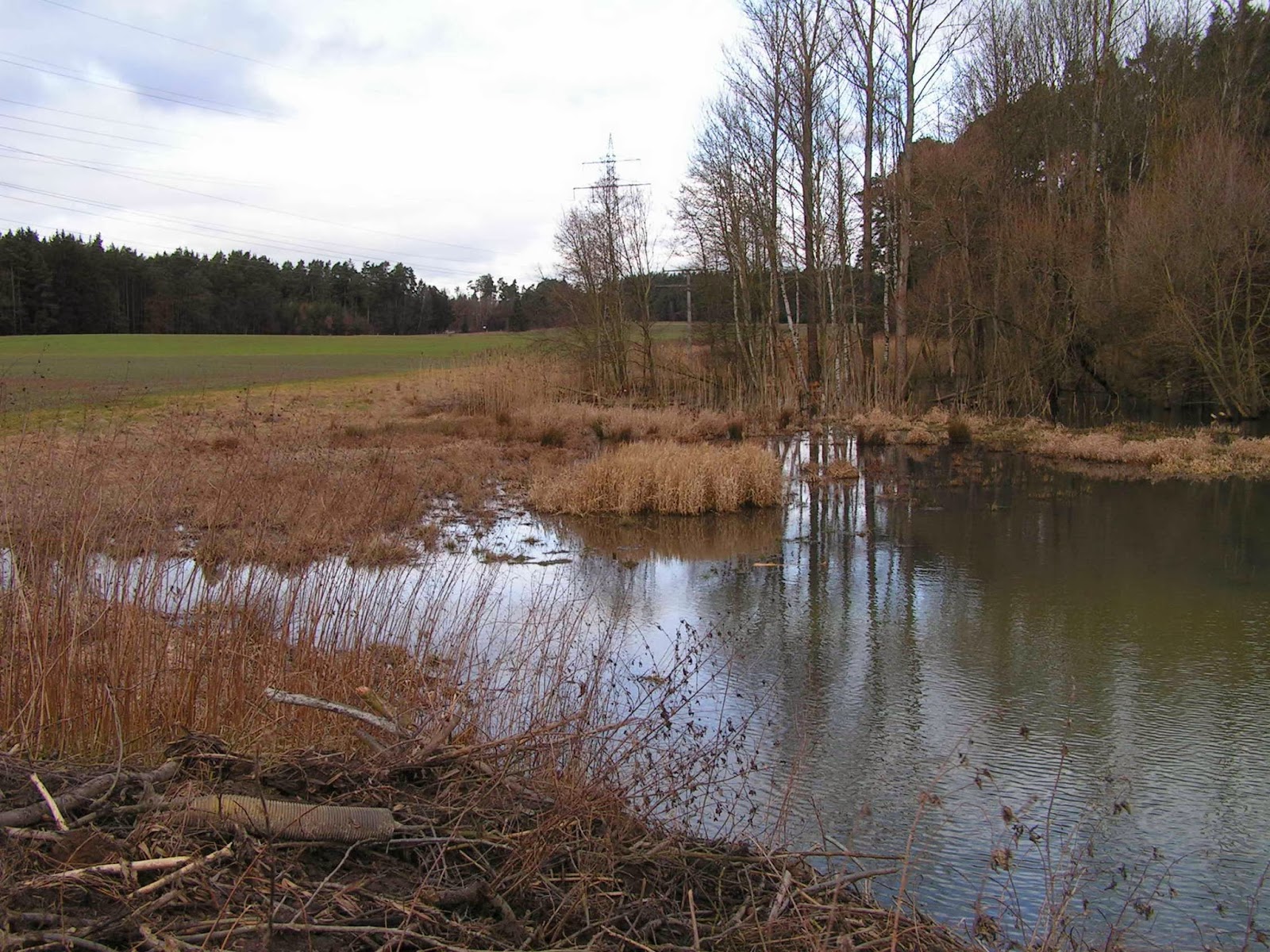
A beaver does not negotiate a land price. It simply floods
what works. And in doing so, it creates value that no human budget could
replicate.
Beaver rewilding does not eliminate these costs entirely.
There are licensing requirements, engagement processes with neighbouring
landowners, monitoring obligations and, occasionally, management interventions
where a dam causes a problem that genuinely cannot be tolerated. But the
structural economics are entirely different. Once the animal is present and
settled, it begins to do the heavy lifting. It builds. It floods. It creates
the slow water, the sediment traps, the wetland margins, the scrubby willows
and the insect-rich shallows that conservationists elsewhere are spending
hundreds of thousands of pounds to engineer. The beaver is not the beneficiary
of the restoration programme. The beaver is the restoration programme.
What the beaver actually does
It is worth pausing to appreciate the sheer ecological
productivity of what a pair of beavers can accomplish, because it is genuinely
astonishing when set against the human alternative. A single beaver family,
working over a decade or two in a suitable river catchment, can transform a
degraded drainage channel into a complex wetland mosaic. Their dams raise the
water table across a far wider area than the impounded pool itself, rehydrating
the surrounding land and allowing wet grassland, carr woodland and fen
vegetation to re-establish. The pools behind their dams accumulate the fine
sediments that would otherwise move downstream, reducing flood peaks in the
wider catchment. The standing deadwood in their flooded areas becomes habitat
for specialist beetles, hole-nesting birds and bats. The shallow, warm,
weed-rich margins of their ponds are among the most productive nursery habitats
for fish, amphibians and invertebrates in the entire freshwater ecosystem.
All of this is what ecologists call ecosystem engineering,
and it is extraordinarily difficult and expensive to replicate by hand. The
Steart Marshes project in Somerset, a wonderful piece of managed realignment
and wetland restoration, cost millions of pounds. The beavers on the River
Otter in Devon, monitored over five years by Devon Wildlife Trust, produced
measurable improvements in water quality, flood attenuation and biodiversity at
a tiny fraction of that cost, principally because the animals themselves were
doing the work.
The point is not that human-led conservation is wasted. It
is not. There are landscapes so degraded, so fragmented, so far from any
semblance of natural function that they genuinely need active intervention to
get them started. But the beaver case makes visible a principle that applies
far more broadly: the most efficient restoration is the one that harnesses
natural process rather than substituting for it. The moment you can hand the
work back to the ecosystem, the economics transform.
The policy blind spot
Which brings us to the problem Matt Larsen-Daw identified so
sharply. Government policy on nature recovery in this country has a persistent
habit of celebrating the visible, the announceable, the thing that can be
photographed for a press release, whilst systematically failing to address the
structural forces that make recovery so difficult and so expensive in the first
place.
Tree planting is the clearest recent example. Billions of
pounds committed, hundreds of millions of trees promised, and all the while the
planning system was approving developments on ancient woodland buffer zones,
the Forestry Commission was struggling to enforce basic protections for veteran
trees, and the pattern of land ownership that makes woodland management
economically unviable for most small woodlands went entirely unreformed.
But there is a deeper absurdity lurking within the tree
planting programme that rarely gets the attention it deserves. Trees, left to
their own devices, plant themselves. They always have. The process is called
natural regeneration, and it is one of the most powerful and underappreciated
forces in ecological restoration. When grazing pressure is removed from a piece
of land adjacent to a seed source, woodland returns. It does not return
uniformly, in the neat rows of a Sitka spruce plantation or the conscientious
spacing of a community planting day. It returns messily, opportunistically, in
the precise configuration that the local seed rain, soil conditions, topography
and microclimate dictate. And that messiness is not a flaw. It is the source of
the thing’s extraordinary value.
Naturally regenerated woodland is, almost without exception,
more structurally diverse than planted woodland of equivalent age. The canopy
is uneven. The understorey is complex. The species mix reflects what genuinely
belongs in that place, drawn from locally adapted seed sources rather than from
a nursery catalogue. Dead wood accumulates in a way that planted woodland,
which tends to be managed for tidiness or timber, rarely allows. The result is
a habitat of quite different ecological character: richer in lichens, fungi,
invertebrates and the birds and mammals that depend on them. Studies comparing
planted and naturally regenerated woodland consistently find greater
biodiversity in the latter, often substantially so.
None of this means tree planting is never appropriate. On
highly degraded land where the seed bank has been exhausted and no seed source
exists within dispersal range, planting is often the only option. But the
Government’s instinct has been to reach for the spade and the sapling before
asking the simpler question: if we simply stopped doing the thing that was
preventing the trees from returning, would they come back on their own? In many
cases, the answer is yes. Reduce the sheep numbers. Remove the deer fence and
let natural browsing reach a sustainable level. Stop burning the moorland. Give
the land permission to rewild, and the woodland will follow, free of charge,
better adapted and more biodiverse than anything we could have put there
ourselves.
The pattern is the same as with the beaver. Nature is not
waiting for us to restore it. It is waiting for us to stop preventing it from
restoring itself.
Enter Land Value Tax
Now I want to make a connection that may seem unexpected,
but which I believe is genuinely illuminating. Because the beaver, in its
relationship to the land, is doing something structurally very similar to what
Land Value Tax does in its relationship to the economy. And understanding that
parallel is, I think, one of the more useful ways of grasping why LVT matters.
Land Value Tax, for those unfamiliar with it, is a levy on
the unimproved value of land: not the buildings on it, not the investment made
in it, but the underlying locational value that arises simply from where the
land sits, what surrounds it, and what the community has built nearby. A plot
of land in the centre of a prosperous city is valuable not because its owner
did anything particular to make it so, but because roads, schools, hospitals,
transport networks, businesses and the accumulated social fabric of a community
have made that location desirable. LVT proposes to tax that value, rather than
taxing the income earned or the improvements made.
The economic argument for LVT, championed by thinkers from
Henry George in the nineteenth century through to contemporary economists
across the political spectrum, is that it is the least distorting tax
imaginable. You cannot move land. You cannot reduce the supply of it in
response to taxation. And because the tax falls on the value created by the
community rather than by the individual, it does not penalise productive
activity. It penalises sitting on land and doing nothing with it, whilst the
community around you makes it more valuable.
The beaver does not ask permission to restore a floodplain.
Land Value Tax does not ask permission to unlock land that is being held idle,
or punish those seeking to harm nature, whilst others go without.
The consequence, in a well-designed LVT system, is that land
is used more efficiently. Owners who cannot afford to pay the annual levy on
land they are holding speculatively will either develop it, put it to
productive use, or sell it to someone who will, or not use it... The great
reservoirs of undeveloped land that are held in hope of planning permission,
whilst housing is unaffordable, begin to drain. The green belt landowner who is
sitting on a brownfield site adjacent to an existing settlement, waiting for
the political wind to change, faces a different calculation. The city-centre
car park that generates enough income to cover a trivial ground rent but whose
underlying land value is enormous becomes untenable to hold idle. Land, in
short, is forced into its most productive use by the logic of the tax itself.
If we wish to genuinely protect our natural habitats, we
must look beyond mere sentimentality and turn to the cold, unfeeling mechanism
of a Land Value Tax.
Picture a piece of pristine, undisturbed woodland or a
tranquil agricultural field. Overtly, it has immense ecological worth but a
rather pitiful commercial market value. Consequently, under a Land Value Tax
regime, the taxman largely ignores it. The land remains cheap to hold, provided
you leave it alone.
However, the precise microsecond a local authority bestows
planning permission upon this leafy idyll, its market value rockets into the
stratosphere. Because the tax is tethered to this market value, the annual tax
bill follows suit and becomes astronomically high. It is, in economic terms, a
severe and immediate slap on the wrist for anyone harbouring dreams of pouring
concrete over badger setts.
To elucidate this with a few practical scenarios, let us
observe how this alters the behaviour of the construction industry:
Scenario A: The Speculative Scoundrel
Let us imagine the common or garden speculative developer.
Our protagonist purchases a pristine wildflower meadow on the edge of a village
for a relative pittance. Under conventional circumstances, they might
aggressively lobby the local council into granting permission for a sprawling
estate of identikit houses, subsequently making a vast, untaxed fortune.
Yet, under a strict Land Value Tax regime, their moment of
bureaucratic victory is immediately soured. The moment that housing permission
is granted, the land is revalued as prime real estate. The developer is
suddenly saddled with a monumental annual tax bill before a single brick is
even laid. The sheer financial terror of holding this newly permitted land acts
as a robust deterrent. Knowing this recurring penalty is baked into the system,
developers quickly realise that buying up the countryside for a quick
speculative profit is a fool’s errand.
Scenario B: The Urban Wasteland
To truly save the countryside, we must also look at the
city. Picture an abandoned, weed-choked industrial lot in the centre of a
bustling town. The location itself is highly desirable, meaning the baseline
land value is naturally astronomical.
Under our tax scheme, the owner of this urban blight is hit
with a punishingly high tax bill every single year, regardless of the fact that
the site is currently home only to broken glass and feral pigeons. To escape
this fiscal strangulation, the owner is forced into a corner. They must either
build something useful upon it to generate income, or sell it hastily to a
developer who will.
The Ecological Triumph
The ultimate beauty of this system is how it manipulates
market forces for the greater good. It mercilessly penalises the destruction of
our natural habitats by making newly permitted greenfield sites financially
toxic to hoard. Simultaneously, it forces the construction industry to
cannibalise the already concreted, derelict spaces of our cities. It is perhaps
the rarest of political phenomena: a taxation strategy that actively gives
Mother Nature a desperately needed hug.
The parallel with the beaver
Here is the parallel I want to draw out. The beaver, when
reintroduced to a catchment, does not merely create ecological value in the
places it inhabits. It forces the entire system around it towards greater
productivity. The flooding it causes, the waterlogging of marginal land, the
altered hydrology of the catchment: these are not simply side-effects. They are
the mechanism. By occupying land that was previously being underused, by
insisting on a relationship with water that the drainage engineers had suppressed,
the beaver induces a wholesale reassessment of what that land is for and how it
should function.
Land Value Tax does exactly the same thing in the human
economy. It does not merely generate revenue. It forces a reassessment of land
use across the entire system. Idle land is made costly to hold. Productive use
is made relatively cheaper. The speculative premium that has made British land
so expensive, and which flows upwards to landowners as unearned wealth whilst
everyone else pays for it through high rents, high house prices, and the
impossibility of starting a business in many of our towns and cities, is
progressively eroded.
The effects flow through the economy in ways that are
remarkably analogous to what the beaver does in the catchment. Housing becomes
more affordable as land is released and the speculative premium deflates. Rents
fall, because the landlord can no longer hold an underused building and simply
wait for rising land values to do the work. Starting a business becomes
cheaper, because commercial premises in accessible locations are no longer
priced at a level that only the very largest chains can sustain. Wages rise,
because the cost of simply existing, of putting a roof over your head and
getting to work, is no longer consuming so large a share of what people earn.
Employment expands, because the friction that land costs impose on economic
activity throughout the system is reduced.
And, critically, land is released for uses that are not
economically intensive at all. Including, potentially, nature.
The rewilding dividend
One of the underappreciated implications of LVT, when
applied thoughtfully, is that it changes the calculus for land on the rural and
peri-urban fringe. At present, marginal agricultural land, land that is not
particularly productive even by farming standards, is nonetheless held at a
price that reflects speculative hope: the hope that it will eventually receive
planning permission, or that a solar farm will want to lease it, or that some
future subsidy regime will make it worth holding. That speculative value has to
be serviced, which means the land has to be used intensively even when the
ecology would benefit enormously from it being left alone or managed very
lightly.
Under LVT, the speculative premium on genuinely marginal
land falls. The holding cost of land whose productive value is modest and whose
location offers no extraordinary locational advantage becomes more
proportionate to its actual use. This is precisely the land that is most
suitable for rewilding, for the kind of extensive, low-intensity land
management that allows natural processes, including beavers, to do their work.
And it is, in many cases, exactly the land on which trees would regenerate
naturally if only the economic pressure to keep it in intensive use were
removed. The tax, in other words, does not merely make the economy more
efficient. It makes space for nature by aligning the economic incentives of
landholding with the ecological potential of the land.
There is a deeper resonance here too. One of the persistent
obstacles to rewilding in Britain is the concentration of land ownership. The
fact that vast tracts of upland Britain are owned by a small number of
individuals and estates, managed primarily for grouse shooting or for the tax
advantages that agricultural land confers, is not simply a cultural curiosity.
It is an economic problem created by the way we tax, or rather fail to tax,
land. When land ownership confers tax advantages, when land is the ultimate
store of wealth in an inflationary system, when the best hedge against the
failures of the productive economy is to own the ground beneath it, then land
concentrates. And concentrated land in the hands of those whose primary
interest is wealth preservation rather than productive use is precisely the
condition that makes large-scale nature recovery so difficult and so expensive
to achieve.
The revolutionary animal
I said at the beginning of this essay that beaver rewilding
is quietly revolutionary. I want to be more precise about why. It is not simply
that beavers are cheap conservation, though they are. It is that they represent
a fundamentally different theory of how restoration works. The conventional
theory says: identify the problem, design the solution, fund the intervention,
implement and monitor. The beaver theory says: remove the obstacle, allow the
process, get out of the way.
Natural regeneration makes exactly the same argument about
trees. Do not plant a woodland. Remove the thing that is preventing the
woodland from returning, and let it come back on its own terms, in its own
time, in the precise form that this particular patch of ground has been
waiting, for decades or centuries, to express. The result will be stranger,
messier and more alive than anything you could have designed.
Land Value Tax is the same kind of thinking applied to the
economy. The conventional theory of economic policy says: identify the market
failure, design the subsidy or regulation, fund the intervention, implement and
monitor. LVT says: remove the structural incentive that is causing land to be
misallocated, allow the market to work on a fairer basis, and trust that the
productive energy of people and communities, no longer drained off into land
speculation, will find its own level.
None of these, the beaver, natural regeneration, or LVT, is
a magic solution. The beaver cannot restore a river that has been straightened,
polluted and confined in a concrete channel. Natural regeneration cannot clothe
a landscape that has been grazed to mineral soil for three hundred years
without first addressing the grazing. LVT cannot, by itself, solve every
inequity in the housing market or conjure employment in a community where the
underlying economic infrastructure has been removed. But all three represent a
shift from the exhausting, expensive, reactive approach of fighting the system
to the far more powerful approach of changing the system so that it works with
you rather than against you.
The beaver, the self-seeding tree and Land Value Tax are
all, at root, arguments about what happens when you stop subsidising the wrong
things and start making room for the right ones.
Who owns the flood?
There is one final question that both the beaver and Land
Value Tax force into the open, and it is the most uncomfortable one of all. It
is the question of ownership.
When a beaver floods a field, it is not, in any legal sense,
asking permission. The water goes where the hydrology dictates. The land that
was being farmed at a loss, or grazed by a handful of sheep for the sake of the
subsidy, becomes a wetland. Its use has changed. Its value, in ecological
terms, has increased dramatically. Its value in conventional agricultural terms
has, at least in the short run, declined. The owner has a legitimate grievance
in law. But the wider community, the communities downstream whose flooding risk
has been reduced, the fishermen whose catches improve, the birdwatchers who
come to see the bitterns, the water companies whose treatment costs fall as the
catchment retains more water and releases it more slowly: all of them have benefited
from something they did not pay for.
Land Value Tax makes the same point about the human economy.
The value of land is created by the community. The roads that make it
accessible, the schools that make it desirable, the hospitals and parks and
cultural institutions that make a place worth living in: all of these are
publicly created values that are currently captured privately, by whoever
happens to own the land in a given location when the value rises. LVT says that
value should be returned to the community that created it.
In both cases, we are being asked to rethink a very deep
assumption: that land is simply property, to be held and used and exploited
according to the wishes of its registered owner, with no obligation to the
wider systems, ecological or social, of which it is part. The beaver challenges
that assumption physically, by flooding without a licence to do so. LVT
challenges it fiscally, by taxing the value that ownership alone creates.
These are not small arguments. In Britain, where land
ownership is one of the most politically protected interests in the entire
economy, and where the relationship between land, wealth and power goes back
centuries, both the beaver and LVT have a habit of provoking reactions that are
rather more intense than their immediate practical effects would seem to
warrant. That intensity is itself instructive. It tells you something about
where the real power lies, and about how much is at stake in seemingly technical
questions about tax policy or wildlife licensing.
What we should actually do
None of this is to suggest that beavers are sufficient, or
that LVT alone will solve the housing crisis or restore our degraded
landscapes. The policy agenda that would genuinely address biodiversity loss in
Britain is complex and unglamorous: stronger protections for ancient woodland
and irreplaceable habitats in the planning system; a land use framework that
allocates land according to ecological and social function rather than simply
to the highest-value extractive use; agricultural support that rewards public
goods rather than production; reduced deer and livestock numbers on land
suitable for natural regeneration; and a planning system that stops treating
the urban fringe as a reservoir of value to be unlocked by development
permission. And yes, more beavers. Many, many more beavers.
The policy agenda that would genuinely address the
structural failures of the British housing and land market is similarly
complex: a shift of taxation from productive activity and labour towards land
values; reform of planning that does not simply protect existing property
values but enables the communities that need housing to actually get it; a
serious engagement with the concentration of land ownership and the privileges,
including agricultural property relief and the treatment of land in inheritance,
that sustain it.
What the beaver, the self-seeding ash and the Land Value Tax
share is not a complete programme but a way of thinking. A way that asks,
before designing any intervention: what is the structural condition that is
producing the problem we are trying to solve? And can we change that condition,
rather than simply managing the symptom?
The beaver does not manage the symptom of a degraded river
catchment. It restores the condition under which rivers heal themselves. The
birch seedling colonising an ungrazed hillside is not managing the symptom of a
treeless landscape. It is the beginning of a process that, given time and the
absence of suppression, will produce something far richer than we could have
planted. Land Value Tax does not manage the symptom of unaffordable housing. It
begins to restore the condition under which land serves the communities living
on it, rather than the other way around.
All three are cheaper than the alternative. All three are
more effective than the alternative. And all three are, in their different
ways, asking us to be honest about who the land is really for.


Comments
Post a Comment